

More time on the road can mean earlier mornings, later evenings, and less time for everything in between. That’s one reason location matters so much during an apartment search. In a Q4 2025 Apartments.com survey, 50 percent of respondents said they were only looking for places close to work.
But not every renter has a short trip to the office. While the average commute in the U.S. is 27.2 minutes, many workers spend far longer getting to and from work each day, compared to the cities with the shortest commutes. In fact, 18 percent of commuters nationwide travel 45 minutes or more. For renters trying to avoid a draining daily trip, these are the cities with the longest commutes in 2026:
|
City |
Short Commute Percentage |
Long Commute Percentage |
Mean Travel Time to Work |
Average Rent |
|
New York, NY |
17% |
41% |
40.6 minutes |
$4,085/month |
|
Jersey City, NJ |
17% |
40% |
39 minutes |
$3,231/month |
|
Chicago, IL |
24% |
28% |
33.5 minutes |
$2,030/month |
|
Newark, NJ |
28% |
27% |
32.7 minutes |
$1,606/month |
|
Philadelphia, PA |
24% |
26% |
33.2 minutes |
$1,765/month |
Methodology
All commute data comes from the U.S. Census Bureau. To identify the cities with the shortest commutes, we analyzed the 100 largest U.S. cities by population and focused on residents age 16 and older who did not work from home. We looked at both mean travel time and the share of commuters with a long commute, defined as 45 minutes and longer, and ranked cities based on those two factors.
New York, NY

- Average rent in New York: $4,085/month
- Short commute percentage: 17%
- Long commute percentage: 41%
- Mean travel time to work: 40.6 minutes
Thanks to its extensive public transit network, New York has one of the lowest shares of car commuters in the country. Nearly half of residents take public transit, including 37 percent who commute by subway. Just a quarter drive to work, while another 10 percent walk and 13 percent work from home.
Even with so many transit options connecting its boroughs, New York still has some of the longest commutes in the country. The mean commute time is 40.6 minutes, and 41 percent of workers spend 45 minutes or more getting to work. Fewer than one in five people have a commute less than 20 minutes.
This is largely due to the sheer volume of people navigating the city. Even with an extensive public transit network, so many people are going to every corner of the city that it slows down commutes. In addition, many residents live farther from the core of the city due to competition and rent prices, which makes commutes longer.
Economy in New York
New York remains one of the world’s major economies, combining a population of more than 15 million, globally recognized universities and cultural institutions, and political and economic reach. The sheer scale and diversity of industries continue to cement the city’s strength, with finance, technology, healthcare, education, legal services, retail, hospitality, and the creative sectors sustaining the economy. As the nation’s financial capital, New York remains home to major firms such as JPMorgan Chase, Goldman Sachs, Citigroup, and Morgan Stanley, while continued expansion from major tech and AI companies transforms the city.
Jersey City, NJ
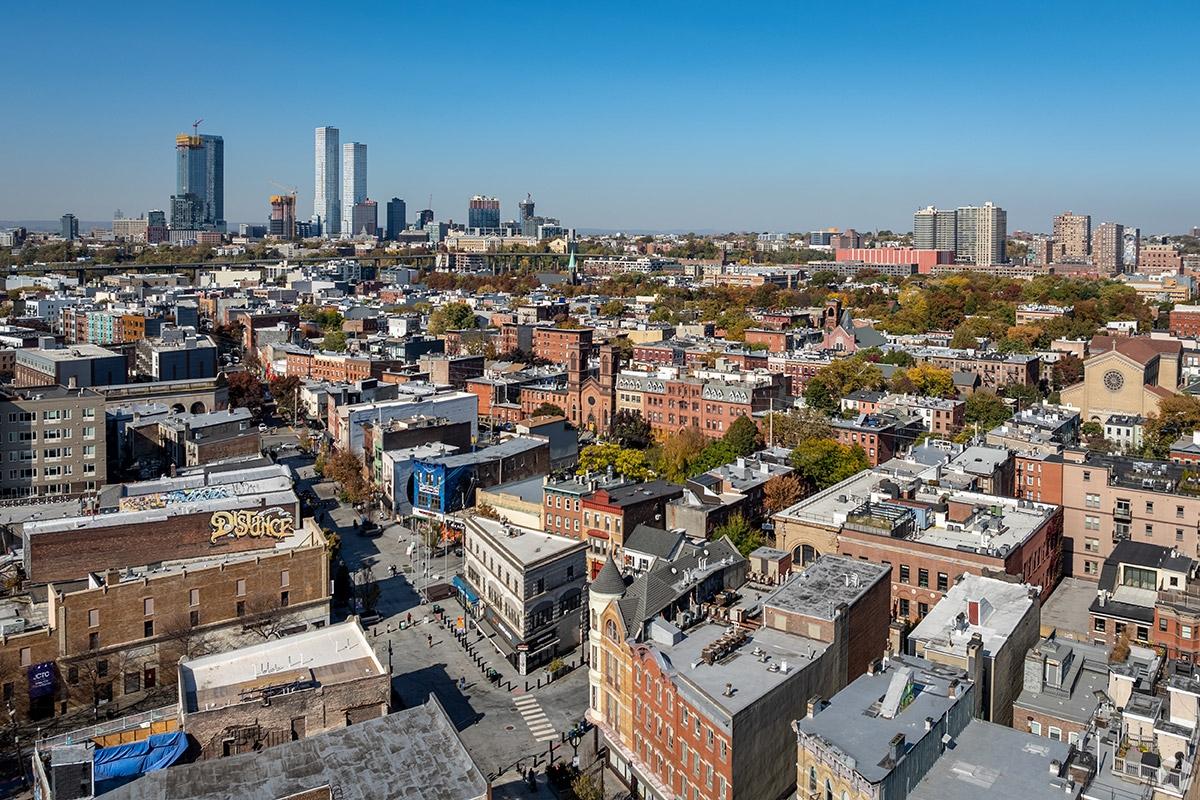
- Average rent in Jersey City: $3,231/month
- Short commute percentage: 17%
- Long commute percentage: 40%
- Mean travel time to work: 39 minutes
Commuting in Jersey City
Jersey City has two sides: one as an economic powerhouse and the other as an NYC commuter town. Many residents travel to larger job hubs such as New York City and other regional centers but choose Jersey City for its more affordable neighborhoods. Only 65 percent of workers stay in the state of New Jersey for work, and just 51 percent work in their home county. More than half, 58 percent, of residents said they left Jersey City for their jobs.
This city-to-city commuting pattern explains the city’s long commute times. The mean travel time is 39 minutes, and 40 percent of residents commute 45 minutes or more. Not even a fifth of people have a commute under 20 minutes.
Though public transit and trains, like PATH and lines run by NJ Transit, give car-free options, the nature of these methods means commutes still take a while. Waiting for the train, transferring, and travel times quickly adds up. However, it’s often faster and more convenient than driving, with 45 percent of residents saying they used public transportation.
Economy in Jersey City
Though Jersey City is a prime spot for New York commuters, it also is an economic stronghold, driven by finance, distribution, sports betting, technology, and life science. Due to its collection of finance and bank headquarters, including the National Stock Exchange, on the Hudson River waterfront, that area is called Wall Street West.
The city’s tech and biotech sectors are expanding rapidly through projects such as SciTech Scity and The Cove, along with new headquarters and lab leases from companies in AI, IT, and biopharma. Jersey City also plays a major role in distribution and shipping thanks to its location, warehouse infrastructure, and Port Jersey, a key freight and container hub in the Port of New York and New Jersey.
Chicago, IL

- Average rent in Chicago: $2,030/month
- Short commute percentage: 24%
- Long commute percentage: 28%
- Mean travel time to work: 33.5 minutes
Commuting in Chicago
Chicago’s size explains why commutes are longer. The sprawling nature of the city means that people live across neighborhoods and suburbs, often farther from the city’s main job centers. This leads to a majority of the city traveling to the same locations, causing high levels of congestion. So, instead of short, simple trips, many commuters end up with longer journeys across the city or even the region.
Chicago’s average commute time is 33.5 minutes, even though the city has a fairly even split between short and long commutes. Commutes over 45 minutes are slightly more common, accounting for 28 percent of workers, compared to 24 percent with short commutes. That gap mirrors Chicago’s mix of living patterns, job locations, and housing costs. Some workers live farther to find more affordable housing or neighborhoods that fit their lifestyle, while others decide the price is worth the city amenities and being close to work.
Though Chicago is a major metro, commuting methods still reflect a reliance on cars, with 51 percent of residents driving to work. Public transit is popular for those with jobs near transportation, as shown by the 24 percent of those who work in the city using public transit. It’s especially vital for those who live in the suburban cities outside of Chicago as 16 percent of those who work in the city said they use the subway, elevated rail, a long-distance train, or commuter rail — the largest percentage out of all the cities.
Economy in Chicago
Chicago is a major economic and transportation hub with one of the most connected logistics networks in the country, anchored by two international airports, extensive interstate access, major rail lines, and freight links. Its diversified economy, with no single sector dominating employment, is resilient and steady. The region is home to numerous Fortune 500 companies, a highly educated workforce, and leading universities that continue to supply talent for finance, professional services, healthcare, technology, manufacturing, and research-driven industries.
Newark, NJ

- Average rent in Newark: $1,606/month
- Short commute percentage: 28%
- Long commute percentage: 27%
- Mean travel time to work: 32.7 minutes
Commuting in Newark
Though Newark is close to New York, it stands on its own as one of New Jersey’s largest employment centers. Yet this status, combined with its location near an even larger employment center, leads to longer commutes. A mean travel time of 32.7 minutes reflects both residents who work within the city and those who travel beyond for work.
The workforce split shows up in the share of short and long commutes. About 28 percent of workers get to work in under 20 minutes, while 27 percent spend 45 minutes or more commuting. That narrow gap shows that Newark functions as both a local employment hub and a city with a sizable base of longer-distance commutes.
Even with public transit connecting Newark and linking the city to nearby metros, driving still remains the most common commute option with 57 percent of residents getting to work by car. For many workers, driving offers a more direct trip and avoids the delays that can come with multiple stops or transfers. Still, public transit plays a major role in the city’s commute patterns. Nearly a quarter of residents use it to get to work, especially for longer trips where rail and bus connections can be more practical than driving.
Economy in Newark
Newark is a massive employment center in New Jersey that supports an economy built on finance, insurance, healthcare, government, transportation, and logistics. Downtown Newark serves as the gathering place for legal, healthcare, and insurance companies. The city’s airport, port, rail network, and highways make it one of the busiest freight and transshipment hubs on the East Coast, with transportation and logistics remaining a major source of jobs. Newark has also grown as a technology center, driven by companies such as Audible, Panasonic, Broadridge, and WebMD, along with startups.
Philadelphia, PA

- Average rent in Philadelphia: $1,765/month
- Short commute percentage: 24%
- Long commute percentage: 26%
- Mean travel time to work: 33.2 minutes
Commuting in Philadelphia
Philadelphia is the center of an interconnected region, drawing commuters from its suburbs, neighboring cities, and counties in Pennsylvania, New Jersey, and Delaware. That regional travel explains the city’s longer commute times, where more than a quarter of residents have a commute 45 minutes or longer, and the average travel time is 33.2 minutes. The extremely high number of people heading into the city’s main employment centers slows travel across the city.
Philadelphia is a city steeped in history, but that older layout has trouble accommodating the volume of traffic, leading to congestion and delays. While SEPTA gives commuters access to buses, subways, and regional rail, public transit can still require extra walking, waiting, and transfers — especially from affordable neighborhoods farther from the city center. This is why more than half of commuters drive to work, compared to the 22 percent who take public transit. These car-centric commutes add to road congestion and keep commute times high.
Economy in Philadelphia
Philadelphia is a major Northeast economic center with a large economy anchored by education, healthcare, professional services, life sciences, logistics, and corporate employment. Once based on industry and manufacturing, the region has evolved into a knowledge- and service-driven market led by major universities, health systems, and research institutions that support a strong talent pipeline and growing life sciences sector. The city’s location along the Northeast Corridor, access to major highways, rail, air, and port infrastructure, and ability to reach a large share of the U.S. population within a day’s drive also reinforce its role as a logistics and distribution powerhouse.
50 Cities with the Longest Commutes
|
Rank |
City |
Short Commute Percentage |
Long Commute Percentage |
Mean Travel Time to Work |
Average Rent |
|
1 |
17% |
41% |
40.6 minutes |
$4,086/month |
|
|
2 |
17% |
40% |
39 minutes |
$3,234/month |
|
|
3 |
24% |
28% |
33.5 minutes |
$2,030/month |
|
|
4 |
28% |
27% |
32.7 minutes |
$1,604/month |
|
|
5 |
24% |
26% |
33.2 minutes |
$1,765/month |
|
|
6 |
25% |
25% |
32.2 minutes |
$3,313/month |
|
|
7 |
27% |
24% |
31.7 minutes |
$2,183/month |
|
|
8 |
25% |
23% |
31.7 minutes |
$3,493/month |
|
|
9 |
31% |
24% |
31.2 minutes |
$2,141/month |
|
|
10 |
32% |
23% |
31.5 minutes |
$1,870/month |
|
|
11 |
28% |
23% |
31.2 minutes |
$1,831/month |
|
|
12 |
42% |
21% |
31.1 minutes |
$1,303/month |
|
|
13 |
24% |
21% |
29.4 minutes |
$1,225/month |
|
|
14 |
32% |
20% |
30.2 minutes |
$1,491/month |
|
|
15 |
25% |
20% |
31 minutes |
$2,250/month |
|
|
16 |
34% |
21% |
29.1 minutes |
$1,178/month |
|
|
17 |
31% |
18% |
29.7 minutes |
$2,137/month |
|
|
18 |
31% |
18% |
29.1 minutes |
$1,374/month |
|
|
19 |
35% |
19% |
28 minutes |
$1,265/month |
|
|
20 |
33% |
18% |
28.2 minutes |
$1,185/month |
|
|
21 |
31% |
18% |
28.7 minutes |
$2,707/month |
|
|
22 |
35% |
18% |
27.2 minutes |
$2,114/month |
|
|
23 |
30% |
17% |
27.5 minutes |
$2,375/month |
|
|
24 |
31% |
17% |
27.5 minutes |
$2,216/month |
|
|
25 |
32% |
15% |
28.1 minutes |
$1,572/month |
|
|
26 |
35% |
16% |
27.2 minutes |
$1,137/month |
|
|
27 |
33% |
15% |
26.8 minutes |
$1,403/month |
|
|
28 |
36% |
15% |
26.5 minutes |
$1,625/month |
|
|
29 |
33% |
13% |
27 minutes |
$1,709/month |
|
|
30 |
36% |
15% |
26 minutes |
$1,446/month |
|
|
31 |
33% |
14% |
26.7 minutes |
$1,304/month |
|
|
32 |
41% |
14% |
26.1 minutes |
$1,640/month |
|
|
33 |
28% |
13% |
26.8 minutes |
$1,330/month |
|
|
34 |
33% |
13% |
26.3 minutes |
$1,296/month |
|
|
35 |
42% |
14% |
25.7 minutes |
$2,923/month |
|
|
36 |
34% |
14% |
25.9 minutes |
$2,089/month |
|
|
37 |
39% |
13% |
25.8 minutes |
$1,521/month |
|
|
38 |
40% |
12% |
26.1 minutes |
$1,578/month |
|
|
39 |
40% |
13% |
25.2 minutes |
$2,228/month |
|
|
40 |
29% |
10% |
26.6 minutes |
$1,282/month |
|
|
41 |
45% |
12% |
25.2 minutes |
$1,757/month |
|
|
42 |
42% |
12% |
25.3 minutes |
$1,567/month |
|
|
43 |
40% |
12% |
25.2 minutes |
$1,666/month |
|
|
44 |
36% |
11% |
25.3 minutes |
$1,470/month |
|
|
45 |
40% |
11% |
24.8 minutes |
$1,595/month |
|
|
46 |
38% |
11% |
25.1 minutes |
$1,076/month |
|
|
47 |
36% |
9% |
25.6 minutes |
$1,301/month |
|
|
48 |
39% |
11% |
24.4 minutes |
$1,516/month |
|
|
49 |
35% |
11% |
24.9 minutes |
$1,619/month |
|
|
50 |
42% |
11% |
24.2 minutes |
$1,385/month |
Search for an Apartment That Works for Your Routine
Your next apartment should fit more than your budget and wish list; it should fit your routine. With the commute tool on Apartments.com, renters can search by travel time and explore nearby transit options before signing a lease.
To get started, select “Options,” then check “Search by Commute Time” under “Travel Time.” From there, choose your preferred transportation method and set your ideal commute time. Apartments.com helps you narrow your search to apartments that make your day-to-day life easier from the start.
Rent data is from CoStar Group’s April 2026 reports.
FAQs
Which state has the longest commute to work?
The state of New York has the longest commute to work with an average of 33.2 minutes.
What is considered an extreme commute?
Extreme commutes are generally considered those over 90 minutes each way. These are aptly named because they are much lengthier than even long commutes, which are 45+ minutes travel times.


