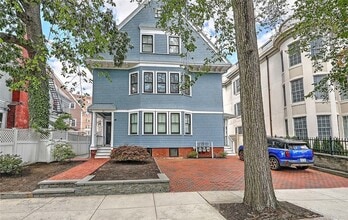
Is Providence, RI, a Good Place to Live?
Thinking about moving to Providence? Here are some pros and cons of living in The Renaissance City to help you decide.
Avg Rent
$2,101
Population
181,279
Renter Mix
67% Rent
Providence, Rhode Island's capital city, combines centuries of history with contemporary city living. Nestled along the Providence River, the city features housing options from preserved Victorian homes in the East Side to contemporary apartments downtown. The presence of Brown University and Rhode Island School of Design (RISD) enriches College Hill with academic and artistic energy. Federal Hill remains a cornerstone of Italian-American heritage, while the West Side features converted industrial spaces and art galleries. Downtown comes alive during the WaterFire festival at Waterplace Park, where thousands gather for evening celebrations combining music and art along the riverfront.
Current rental market data shows Providence maintaining competitive rates, with average one-bedroom apartments priced around $2,022, while two-bedroom units typically command $2,584. Spanning 21 square miles with approximately 181,000 residents, Providence offers convenient access to Boston while maintaining more affordable living costs. The Fox Point neighborhood features waterfront views and celebrates its Portuguese heritage, while the Knowledge District showcases restored mill buildings transformed into residential spaces alongside technology companies. The city's arts scene flourishes through performances at the historic Trinity Repertory Company and Providence Performing Arts Center.
Providence's skyline comes equipped with its quintessential center piece: The Superman Building.
Burnside Park is the central heart of Providence located at the base of it's skyline.
Hope Street in Providence is a major hotspot for unique, locally owned retail and restaurants.
Median Household Income
$58,801
Average: $84,148
Education
52,286
Residents Have a Degree
Job Market
87,445
Workers Employed
Median Age
34 Years
Largest Age Group
25-34 Years
Approximately 19% of Residents
Under 20
25%
Over 65
13%
Housing Distribution
Providence has more renters than homeowners.

Education Distribution
Review this city's overall education levels.

As of September 2026, the average apartment rent in Providence, RI is $1,777 for a studio, $2,119 for one bedroom, $2,624 for two bedrooms, and $2,935 for three bedrooms. Apartment rent in Providence has increased by 1.9% in the past year.
The cost of living in Providence, RI is 10.8% higher than the national average. Generally, housing in Providence is 15.2% more expensive than the national average, with rent falling between $1,777 - $2,935. You can expect to pay 2.1% more for groceries, 28.7% more for utilities, and 0% less for transportation.
Compare Cities

Is Providence, RI, a Good Place to Live?
Thinking about moving to Providence? Here are some pros and cons of living in The Renaissance City to help you decide.

7 Best Places to Live in Rhode Island
Thinking about moving to Rhode Island but don’t know where to start? Explore our comprehensive guide to five of Rhode Island’s best cities.

What Is a Studio Apartment?
A studio apartment is more than a small space. It’s a one-room layout with a lot to offer.
Explore how walkable, bikeable, drivable, and transit-friendly Providence, RI is for everyday living.
Exceptionally Walkable
Walkability
Good Public Transit
Transit
Very Drivable
Drivability
Fairly Bikeable
Bikeability

Public
Grades K-5
479 Students

Vartan Gregorian Elementary School
Public
Grades K-5
351 Students
Robert F. Kennedy Elementary School
Public
Grades K-5
499 Students

Public
Grades K-8
418 Students
Public
Grades K-5
327 Students
Public
Grades K-8
418 Students
Public
Grades 6-8
202 Students

Nathanael Greene Middle School
Public
Grades 6-8
940 Students

Public
Grades 6-8
807 Students
Nuestro Mundo Public Charter School
Public
Grades K-8
301 Students
Public
Grades 9-12
1,121 Students

Public
Grades 9-12
230 Students
RINI Middle College Charter School
Public
Grades 9-12
528 Students
Trinity Academy for the Performing Arts
Public
Grades K-12
267 Students
Public
Grades 9-12
401 Students

 The GreatSchools Rating helps parents compare schools within a state based on a variety of school quality indicators and provides a helpful picture of how effectively each school serves all of its students. Ratings are on a scale of 1 (below average) to 10 (above average) and can include test scores, college readiness, academic progress, advanced courses, equity, discipline and attendance data. We also advise parents to visit schools, consider other information on school performance and programs, and consider family needs as part of the school selection process.
View GreatSchools Rating Methodology
Data provided by
GreatSchools.org
© 2026. All rights reserved.
The GreatSchools Rating helps parents compare schools within a state based on a variety of school quality indicators and provides a helpful picture of how effectively each school serves all of its students. Ratings are on a scale of 1 (below average) to 10 (above average) and can include test scores, college readiness, academic progress, advanced courses, equity, discipline and attendance data. We also advise parents to visit schools, consider other information on school performance and programs, and consider family needs as part of the school selection process.
View GreatSchools Rating Methodology
Data provided by
GreatSchools.org
© 2026. All rights reserved.
† Our analysis of utilities, groceries, transportation, healthcare, home prices, and other goods and services is sourced from the Cost of Living Index, a respected benchmark published by the Council for Community and Economic Research (C2ER) that provides a thorough overview of living expenses across different regions.
Rent data is provided by CoStar Group’s Market Trend reports. As the industry leader in commercial real estate information, analytics, and news, CoStar conducts extensive research to produce and maintain a comprehensive database of commercial real estate information. We combine this data with public record to provide the most up-to-date rental information available.
Consumer goods, services, and home prices are sourced from the Cost of Living Index published by the Council for Community and Economic Research (C2ER). The data on this page is updated quarterly. It was last published in September 2026.
Demographic information comes from Neustar and combines detailed address data with U.S. Census and American Community Survey statistics to produce reliable local estimates.