

Download our free letter templates to explain a security deposit refund or withholding:
There comes a point in every lease where you must decide the fate of your tenant’s security deposit. Ideally, your tenant adhered to their lease, cared for the property, and put themselves in good standing for a full refund. However, there may be instances where you deduct from the deposit or withhold it altogether.
In this article, we’ll walk you through how to write a security deposit refund letter and when to send it, plus provide free letter templates.
Key Takeaways
- A security deposit return letter documents whether you're refunding the deposit in full, deducting part of it, or withholding it entirely, and explains why.
- Your refund decision should be based on three factors: whether the tenant complied with the lease, the property's condition at move-out (beyond normal wear and tear), and your state/local security deposit laws.
- Sending a written letter protects you legally by documenting your decision-making process, and it reflects professionalism even as the tenancy ends.
What Is a Security Deposit Return Letter?
A security deposit return letter is a written statement that outlines the specifics of a tenant's deposit and explains the reasons for any deductions or withholdings. If no deductions apply, it simply confirms that the full deposit is being returned. Whether you're issuing a full refund, a partial refund, or no refund, sending one is the best way to communicate with your tenant clearly and professionally.
Refund vs. Withhold: Which Option Should You Choose?
Before you can send your security deposit refund letter, you must first decide whether to refund or withhold the deposit. This choice should not be taken lightly, as it could have financial and legal implications for your rental business.
So, before you put anything in writing, consider the following factors and check out the flowchart to help guide your decision. Keep in mind that every lease, property, and tenant situation is different, so use these factors and the flowchart as a general guide rather than a one-size-fits-all answer.
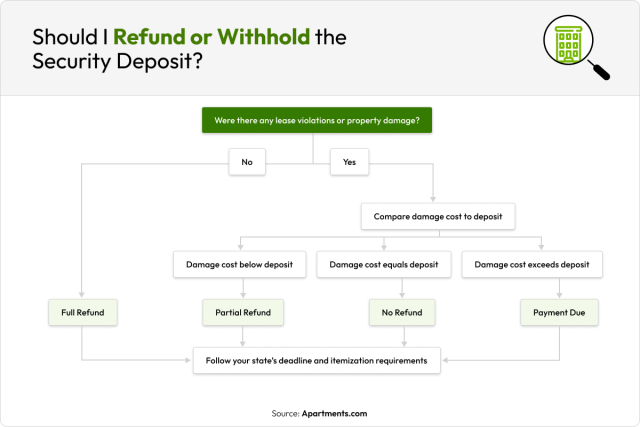
Lease compliance
If the tenant adhered to the terms of their lease agreement, you should return the security deposit in full. However, if the answer is no, consider the significance of their lease violation. If they were late on rent once or twice, you may be able to overlook it. But, if they consistently paid late or damaged the property, you may need to withhold some or all of their deposit.
Property condition at move-out
Property condition is often the deciding factor with security deposits. During your move-out inspection, you should note any property damage that goes beyond normal wear and tear or any unauthorized changes. Examples of this might be large holes in the wall, stubborn carpet stains, or broken appliances.
If the tenant is responsible for these damages, you can deduct the amount from the security deposit to cover repair costs. However, if all you find is normal wear and tear, like peeling paint or slight scuff marks, it’s best to return the deposit in full.
State and local laws on security deposits
Lastly, consider state law before solidifying your security deposit decision. Depending on where you live, you may be subject to stringent policies such as refunding the deposit within a certain timeframe or providing an itemized list of deductions. To ensure compliance, review these laws before issuing your letter. Otherwise, you could face legal ramifications.
The Importance of Writing a Security Deposit Return Letter
A security deposit return letter is necessary mainly for legal protection and professionalism.
Legal protection
Firstly, sending a refund letter protects you from any potential legal claims or allegations. In case your tenant claims unfair withholdings, you can reference the letter and its content as proof of your decision-making process. If you’ve written it correctly, your letter should state how much was returned or withheld and clearly justify your decision. This documentation will protect you should issues arise.
Professionalism
Secondly, issuing a letter reflects well on your rental business. While a brief text or a quick phone call may seem more personal or convenient, a formal letter showcases professionalism and commitment to your rental business. It also shows that you respect and prioritize your landlord-tenant relationship, even if it’s about to come to an end.
How Do I Write a Letter to Refund a Security Deposit?
Whether you’re refunding the deposit in full, partially, or not at all, your letter should be clear, to the point, and professional. To help you get started, we’ve provided some security deposit return letter templates below.
Sample return of security deposit letter #1 — Full Refund of Security Deposit
If your tenant left the property in good condition and met the terms of their lease, a full refund letter is the simplest and most positive way to close out the tenancy. Use the template below as a starting point, or download the Security Deposit Refund Template to fill in your own details.
[Property address]
[City, State, Zip]
[Date]
Dear [tenant’s name],
We are reaching out to you today regarding your security deposit in the amount of [Total Deposit Amount] for your lease at [Property Address] that ended on [Lease End Date].
A check for your entire security deposit is included with this letter.
It was a pleasure having you as a resident. We wish you the best of luck moving forward
Sincerely,
[Your signature]
[Your full name]
[Your phone number or email]
Sample return of security deposit letter #2 — Partial Refund of Security Deposit
When a tenant is due most of their deposit back, but you need to deduct for specific repairs or cleaning, a partial refund letter lets you document those costs clearly while still returning what's owed. Customize the template below, or download the Security Deposit Partial Refund Template to get started.
[Property address]
[City, State, Zip]
[Date]
Dear [tenant’s name],
We are reaching out to you today regarding your security deposit in the amount of [Total Deposit Amount] for your lease at [Property Address] that ended on [Lease End Date].
We are deducting [Amount] from your security deposit to cover the following:
[Itemized List of Damages]
A check for the remaining balance of your security deposit is included with this letter. Should you have any further questions regarding the contents of this letter, please do not hesitate to reach out.
Sincerely,
[Your signature]
[Your full name]
[Your phone number or email]
Sample return of security deposit letter #3 — No Refund of Security Deposit
If damages or unpaid charges add up to the full deposit amount, you'll need to withhold the entire deposit and explain exactly why. This template walks through the required itemization; you can also download the Security Deposit Withholding Template for your own use.
[Property address]
[City, State, Zip]
[Date]
Dear [tenant’s name],
We are reaching out to you today regarding your security deposit in the amount of [Total Deposit Amount] for your lease at [Property Address] that ended on [Lease End Date].
Your entire security deposit is being withheld to cover the following:
[Itemized List of Damages]
The total cost to cover these damages is [Total Amount]. Should you have any further questions regarding the contents of this letter, please do not hesitate to reach out.
Sincerely,
[Your signature]
[Your full name]
[Your phone number or email]
Sample return of security deposit letter #4 — No Refund of Security Deposit with Request for Payment
Sometimes damage costs exceed the deposit itself, meaning your tenant owes you money rather than the other way around. This letter itemizes the damages, shows how the balance was calculated, and requests payment. Download the Security Deposit Request for Payment Template to send your own.
[Property address]
[City, State, Zip]
[Date]
Dear [tenant’s name],
We are reaching out to you today regarding your security deposit in the amount of [Total Deposit Amount] for your lease at [Property Address] that ended on [Lease End Date].
Your entire security deposit is being withheld to cover the following:
[Itemized List of Damages]
The total cost to cover these damages is [Total Amount].
Because the cost of damages exceeds your security deposit amount, you now owe [Amount], which represents total damages minus your deposit, payable immediately.
Please remit your balance to: [Your Full Name and Property Address]
Sincerely,
[Your signature]
[Your full name]
[Your phone number or email]
Manage Security Deposits with Apartments.com
When it comes to refunding security deposits, you need to do everything by the book. This means understanding your state and local laws, keeping meticulous records, and communicating professionally with your tenant. If that sounds like a lot, don’t worry! Apartments.com has got you covered.
With an extensive suite of landlord rental tools, Apartments.com can help you navigate all areas of property management, including handling security deposits and refunds. Need help writing a security deposit clause for your lease? Use our Lease Agreement Generator to ensure it’s detailed and legally compliant. Looking to organize your records and receipts? Track expenses with ease using our Expense Tracking Platform. Whatever your property management needs, Apartments.com has the tools to help.
This article was originally published on September 25, 2019, by Laura Agadoni.
FAQs
What if my tenant didn’t provide a forwarding address?
If your tenant moved out without providing a forwarding address, send the security deposit return letter to their last known address. Even if that address is your rental property, still send the letter to ensure full legal compliance. It’s also a good idea to send the letter via certified mail with return receipt requested. This will provide proof that you made an effort to contact your tenant and return their deposit.
How do I return a security deposit?
The procedure typically involves the landlord inspecting the property for damages after the tenant moves out. If the property is in good condition and meets the lease terms, the landlord returns the deposit, often within 30 days. If the property needs significant repairs, the landlord may deduct part of the deposit or withhold it entirely. However, any deductions or withholdings should be itemized and communicated to the tenant in writing.
How do I write a letter to refund a security deposit?
Start by addressing the tenant by name and stating the purpose of the letter, including the amount of the security deposit and the date the lease ended. If you're returning the full deposit, say so straightforwardly, include a check for the refund, and consider adding a brief, well-wishing closing line. If you're withholding or deducting from the deposit, provide an itemized list of damages with their corresponding costs, and state the amount being returned (if any) or owed. Whichever type of letter you're sending, it's also crucial to reference any relevant state laws regarding security deposits and deadlines.
Is it illegal for landlords to refuse to return security deposits?
It is illegal for landlords to withhold security deposits without a valid reason, such as unpaid rent or property damage. Laws vary by location, but landlords are generally required to provide an explanation and documentation for any deductions. Tenants can take legal action if the deposit is wrongfully withheld.


