Published on
Annual rent growth hit the 1 percent mark in July, while monthly growth stalled, according to the latest rent growth report from Apartments.com. The slight acceleration in annual rent growth follows a weaker-than-usual spring leasing season and comes amid an overall trend of stabilization in multifamily market conditions.
Annual rent growth ticks upward even as monthly rent growth flattens
Following a slow spring leasing season, national rent growth reached 1.0 percent in July. This marked a steady, if slow, rise from 0.7 percent at the beginning of the year and a slight drop compared to the 1.1 percent annual rent growth seen at this time last year.
Monthly change in asking rents was minimal, increasing only 0.03 percent, compared to 0.2 and 0.3 percent in prior months.
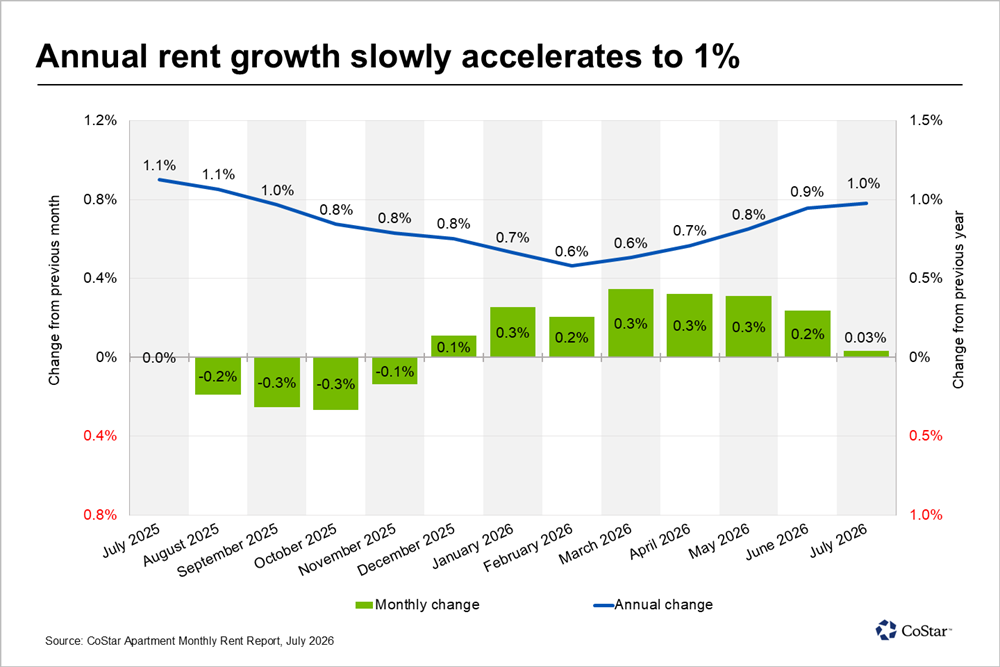
This year has been marked by a stabilization in multifamily market conditions, with the national multifamily vacancy rate hovering in the mid-8 percent range throughout the year. Even as new supply additions have fallen since their peak in 2024, the lack of sufficient demand has kept vacancy elevated and rent growth weak. For multifamily owners and operators hoping for relief, the latest CoStar data reveals that the multifamily recovery will be gradual.
Bay Area rent growth accelerates
Rents continue to rise in the San Francisco multifamily market, which has led rent growth charts throughout 2025 and 2026. San Francisco rent growth hit double digits in July, with the tech-heavy market posting 10.9 percent rent growth compared to the previous year.
Two other Bay Area markets ranked in the top four: San Jose followed close behind San Francisco in second place with 6.8 percent, and the East Bay came in fourth with 4.1 percent.
San Francisco and San Jose also saw the highest monthly increases among major multifamily markets, with monthly growth of 0.59 percent in San Francisco and 0.39 percent in San Jose.
Driving this chart-topping growth is strong demand. Home to Silicon Valley, the Bay Area has benefited from the AI boom and return-to-office trend. At the same time, development has been very limited in this metropolitan area. In the San Francisco market, for example, multifamily developers have delivered fewer than 700 net units in the last 12 months.
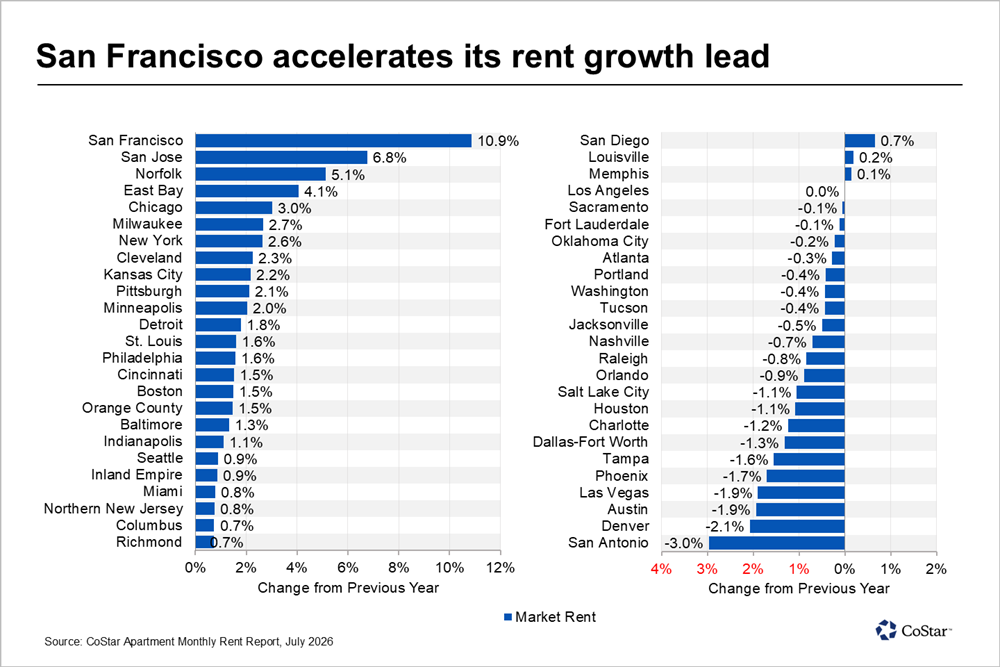
Joining the Bay Area among the top five rent growth leaders, Virginia’s Norfolk market ranked third with 5.1 percent, and Chicago came in fifth with 3.0 percent rent growth.
Regionally, the Midwest has posted the highest annual rent growth at 2.0 percent as of July. The Pacific region, which crept into second place last month, has maintained its position with 1.8 percent rent growth, closely followed by the Northeast at 1.6 percent.
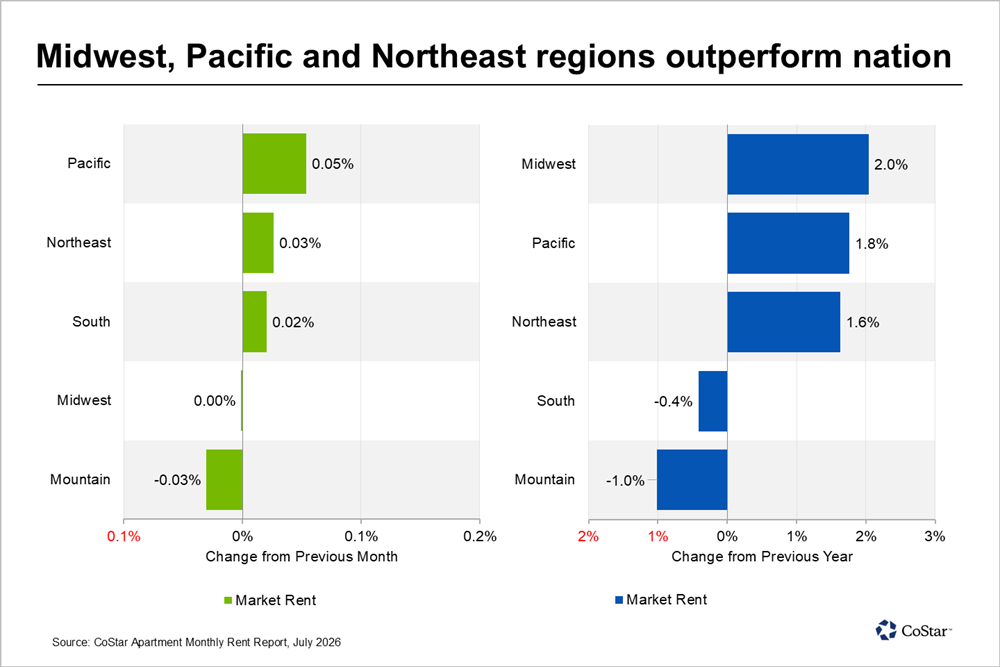
The South and Mountain regions, on the other hand, remain in negative territory with annual declines of 0.4 percent and 1.0 percent.
San Antonio solidifies its position as the new Austin
The Austin multifamily market, which had posted the nation’s largest rent declines for nearly three years straight, finally climbed out of last place a month ago. The Austin market was replaced by San Antonio and Denver at the bottom of the rent growth charts. The trend has held into July.
San Antonio took the bottom spot for rent growth, thanks to a rent decline of 3.0 percent. In second-to-last place, Denver posted a rent decline of 2.1 percent. Austin’s rent decline, in contrast, has slowed to a drop of only 1.9 percent.
Las Vegas and Phoenix rounded out the bottom five markets with rent declines of 1.9 and 1.7 percent.
Get more multifamily insights
Explore what’s been going on in the multifamily market this year with the latest analysis from CoStar’s Grant Montgomery, including the outlook for the remainder of 2026. Watch now: