Published on
Elevated supply, paired with limited demand, has continued to restrain annual multifamily rent growth heading into the summer leasing season. Year-over-year rent growth, which has ranged between 0.6 and 0.7 percent since the start of the year, stands at 0.7 percent in May, according to the latest rent growth report from Apartments.com.
Rent growth plateaus in 2026
A year ago in May, national annual rent growth stood at 1.3 percent. Since then, rent growth has decelerated to about half that rate. Through January, February, and March, rents grew annually by only 0.6 percent, according to the latest adjusted numbers from CoStar. Rent growth accelerated slightly in April to 0.7 percent and remained flat at the same rate in May.
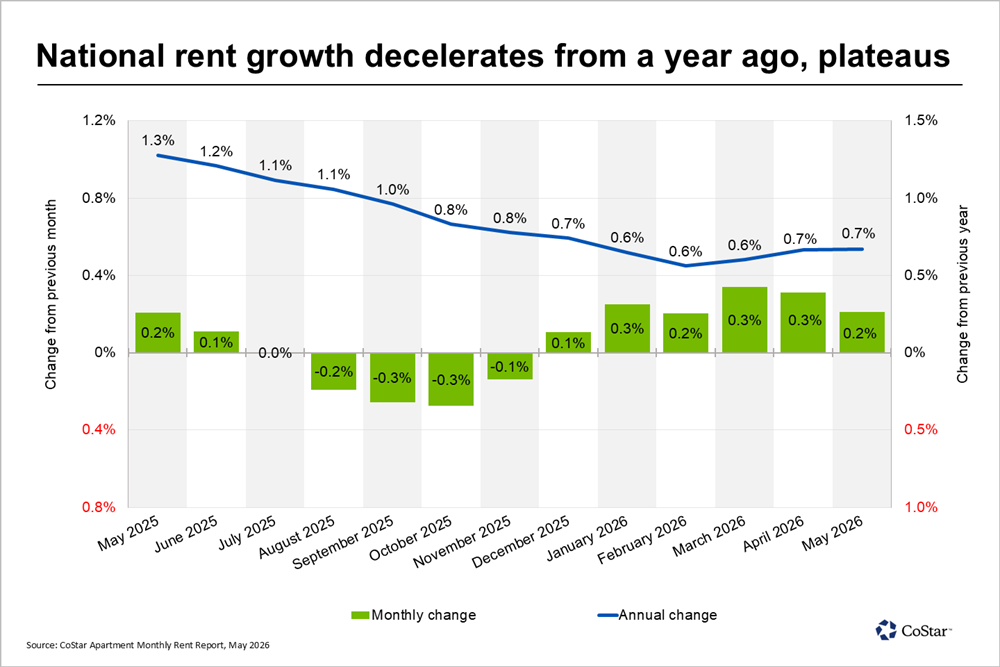
In contrast, the spring leasing season typically sees a notable upswing in asking rents as leasing activity picks up.
In 2026, however, this typical price momentum has been restrained by the continued supply overhang and weaker-than-usual renter demand. After new deliveries set a 40-year record in 2024, the multifamily market continues to face elevated supply and above-average vacancy.
Midwest holds steady as national rent growth leader
At the regional level, the Midwest continues to lead the nation for rent growth. This region, where a healthy balance of supply and demand prevails, posted 2.0 percent year-over-year rent growth.
The Northeast, where supply has been similarly constrained relative to demand, remains in second place with 1.3 percent annual rent growth. However, the Pacific region has nearly closed the gap, posting 1.2 percent annual rent growth. The Pacific region has benefited from its low exposure to new supply, and it currently maintains the lowest rate of new construction relative to current inventory.
The regions with the highest levels of construction, the South and Mountain regions, posted negative year-over-year rent growth. The South saw asking rents drop by 0.8 percent, while the Mountain region lags far behind the rest of the country with a decline of 1.7 percent.
At the monthly level, all regions posted positive rent growth, with rents increasing by a rate of 0.1 percent to 0.3 percent.
San Francisco accelerates its position at the top of the charts
At the market level, San Francisco continues to post skyrocketing rent growth. The rent growth leader throughout 2025 and 2026, San Francisco has accelerated its rent growth to 8.4 percent, which is nearly twice that of runner-up San Jose at 4.9 percent.
Norfolk, Virginia remains in third place with 4.4 percent rent growth. Rounding out the top five, Chicago posted 2.9 percent rent growth, and the East Bay posted 2.7 percent.
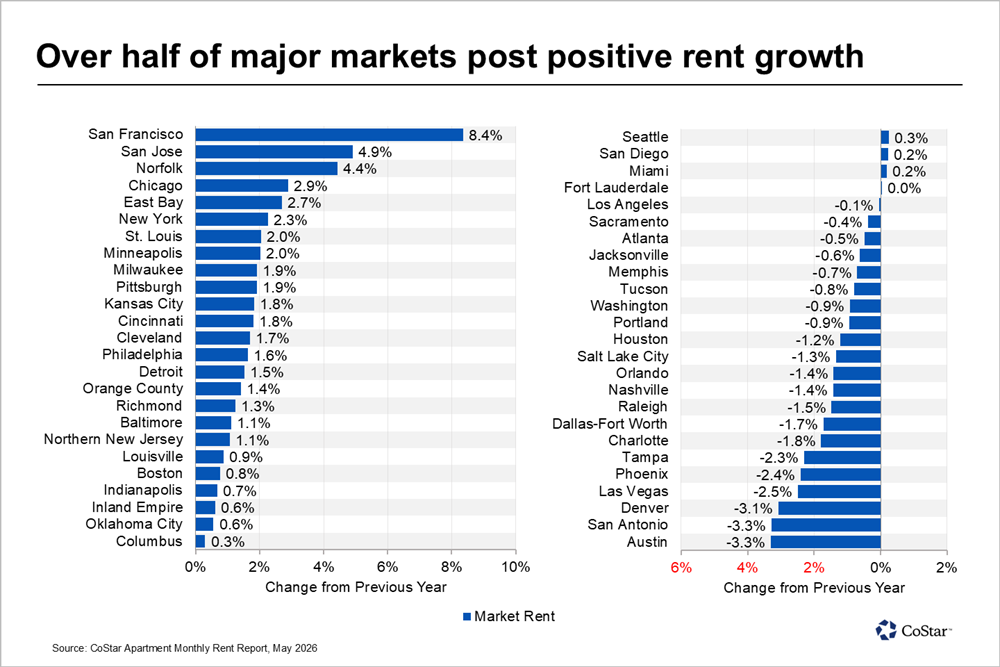
Representing three of the top five markets, the San Francisco Bay Area showed some of the strongest rent growth in the country.
Supply woes continue to push down rents in Austin and San Antonio
At the other end of the scale, 21 of the 50 major multifamily markets posted negative rent growth.
Austin retains the bottom spot on the charts, though it comes in nearly tied with San Antonio at negative 3.3 percent. Both markets have faced a severe supply overhang and weak demand, driving down asking rents. Austin, which fell to the bottom of the chart in mid-2023 and has remained there ever since, saw 20 percent of its total inventory under construction during its supply peak. And at 16 percent vacancy, San Antonio currently has the highest multifamily vacancy in the nation.
In Denver, which has faced a challenging mismatch between supply and demand in recent quarters, asking rents fell by 3.1 percent.
Las Vegas and Phoenix rounded out the bottom five with negative 2.5 percent and negative 2.4 percent rent growth.