
The rental market is seeing a high number of people staying in their current homes even as more apartments become available. At Apartments.com, we recently surveyed over 587 U.S. renters to understand how they are making housing decisions in a market that is currently absorbing over 500,000 new units and maintaining a 7.2 percent vacancy rate.
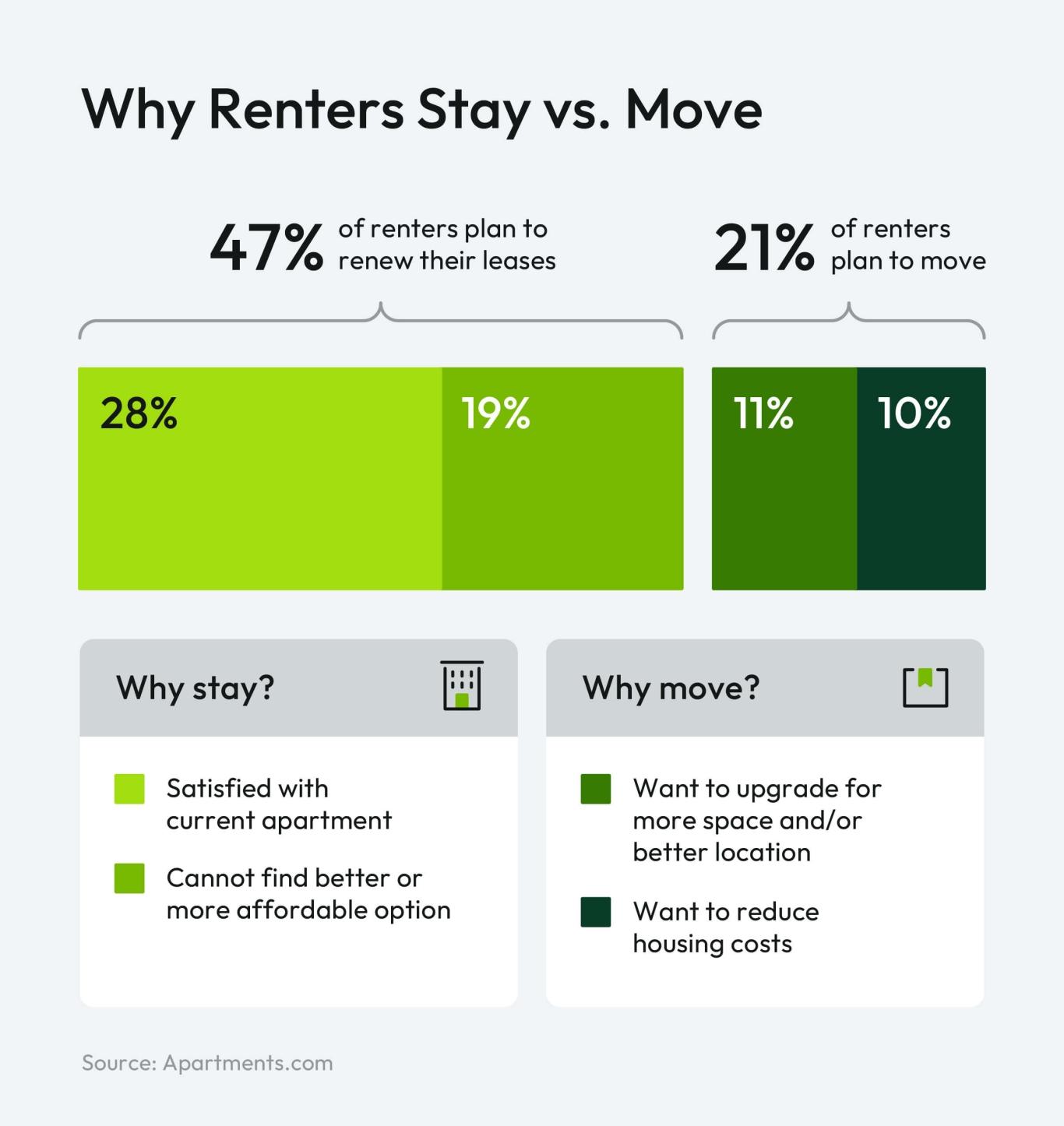
We discovered that 47 percent of those surveyed plan to stay in their current apartments for the next year for various reasons. Of that group, 28 percent are happy with their current homes but 19 percent stay only because they see no better or more affordable options.
This report explores the motivations that keep some renters in place and highlights resources to help people find a home that fits their specific needs. Identifying a high-value apartment is becoming increasingly important as the pace of new construction begins to slow.
Understanding these trends and exploring different markets with tools like our Cost of Living Calculator can help people find a deal before market demand begins to outpace new supply.
Key Takeaways
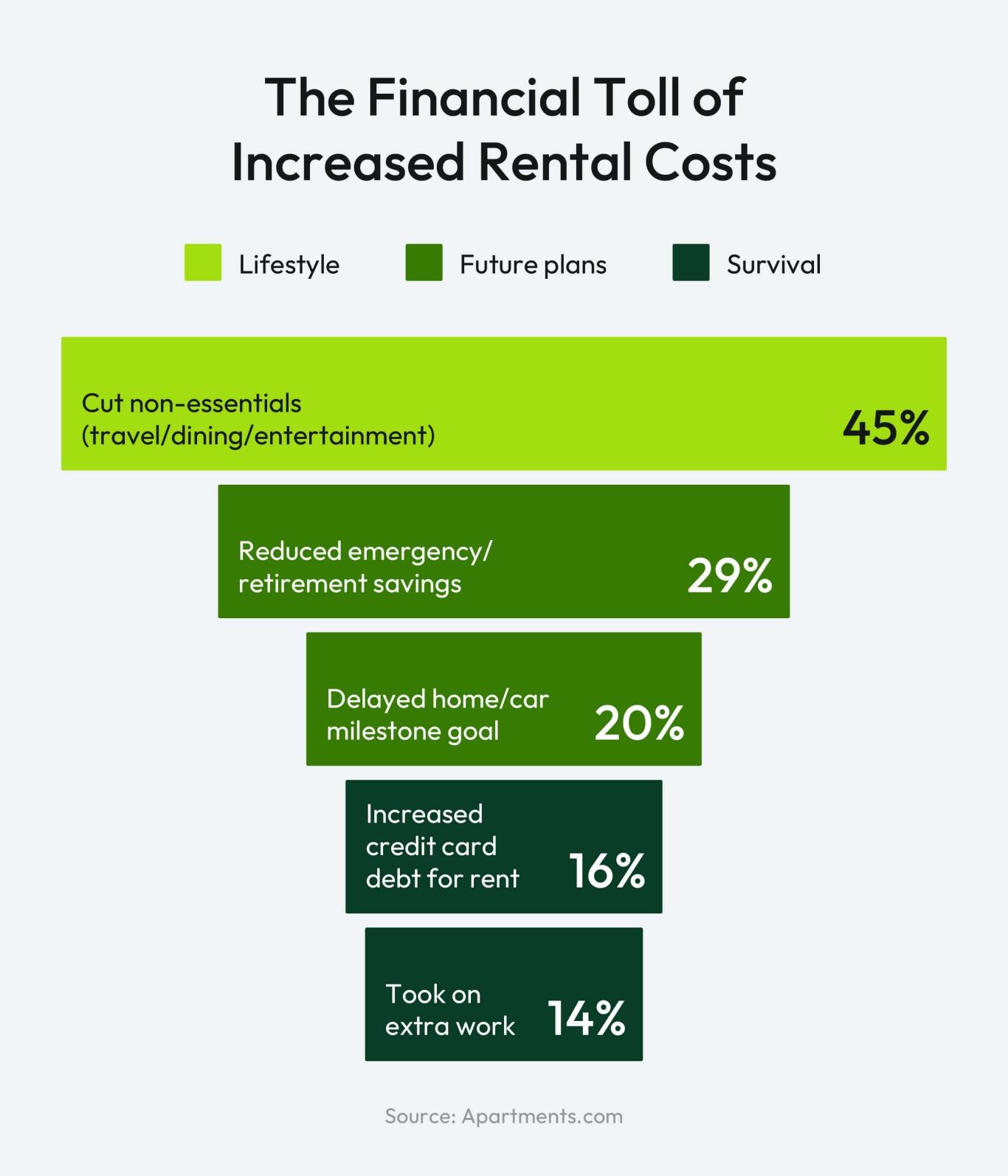
- Rent is hitting fun money first, as 45 percent of renters report cutting back on travel, dining out, or entertainment to manage the rising cost of rent.
- Rising housing costs are forcing 69 percent of U.S. renters to alter their daily lifestyles, with only 18 percent reporting that the current market has had no impact on their personal spending or life decisions.
- Baby Boomers are nearly three times as likely as Gen Z to be insulated from these market shifts, as 27 percent of Boomers report no lifestyle impact compared to only 10 percent of the youngest generation of renters.
- Beyond discretionary spending, savings and big life plans are also taking a backseat due to increased rental housing costs. That includes 29 percent of all renters who aren’t saving as much for emergencies or retirement and 20 percent who are putting off big financial milestones like buying a car or saving for a house.
- Credit cards and extra work are helping renters manage their housing costs, as 16 percent racked up more credit card debt to help cover bills and 14 percent said they’ve taken on a second job or side hustle.
1 in 5 Renters Renew Due to a Lack of Better Options
Many renters would like a change but feel they cannot move because every alternative looks more expensive or like a downgrade. Faced with rising costs and no clear upside, they stay put, unable to justify the move.
Our survey findings show that 47 percent of renters plan to renew their leases, but 19 percent of those residents are staying purely by necessity. For those in this position, pursuing a lease negotiation may be the only way to make their current housing situation more sustainable for another year.
Additionally, 45 percent of renters reported having no challenges when searching for a rental. This suggests that while rental supply exists, finding the right fit is the primary hurdle. Many are not struggling to find a vacancy, but rather a unit that fits their life without forcing a major financial or personal sacrifice.
Data from the U.S. Census Bureau supports this, showing that authorizations for buildings with five units or more stayed high at a rate of 515,000 in late 2025. This means new buildings are being approved and built. Even with this growing supply, many new units do not meet the specific budget or location needs of the average renter.
Higher Rents Are Cutting into Family Budgets and Future Plans
As housing costs have risen, wages have not quite kept pace. Inflation-adjusted earnings increased only slightly in 2025 because of persistent price pressures. This makes it harder for many people to cover their monthly rent without making significant sacrifices in other parts of their lives.
Our survey found that 45 percent of renters have cut back on non-essential spending like travel, dining out, and entertainment. About 29 percent of renters have reduced their emergency or retirement savings, and 20 percent have delayed major goals like saving for a home or a new car. For those feeling the squeeze, the costs and effort of relocating may eventually be lower than the long-term price of staying in an unaffordable unit.
These financial pressures can create a cycle of debt that is difficult to break. Around 16 percent of renters reported increasing their credit card debt specifically to manage their housing-related expenses. To help avoid these trade-offs, the Apartments.com Rent Calculator is a helpful tool for finding a budget that leaves room for both a home and a future.
31 Percent Unaffected by Rent Hikes — But Budget-Driven Moves Span All Generations
While many feel the squeeze, roughly 31 percent of renters report that they are not concerned with these rising costs. About 18 percent say rent changes have not touched their lifestyle at all, and 13 percent have not seen rent hikes in their local area. These experiences vary significantly depending on when a person entered the market.
Generational data shows a clear divide in how renters experience these changes. Baby Boomers are the most likely to be unaffected, with 27 percent reporting no impact on their lifestyle. In contrast, only 19 percent of Millennials, 14 percent of Gen X, and just 10 percent of Gen Z can say the same. Older renters often benefit from steady pay or fixed housing costs, and there are many resources available specifically for senior renters looking for a stable home.
Affordability is a major motivator for those looking to move. Over the past year, 21 percent of renters have considered switching to a different city or state just to find a more affordable home. Identifying the states with the cheapest rent is often the first step for those looking to move to a market that fits their budget.
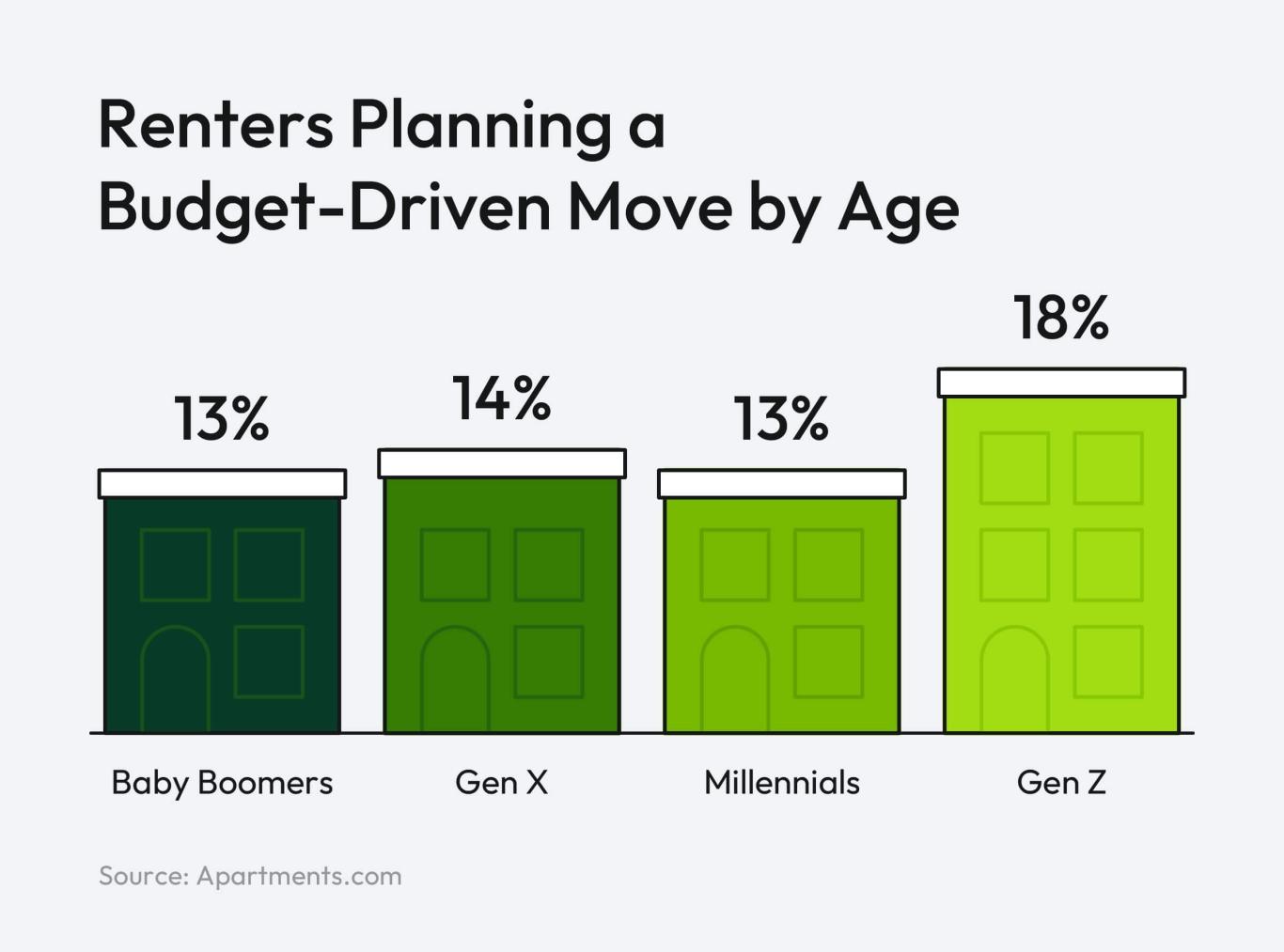
Younger adults are slightly more likely to plan a move specifically to lower their housing costs. When looking at those moving to a cheaper unit or moving in with roommates, Gen Z leads at 18 percent, followed by 13 percent for Millennials and 14 percent for Gen X.
Gen Z is also the most active generation when it comes to seeking a better lifestyle. About 17 percent of Gen Z renters plan to move for more space or a better location, which is significantly higher than the 8 percent of Millennials or 7 percent of Baby Boomers doing the same. This search for a better lifestyle highlights the importance of identifying the best cities for renters that can accommodate a higher demand for space and improved locations.
Additionally, younger renters are less likely to stay in a lease out of necessity. Only 14 percent of Gen Z say they are renewing because they have no better options, compared to 20 percent or more for all other generations.
A pro tip for any renter looking to break free from high costs is to use search tools strategically. Using Apartments.com to compare commute costs or find a better fit can make a move feel like a win rather than a sacrifice. Filtering by price drops or exploring different neighborhoods can reveal opportunities for real savings.
Finding Your Way Forward in a Challenging Market
Record apartment supply hasn't yet translated into easier moves for everyone. Many renters are trading their future financial security for current housing stability. However, staying in a lease out of necessity carries its own long-term costs. It is important to recognize when the weight of increasing debt and depleted savings outweighs the effort of finding a new home.
Breaking free of a less-than-desirable lease starts with a clear view of your financial margin. Identifying a budget that allows for both a comfortable home and consistent savings is the first step toward being able to move when you want and having somewhere worth moving to.
Apartments.com offers tools like the Rent Calculator to help you find a price point and discover listings that restore your financial balance.
Methodology
The survey of 587 U.S. adults was conducted by YouGov for Apartments.com between January 22 and 27, 2026. Data is weighted, and the margin of error is approximately +/-4 percent for the overall sample with a 95 percent confidence level.
In order to qualify, respondents were screened to be residents of the United States, over 18 years of age, and current renters of apartments, condos, and duplexes.


