

Affordability and housing crises have forced renters to choose between trade-offs when looking for their next apartment. As of 2026, Apartments.com found that 47% of all renters have changed their living situation or what they look for in a rental just to keep up with bills and other living expenses.
Survey data reveals that renters are making a variety of trade-offs and these choices often depend on their age. Younger renters are consistently on the hunt for better deals and tend to move more frequently, while older renters prefer to stay in place even as rent rises. This trend means that young adults are more likely to make housing compromises to manage their bills and expenses.
Regardless of age, renters have certain priorities they simply won’t compromise on, staying true to what matters most when choosing a home.
To better understand these cost-of-living tradeoffs, we surveyed 3,635 U.S. adults to analyze how renters are navigating the housing affordability crisis, what they are sacrificing, what they refuse to compromise on, and if their choices are leaving them satisfied or resigned.
Key Takeaways
- 79% of renters have cut back on their daily spending to cover their rent payments, often putting off doctor visits or credit card payments.
- 47% of renters are spending more than 40% of their income on rent, exceeding the recommended 30% commonly suggested.
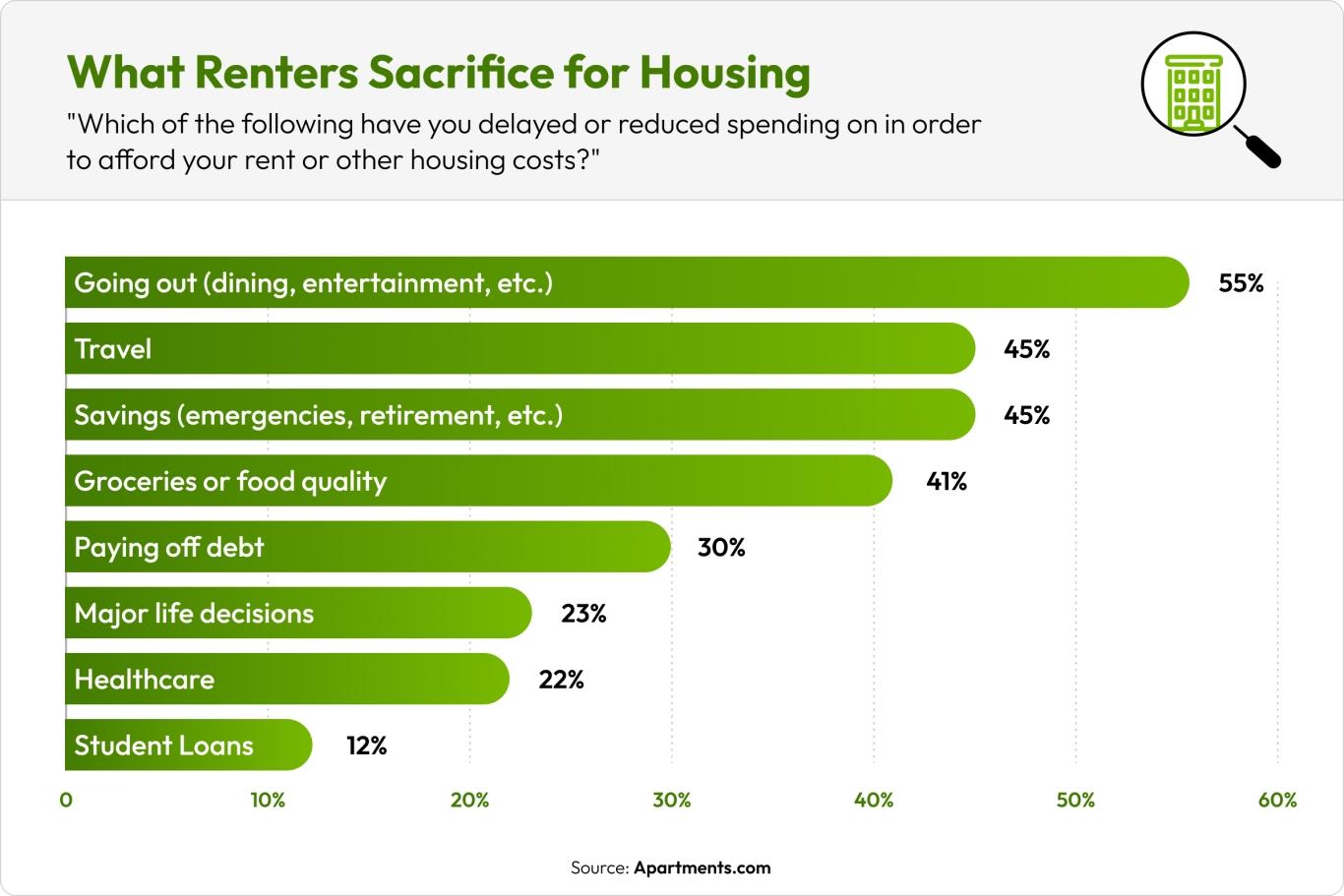
- High rent costs are forcing life changes, with 45% of renters cutting savings, 41% downgrading their groceries, and 23% delaying major milestones like starting a family or going back to school.
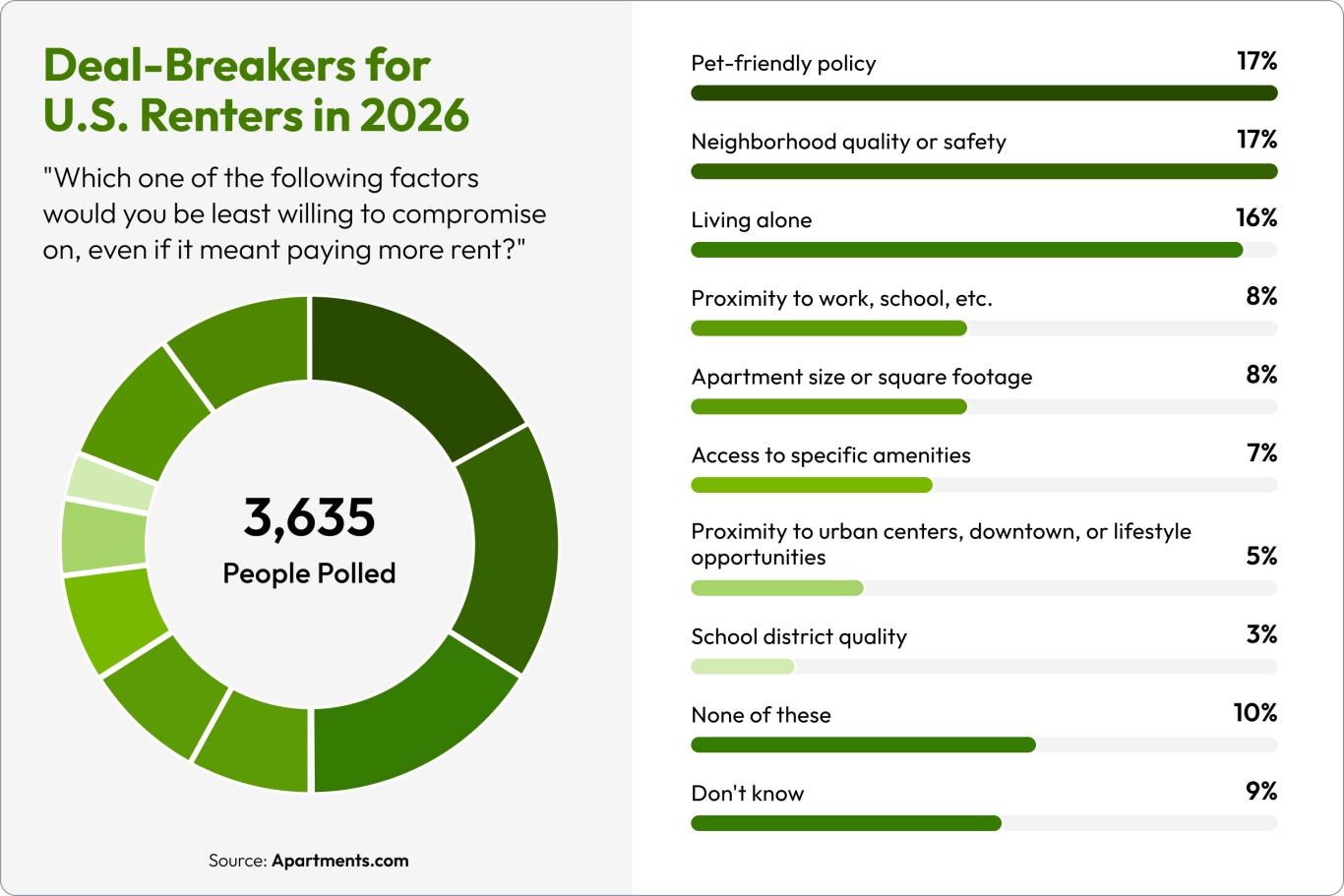
- Safety and pet-friendly policies were the most commonly chosen priorities when searching for rentals, with 17% of renters saying they would pay more to feel safe in their neighborhoods and 17% saying having pets is non-negotiable.
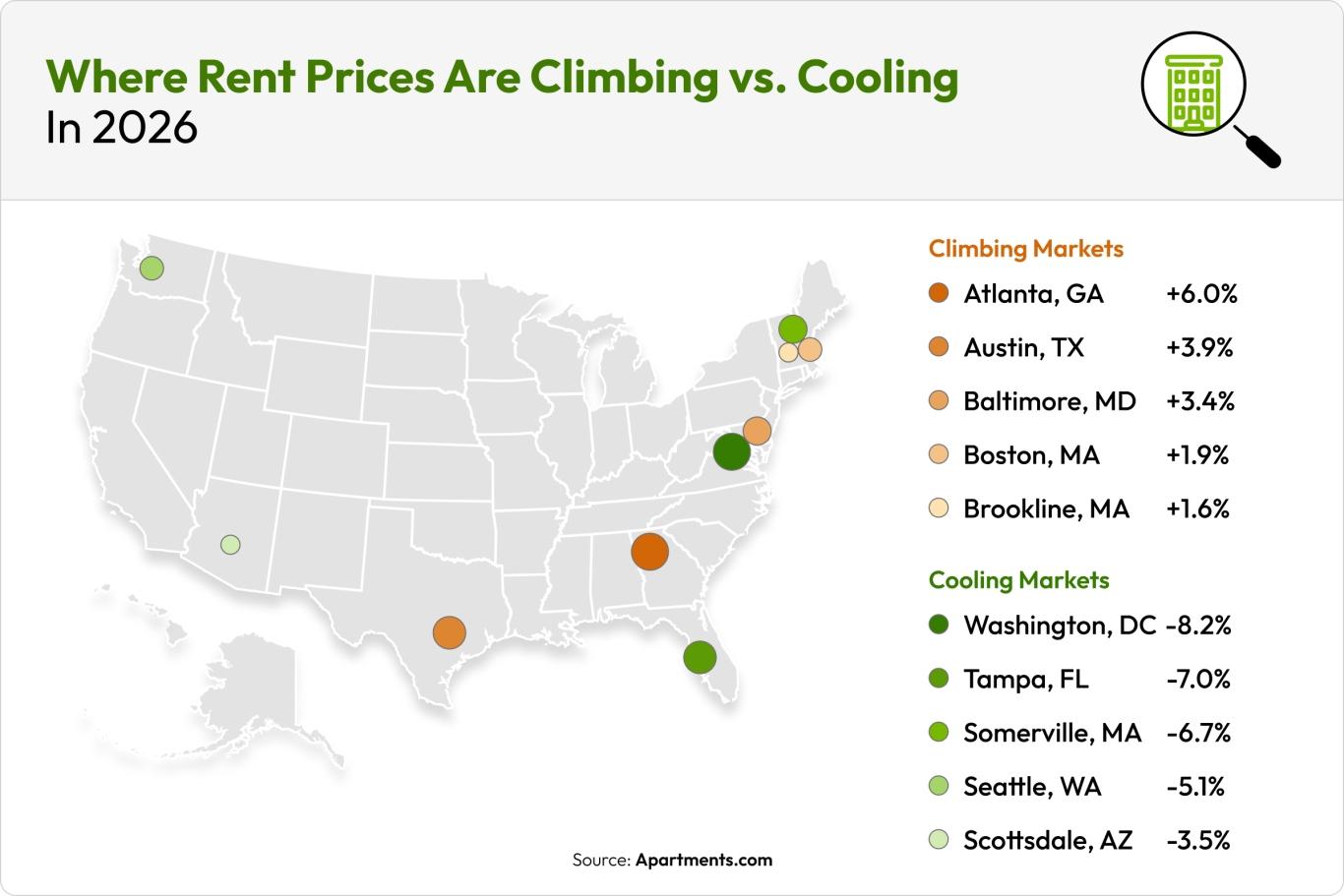
- While rent is still spiking in some places, such as Atlanta, GA, with the highest increase of +6.0 percent, cities like Washington, DC, are seeing prices drop, with the biggest decrease of -8.2 percent.
Savings and Health Are Taking a Backseat for Many Renters
High rent costs are not just forcing renters to cut out the “fun” stuff in their life like ordering takeout or going out with friends. 22 percent of renters stated that they have to delay doctor visits or reduce spending on medicine just to afford increasing housing costs. This marks a trend of renters making potentially harmful tradeoffs simply to afford their monthly rent payment.
Our survey found that 45% of renters have cut back on their savings to afford rent and housing costs. These savings include emergency funds, education savings, and more. These cutbacks not only place financial stress on the renter but also threaten future financial security.
In addition, 23% of renters stated that they have delayed major life goals because their housing costs are too high. Going back to school or starting a family is not a possibility for some renters because of increased rent prices and living expenses taking priority.
These affordability problems are affecting both men and women, but survey data shows that 82% of women have delayed or reduced spending in order to afford rent, versus 76% of men who recorded a cutback in spending. Women also showed higher rates of reducing their spending on groceries (44% vs 37%, respectively), paying off credit cards (33% vs 27%), and going out (58% vs 52%).
Tradeoffs vary from renter to renter, but it is more common than ever for renters to reduce in one area of life to simply afford their rental payment.
How Rent Costs Are Stalling Young Adulthood
It is no secret that young people are having trouble in today’s rental and economic world. A combination of a tough job market and high rent costs have made it difficult for young people to launch their lives and bloom into adulthood.
Reactions to increasing rent rates differ among generations and age groups. Of respondents who said they delay or reduce their spending on travel, going out, and building their savings to afford their rent, 86% of those were Gen Z and 81% were Millennials. Tradeoffs like these are just a couple of reasons why young renters are sacrificing lifestyle to afford housing costs.
Younger renters are also more likely to change housing based on increasing rent prices or housing problems.
Fifty-seven percent of Gen Z and 54% of Millennial survey respondents stated that they switched their housing or altered what they were looking for in a rental within the last year to save money. Sixty-two percent of Baby Boomer renters responded conversely and stayed in their residence even if prices went up or did not meet their standards.
Living where they want and making their rent payments are important to Gen Z and Millennial renters. The survey found that younger renters are slightly more likely to spend over half of their paycheck on their housing and rent payments. Specifically, 22% of Gen Z and 19% of Millennial respondents stated that they will spend over 60 percent of their income on rent and utilities combined, compared to the recorded 18% of Gen X and 15% of Baby Boomers.
The Deal-Breakers: What U.S. Renters Won't Sacrifice for Housing
Non-negotiables are important to have when looking for rentals. Whether it’s in-unit amenities or a fitness center, renters have things they want and don’t want. Even with the rising costs of renting and the ever-changing rental market, there are still some things that renters will not budge on when it comes to their next space.
Neighborhood safety is the number one priority to renters, with 17% of survey respondents stating that they will not compromise when it comes to their safety. Pets are also important to other renters, with another 17% of respondents stating that a pet-friendly policy is a must-have in their space.
Among the list of non-negotiables prompted in the survey, one that sticks out is living alone. The survey found that 16% of people would rather pay more to live alone than take on one or more roommates to save money. This is different from the commonly held belief that young people today, especially renters, are living with a roommate.
The increasing costs of living and rental market changes make it difficult for young people and experienced renters alike to find the perfect place for themselves. Compromise and budgeting are just a couple of things renters must do in today’s rental landscape to find a place that works for them.
Rent Check: Where Prices Are Climbing and Falling
Rent prices can fluctuate quickly in today’s rental market; however, certain cities see rent spikes more often than others. Whether you want to stick around in your city despite the increasing rent payments or you’re willing to move around to take advantage of a lower cost of living, these cities have had the largest year-over-year rent changes.
Atlanta, GA, comes in at the highest YoY rent change with a whopping six percent jump from past years. Austin, TX, is not too far behind with a 3.9% increase. These increases can happen based on a multitude of factors, like city changes, national rent average increases, and more.
If price is a factor to you when it comes to searching for a new space in a new city, it is important to be aware of rent changes over the years, as that can be a good indicator of how the rent is expected to change in the future.
Top 5 YoY rent increases by city
|
Rank |
City |
Average rent (approx.) |
Avg. square footage |
YoY rent change (%) |
|
1 |
$1,768 |
765 sq. ft. |
+6.0% |
|
|
2 |
$1,548 |
712 sq. ft. |
+3.9% |
|
|
3 |
$1,558 |
690 sq. ft. |
+3.4% |
|
|
4 |
$3,718 |
697 sq. ft. |
+1.9% |
|
|
5 |
$3,350 |
661 sq. ft. |
+1.6% |
Even though rent seems to be spiking all over the country, there are some cities that have seen big drops in their YoY rent.
Washington, DC, saw a massive decrease of 8.2% in their rent prices over the past year, with Tampa, FL, noting a seven percent drop. Although rent prices are usually seen trending upward, there are some hidden gem cities throughout the country where rent is cooling off.
Top 5 YoY rent declines by city
|
Rank |
City |
Average rent (approx.) |
Avg. square footage |
YoY rent change (%) |
|
1 |
$2,423 |
690 sq. ft. |
-8.2% |
|
|
2 |
$1,817 |
720 sq. ft. |
-7.0% |
|
|
3 |
$3,375 |
671 sq. ft. |
-6.7% |
|
|
4 |
$2,104 |
649 sq. ft. |
-5.1% |
|
|
5 |
$2,072 |
774 sq. ft. |
-3.5% |
Making the Best of a Tough Market
Today’s unstable rental market is about making tough choices. It is common for renters to sacrifice some part of their lifestyle to afford the rising rent costs across the country. Some people are moving to new cities to find lower prices, while others are staying put and cutting back on other expenses like groceries or pulling from their savings accounts.
Whether you’re looking for a safer neighborhood or a place that accommodates your pet needs, knowing where the rental market is cooling off versus heating up can help you find a place that fits within your budget.
With Apartments.com rent trends and cost of living calculator, you can see where rent is rising or falling throughout the country. Finding affordable apartments that check all your boxes is easy using Apartments.com. Let us help you find the perfect place for you in this tough rental market.
Methodology
The survey was conducted by YouGov for Apartments.com. The survey was fielded between January 19 and 22, 2026. The results are based on 3,635 respondents. In order to qualify, respondents were screened to be residents of the United States and over 18 years of age. Data is weighted, and the margin of error is approximately +/-3 percent for the overall sample with a 95 percent confidence level.


