

Renting with a roommate has become more than just a short-term arrangement. Now, it’s a way to help renters save money and work towards major milestones. Thirty-two percent of 18–34-year-olds specifically use roommates to fund major milestones like homeownership or starting a family, reframing the narrative as strategic and goal-oriented.
Solo living still remains the gold standard for many renters, with 32 percent of adults saying they’re willing to pay more to live alone. Another 39 percent of Americans say they would never be comfortable with a roommate. Yet the subset of renters using shared housing to hack the affordability crisis continues to grow.
Key Takeaways
- 39 percent of U.S. adults say they would never be comfortable with a roommate, a feeling that rises to 44 percent among women and 45 percent among people who earn less than $40,000 a year.
- Most Americans (54 percent) would choose a smaller space before they would choose a roommate (26 percent), suggesting privacy is a highly valued premium.
- Among those open to roommates, 32 percent of 18–34-year-olds see them as a way to fund big milestones like starting a family or buying a home.
- Markets in the Midwest and South, such as Lubbock, TX and Memphis, TN, offer the highest "roommate affordability" scores based on new rent-to-income data.
The Demographic Breakdown: Women and Lower-Income Earners Are More Likely to Avoid Roommates
Though many see roommates and moving in together as a purposeful arrangement used to manage high housing costs and accelerate life goals, when you break responses out by demographic, the picture shifts. Certain groups are much more inclined to live alone compared to others, namely, lower-income renters and women.
Income level
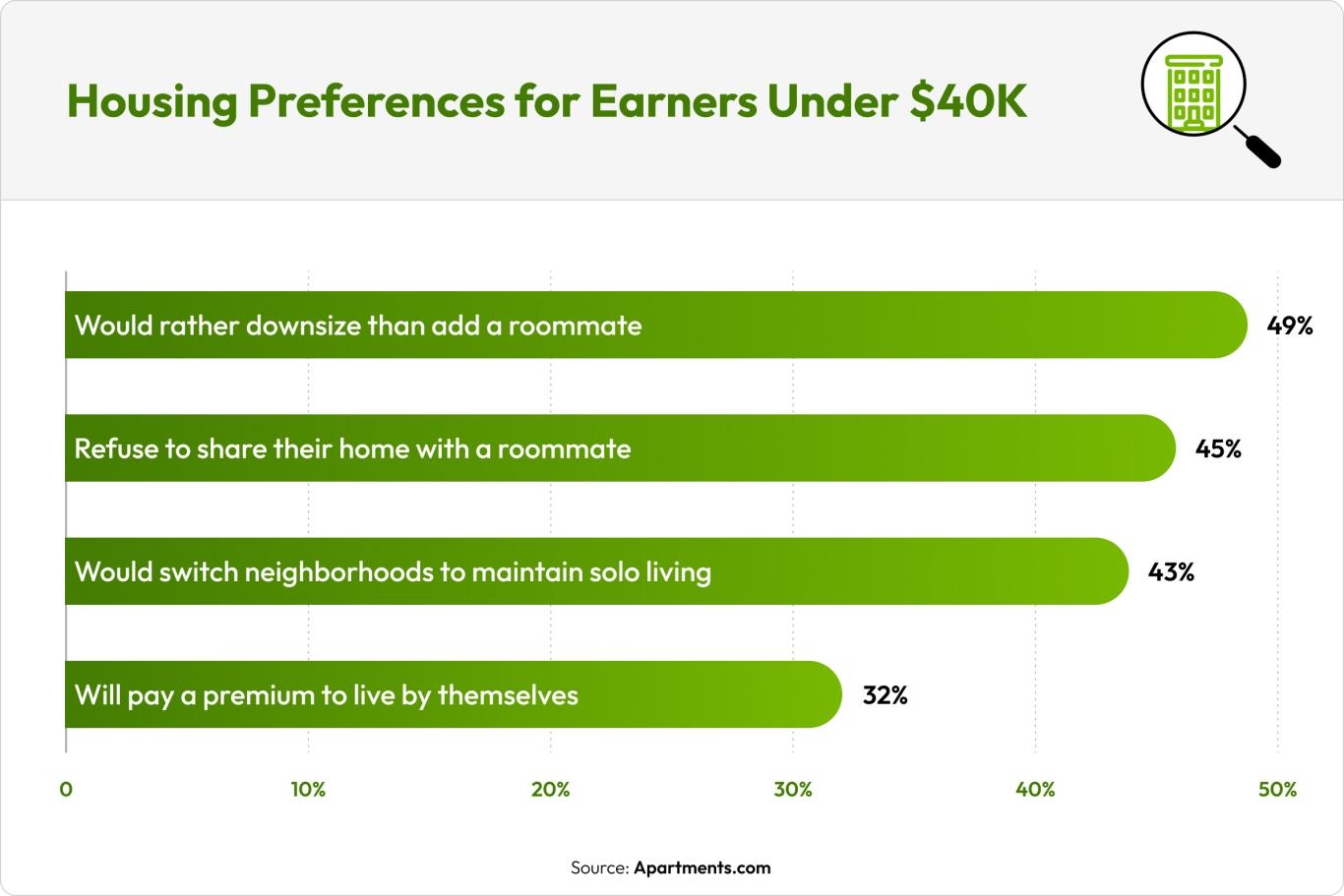
Lower-income earners prioritize personal space. Among respondents earning under $40,000, 45 percent said they would never want a roommate — the highest share across income groups. The drive behind that preference seems to be personal choice, rather than social expectation. This group had the largest proportion (33 percent) who said they haven’t thought about the social acceptability of roommates.
In order to live alone, lower-income renters are willing to make trade-offs. Nearly half, 49 percent, would downsize rather than share a home, and 43 percent are willing to move to a less expensive neighborhood. Some would even take a financial hit: 32 percent said they would pay more for housing to live alone.
Gender
Women and men have differing opinions on roommates, and the gap is clear. A large majority of women, 44 percent, said they’d never be comfortable having a roommate, compared with 34 percent of men, a 10-point difference.
The compromises each group is willing to make in order to live alone show an interesting divide. Both men and women are more willing to downsize, but women lean more toward sacrificing space, while men are more open to changing neighborhoods. Fifty-eight percent of women said they would downsize, seven percent higher than the 51 percent of men who agreed. That difference flips when you look at who would move to a more affordable neighborhood; 48 percent of men would move, versus 40 percent of women.
The 35+ Stigma: When Roommates Stop Being Socially Acceptable
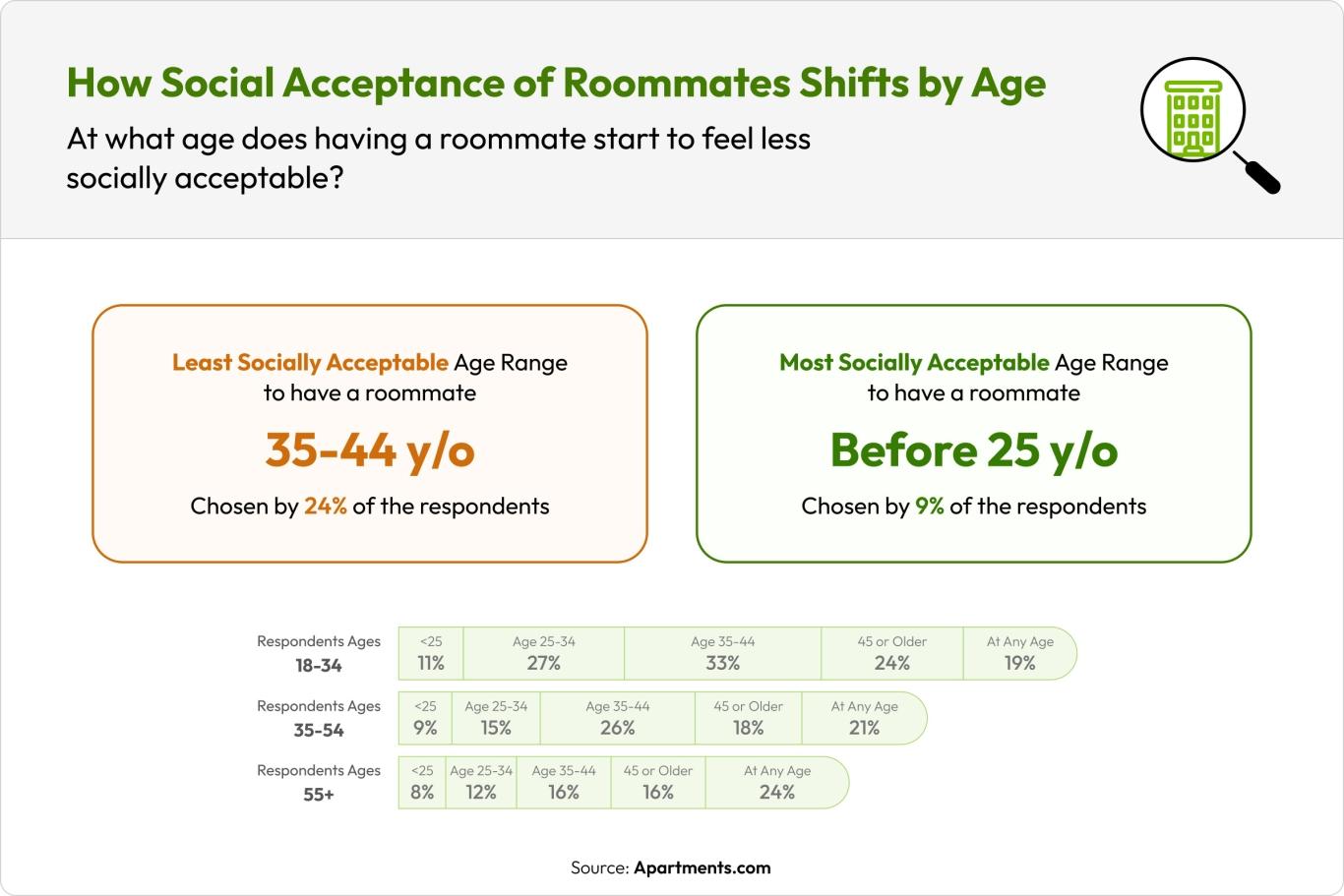
Though roommates are increasingly framed as a practical solution, the stigma still remains. Only 22 percent of adults believe that shared living is acceptable at any age if needed. Age is the main dividing line. The older someone is, the less acceptable it is to have a roommate.
Only nine percent of respondents said that roommates are socially unacceptable for people 25 and under. However, the tolerance erodes as people age, since 24 percent of respondents said that it was less socially acceptable for those ages 35-44 to have a roommate, jumping 15 points.
Resistance to having a roommate also increases with age. Just 24 percent of respondents aged 18-34 said they’d never be comfortable with a roommate. Among those 55 and older, that share doubles to 48 percent. As people age, roommates become both less socially acceptable and less personally desirable.
The Rise of Multigenerational Living
Renters have found a comfortable middle ground in multigenerational living that balances sharing space for affordability reasons and preserving comfort and privacy.
If they have to share a home, 24 percent of responders would prefer a multigenerational home with family members rather than living with unrelated people. That option ranks just behind the most popular choice: sharing a two-bedroom apartment with a non-family-member roommate.
Even when renters are open to unrelated roommates to manage housing costs, they prioritize personal space. The most preferred shared setup is a two-bedroom apartment with one roommate, as 35 percent selected that configuration. That is the largest share out of all the layout options. By contrast, only five percent would share a studio or one-bedroom with a roommate, suggesting that privacy matters just as much as price.
Regardless of whether it is family or friends, the desire to have a roommate is a personal decision. While most renters would be open to having a roommate to help with housing costs (especially with the right apartment size), 17 percent said they would not want any shared housing arrangement under any circumstances.
Best Cities Where a Roommate Can Save You Money
Shared living isn’t just a personal preference or financial question. It’s also a city-by-city decision that explores the confluence of the cost of living and rent trends. In major metros, splitting rent can buy a better location, more space, or a more modern apartment. Still, the cities where roommates provide the most value aren’t always the biggest ones.
Based on our rent-to-income analysis, these are the cities that provide the best value for roommates:
|
City |
Average Two-Bedroom Rent |
Average Rent Per Roommate |
Annual Income Needed Per Roommate |
|
Lubbock, TX |
$1,013/month |
$506.50 |
$23,840 |
|
Memphis, TN |
$1,065/month |
$532.50 |
$27,100 |
|
Louisville, KY |
$1,278/month |
$639.00 |
$26,600 |
|
Indianapolis, IN |
$1,314/month |
$657.00 |
$25,660 |
|
Cincinnati, OH |
$1,402/month |
$701.00 |
$25,740 |
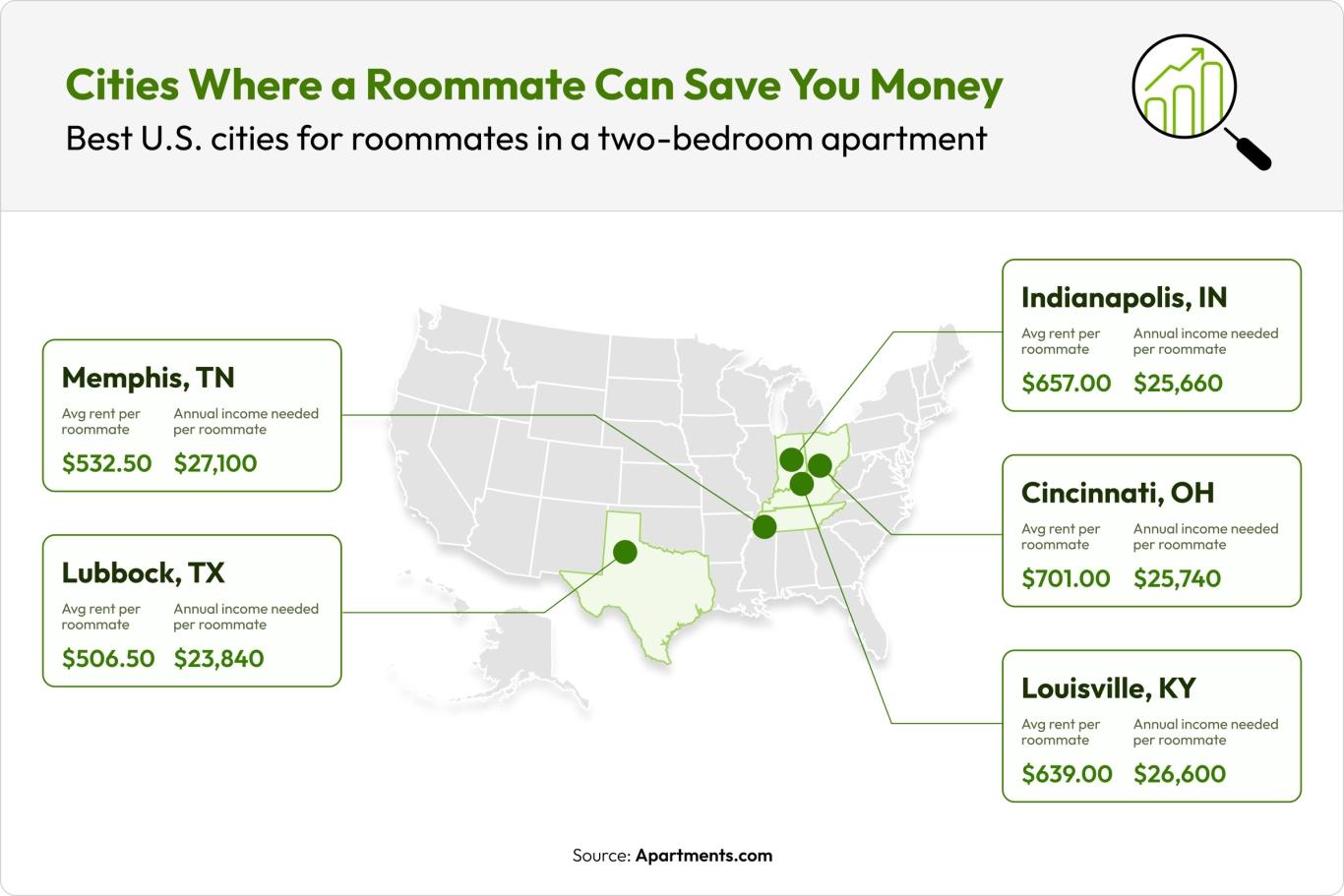
Most of the best-value roommate cities lie in the Midwest and South. These regions have become hotspots because they offer big-city amenities with a lower price tag. In these metros, splitting a two-bedroom apartment typically takes up a smaller share of income, making the per-roommate cost comparatively affordable. Shared housing can cut down on housing costs, but your exact savings depend on the city.
Why Shared Housing Is a High-Value Trade-Off
Shared living can be a high-impact way to prioritize financial freedom over the traditional solo-living script. For renters who are willing to be flexible with their living arrangements, dividing housing costs can free up room in the budget for bigger goals and milestones, whether that’s paying down debt, building savings, or creating more monthly breathing room.
The key is choosing a setup that supports your milestones, not social expectations. That could look like a straightforward two-bedroom apartment with a roommate or a multigenerational home. When you’re ready to explore your options, search for two-bedroom apartments in your area on Apartments.com.
Methodology
The survey was conducted by YouGov for Apartments.com. The survey was fielded between January 21 and 22, 2026. The results are based on 1,155 respondents. In order to qualify, respondents were screened to be residents of the United States and over 18 years of age. Data is weighted, and the margin of error is approximately +/-3% for the overall sample with a 95% confidence level.
The rent-to-income analysis was achieved using proprietary data from Apartments.com, tracking the average monthly rent for a two-bedroom apartment in cities across the U.S. That data was compared to the annual income needed to afford a two-bedroom apartment at Fiscal Year 2025 Fair Market Rent, as calculated by the National Low Income Housing Coalition.
FAQs
Can you share renters insurance with roommates?
Yes, roommates can share a renters insurance policy if the insurance provider allows it. In that case, both roommates need to be listed on the policy, and you’ll need to agree on how you’ll split the premium.
Just keep in mind that sharing can get complicated if one roommate moves out, doesn’t pay their portion, or if you have to sort out who gets what in a claim payout. The article also notes that liability can overlap, meaning a roommate’s accident (like damage caused by a pet or flooding a neighbor) could affect both of you under a shared policy.
Is it better to rent with a roommate?
It depends since renting with a roommate is a highly personal decision based on your budget, lifestyle, and housing preferences. It can be a smart move to help renters cut down on costs and save money to work towards major goals. Roommates can also expand living options like a better location or more modern apartment.
At what age do most people stop living with roommates?
People don’t stop living with roommates at any particular age. Some continue to live with roommates well into adult life, while others value privacy and choose to part ways. Still, the survey reports that having a roommate at age 35 or older, compared to younger years, is viewed as less socially acceptable by respondents.


