

With mortgage rates rising and affordability becoming a priority across the country, is the United States becoming a nation of renters? The 2024 American Community Survey (ACS) found that 34.7 percent of occupied housing units in the U.S. were renter-occupied, while 65.3 percent were owner-occupied. Compare this to the 2010 ACS, which recorded 29.9 percent of units as renter-occupied and 70.1 percent as owner-occupied.
Although homeowners still represent the majority of occupied units today, renting has become more common due to housing shortages and flexibility. Let’s dive deeper into the data to determine whether renting is becoming the preferred housing choice for Americans.
Key Takeaways
- Median gross rent has increased by 3.8 percent since 2011, while real median home values have only increased by 1.8 percent, marking a lower level of change.
- Markets with the newest construction and supply have tended to show the weakest rent performance, while supply-constrained metros continue to experience stronger rent growth.
- New York, one of the most competitive markets in the country, is experiencing high levels of supply and lower demand, causing more vacancies.
- Organizations added 71 percent fewer jobs in 2025 than 2024, contributing to slower employment and rent growth.
- The national homeowner vacancy rate in 2025 was around 1.2 percent, while the rental vacancy rate surged to 7.2 percent. Multifamily vacancies now sit at 8.6 percent in early 2026.
Why More Americans Are Renting for Longer
Renting provides flexibility during times of uncertainty. With housing becoming more expensive and scarce, renting can offer financial security and more stability. Data reveals that buying a home has become harder across the country, especially for young families.
Buying a Home Is Becoming More Difficult
The median monthly mortgage payment in 2024 rose to $2,225, marking a 20 percent increase since 2021. First-time home buyers made up just 21 percent of home buyers in 2025, with the average age of a first-time home buyer rising to 40 years old.
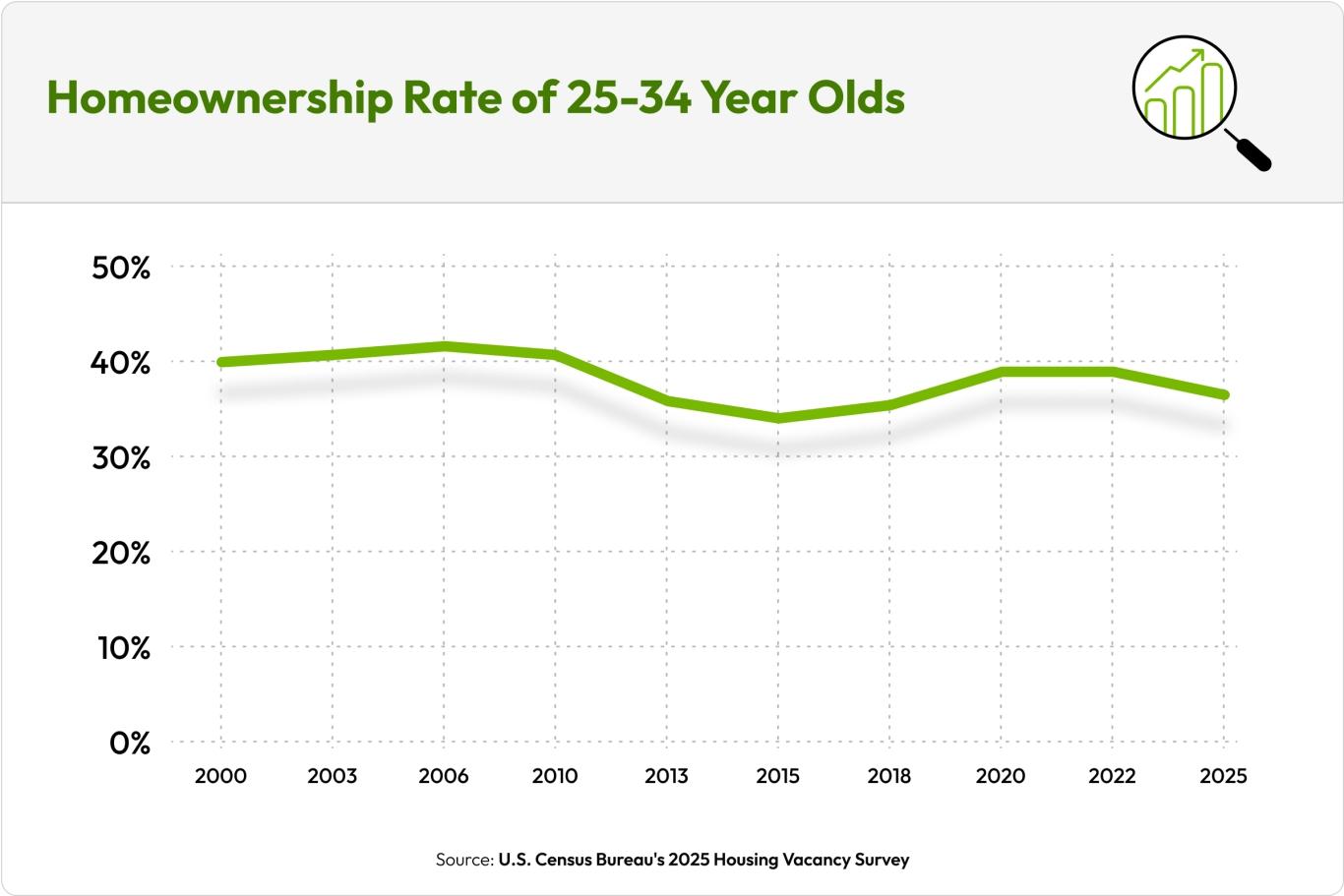
Homeownership among people ages 25 to 34 was as high as 47 percent in some quarters from 2003-2007 but fell to 41.3 percent in 2010 and has since leveled out to 37.9 percent in late 2025, according to the U.S. Census Bureau’s Housing Vacancy Survey.
With mortgage rates rising and homeownership falling, renting has become increasingly popular as a housing alternative.
Renting Is Still Expensive, but More Flexible
According to the ACS, the median gross rent in 2024 was $1,487. While this is typically lower than a monthly mortgage payment, rent still increased by $311 from the recorded $1,176 cost in 2005.
Real median rent (utilities and base rent) has grown 3.8 percent while real median home values have only increased by 1.8 percent since 2011. The National Low Income Housing Coalition reported that the wages needed to afford a rental exceed both the federal minimum wage and median wages in common occupations.
As prices rise, renters have been forced to make tradeoffs just to afford a place to live. Even though neither renting nor owning is “cheap,” renting can provide more financial stability than owning in today’s unstable economy.
What Current Rental Market Trends Reveal
Analyzing the current rental market can provide insight into why rent growth may be declining or increasing. Vacancy rates, apartment demand, and national housing trends are important factors to consider when discussing the increasing popularity of renting.
Rent Growth Has Slowed Nationwide
CoStar Group’s 2026 Multifamily National Report found that national rent growth is up 0.4 percent year over year. This number marks a decline from the 1.5 percent recorded in February 2025. These rental trends suggest that rent growth has slowed nationwide. Even so, the national rent growth average is expected to increase from 0.4 percent to 0.6 percent by the end of 2026, forecasting a positive end to the rental year.
Vacancy Rates Are Rising
Multifamily vacancies reached a record-high 8.6 percent in early 2026 (CoStar Group’s 2026 Multifamily National Report). These vacancies were only at 7.2 percent at the end of 2025. Homeowners are far less likely to vacate their home due to mortgage constraints and ownership regulations, while renters remain flexible and can break their lease (with potential consequences) when necessary. That flexibility doesn't mean everyone uses it, though; some cities see renters staying in the same apartment for years, even when they technically could move.
Although a high vacancy rate is often seen as a challenge for property owners, it can benefit renters. Properties and property managers may extend more rent concessions when vacancies are higher. It can also create opportunities for renters to negotiate lease terms or pricing.
What Rent Search Volume Tells Us About Demand
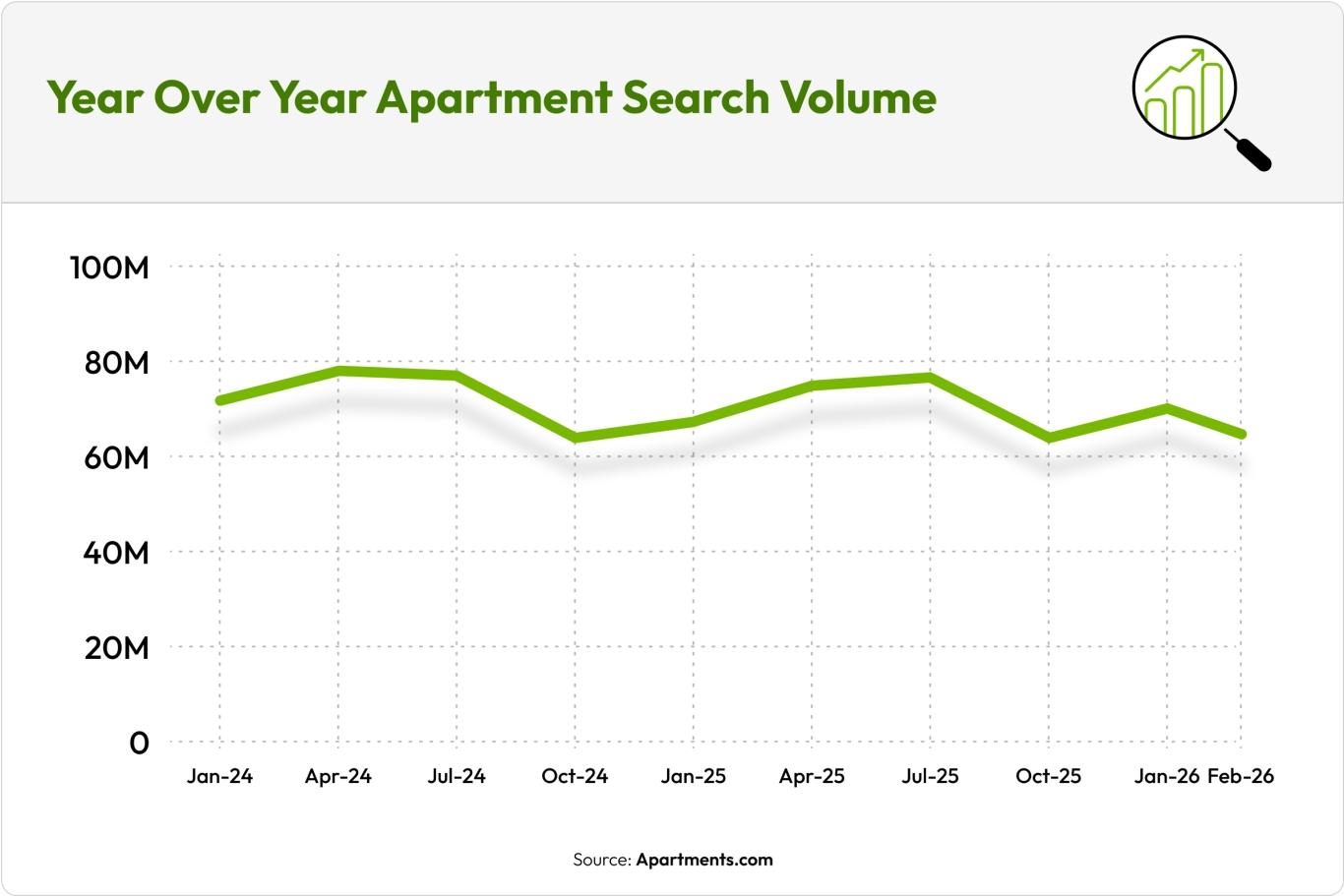
There was a 6.91 percent increase in search volume year over year since 2024 according to Apartments.com, suggesting a positive yearly trend. However, apartment search volume declined by 12.7 percent in February 2026.
Rising vacancy rates and declining apartment search volume suggest lower demand for rentals at the beginning of the year. Seasonality can also contribute to lower month-over-month search activity. Together, the increase in yearly search activity and the short-term monthly decline suggest that renter demand shifts throughout the year, with some seasons seeing more activity than others.
What’s Driving These Changes?
The rental market is constantly evolving due to economic and social factors. Supply, demand, and job growth are just a few outside factors that can affect whether the rental market is growing or falling short.
Job Growth Is Slowing
Employment is a large factor when it comes to choosing your next rental. Rent affordability and commute times play an important role in deciding where to live. The Bureau of Labor Statistics reported that the unemployment rate in January 2026 was 4.3 percent. This number remains steady with the national average of 4.3 percent that was recorded in 2025.
Slow employment growth is contributing to weaker rent growth in some cities. Employers and organizations only added 584,000 net new jobs in 2025. That is almost 71 percent less than the two million positions added in 2024. Pew Research Center found that there is a correlation between unemployed young adults living with their parents. Families and young people alike are finding it difficult to afford housing.
Fewer New Apartments Are Being Built
In some cities, demand is still outpacing supply for apartments and rental homes. CoStar Group data reported that rental construction dropped by 25 percent in 2025 and is expected to fall to 36 percent by the end of 2026. This represents the lowest level of new multifamily construction in the United States since 2014. Higher interest rates, material costs, and 2025 tariffs have made new development more expensive.
Where Renting Is Most Common
Historically, certain states have seen higher renter populations than others. Throughout the United States, there are cities that are more well-suited to renting rather than owning a home.
States With the Most Renters
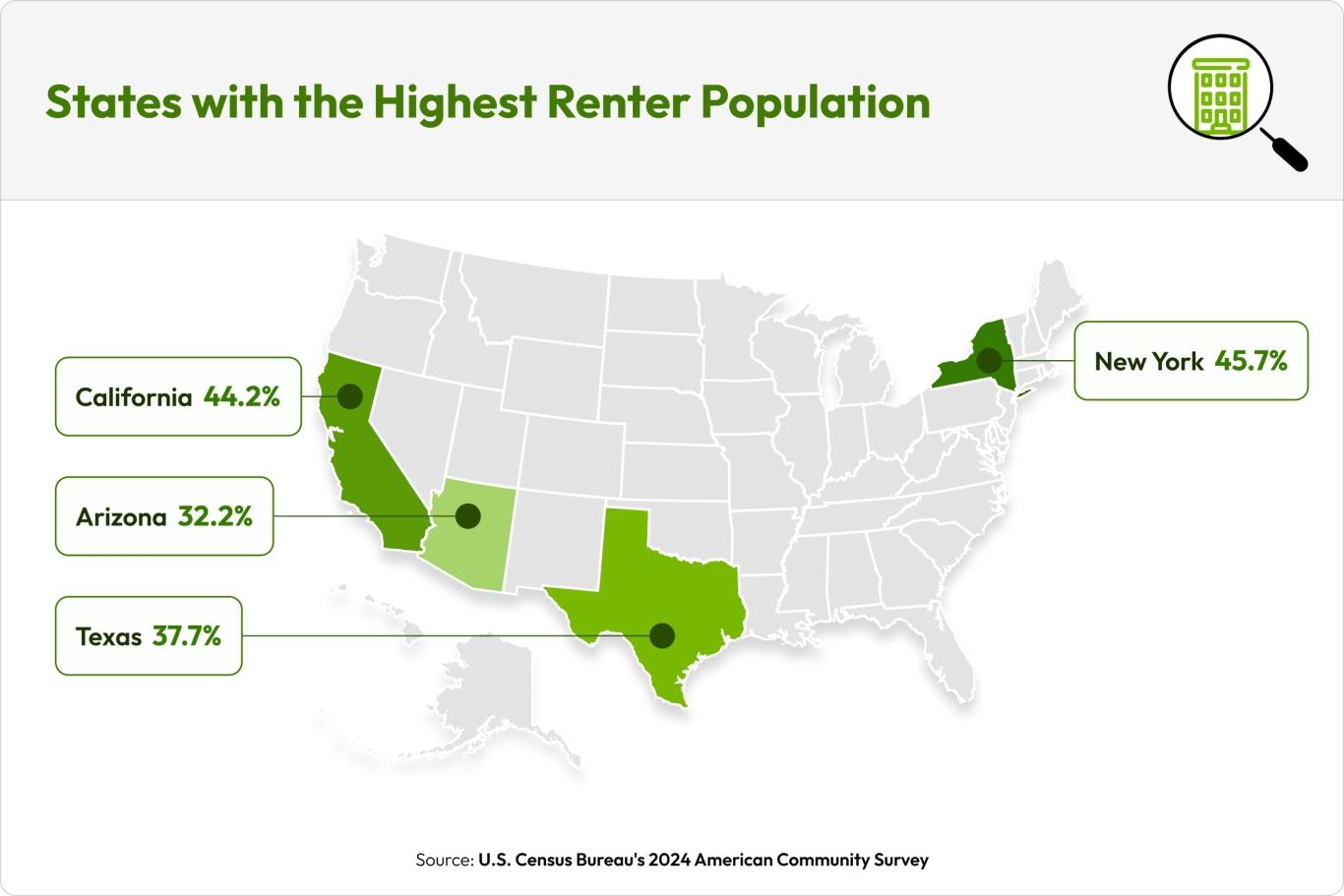
California, Texas, New York, and Arizona are the states that have the largest renting population among the housed population in the U.S., according to the 2024 American Community Survey.
45.7 percent of New Yorkers living in a home are renters. Following close behind is California with a 44.2 percent renter population, Texas with a 37.7 percent renter population, and Arizona with 32.2 percent.
These Rental Markets Have Stayed Competitive for Years
These U.S. markets have historically remained competitive. Analyzing the 2010 ACS found either a small dip or increase in these renter-majority metros.
New York has stayed consistent with a 45.7 percent renter population. California comes in at 44.4 percent, followed by Texas with 36.4 percent, and finally Arizona reporting a 34.8 percent renter population in 2010.
These results suggest that rental popularity has stayed relatively the same or increased in these markets over the last 15 years.
Where Supply and Vacancy Are Highest
Although rental construction is set to decline by the end of 2026, cities with the newest construction and supply have tended to show the weakest rent performance, while supply-constrained markets continue to experience stronger rent growth. This oversupply and under demand trend can be seen throughout the U.S. in some of the most populated metros.
Metros With the Most Construction and Vacancies
The top three cities with the most apartments under construction as of February 2026 are New York, Dallas-Fort Worth, and Phoenix.
New York currently has 43,313 units under construction, Dallas-Fort Worth has 28,282, and Phoenix has 18,373. CoStar Group data found that the three cities with the highest number of multifamily vacancies are New York (45,078 units), Orange County (10,979 units), and San Jose (6,813 units).
New York, although one of the most competitive markets, is also experiencing oversupply in some areas. This oversupply can leave newly constructed apartments vacant when renter demand doesn’t match the number of new units.
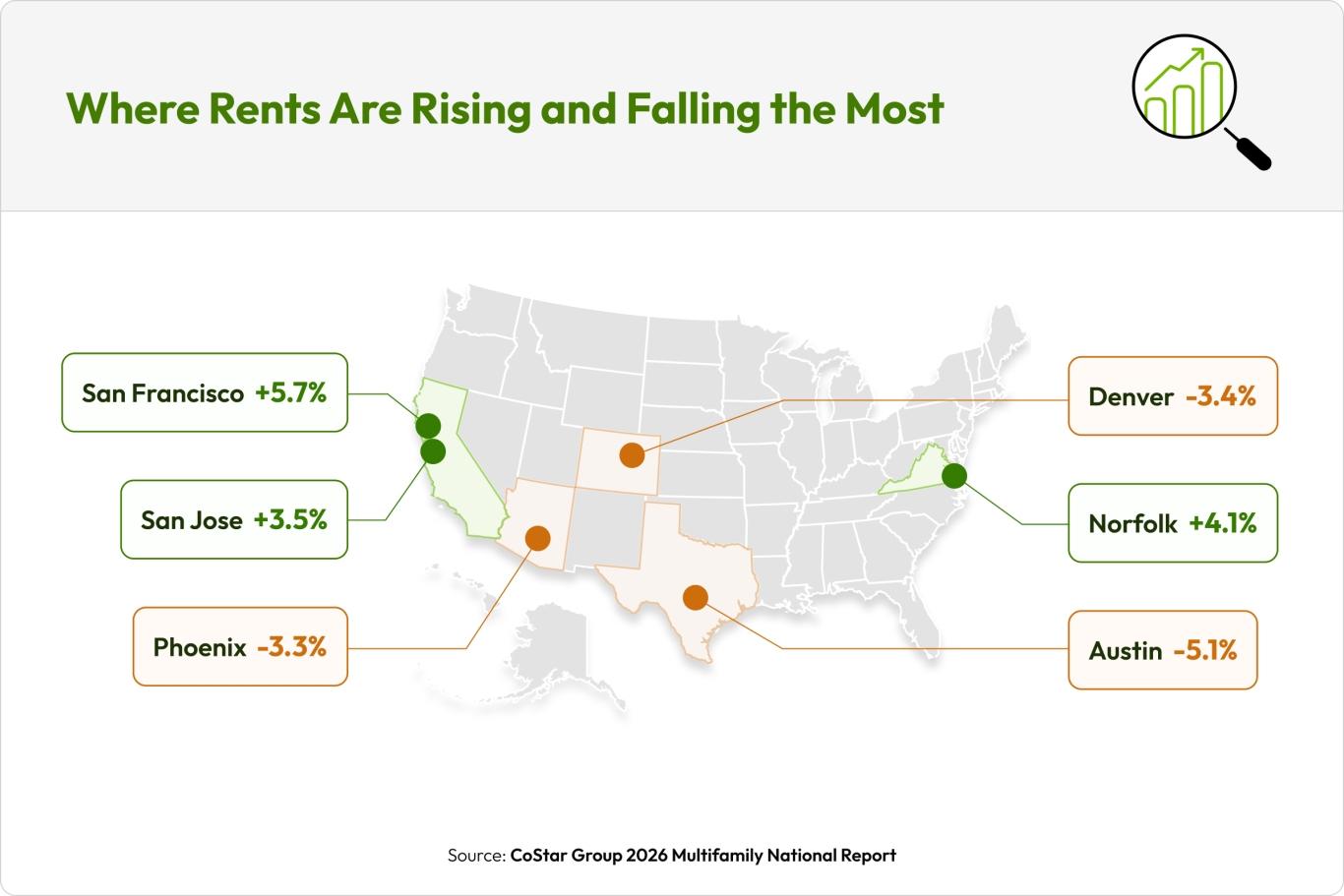
Cities Where Rent Growth Is Rising and Falling
CoStar Group’s 2026 Multifamily National Report found that some cities are seeing higher rent growth than others. The data suggests that cities with the highest supply experience lower rent growth, while cities with less supply are seeing stronger demand overall.
Is the U.S. Becoming a Nation of Renters?
Renting has grown dramatically over the past 15 years, increasing from 29.9 percent of occupied housing units in 2010 to 34.7 percent in 2024. While renting has increased nationally, homeownership has declined from 70.1 percent in 2010 to 65.3 percent in 2024.
Renting has become more common in large part because it’s often more affordable than owning a home. Monthly mortgage payments are higher than monthly rent payments, and renting offers more flexibility during economic uncertainty, resulting in first-time home buyers being older and fewer. Although renting has become more common, the United States is still not a renter-majority nation.
The takeaway: the U.S. is becoming a country where renting is a long-term housing solution for many households.
Methodology
This article uses CoStar Group data and CoStar’s February 2026 Multifamily National Report to analyze vacancy, construction, regional, and demand trends. U.S. Census Bureau and Bureau of Labor Statistics data were used in this article to analyze renter and homeowner data. The Housing Vacancy Survey and the American Community Survey are recurring demographic surveys conducted by the U.S. Census Bureau that collect information on housing and workforce trends in the United States.
Find Your Place with Apartments.com
Renting versus owning a home demands two very different things. Renting offers flexibility, a lower level of commitment, and, sometimes, less fees. Owning a home requires more income and responsibility. If renting fits your lifestyle, Apartments.com makes it easy to explore listings, compare neighborhoods, and find apartments that match your budget. Ready to rent? Let’s go!
FAQs
Why are more Americans renting instead of buying homes?
Renting is often more affordable than owning a home. Less responsibility, financial security, and flexibility are some of the main reasons that Americans are starting to rent their homes rather than buy them.
Is renting cheaper than owning a home in 2026?
Renting is generally more affordable month to month, though both options come with tradeoffs. Renters typically pay less upfront and have fewer maintenance responsibilities, while homeowners face higher monthly costs but have complete ownership of their space.
Has homeownership declined in the United States?
Homeownership has declined in the United States over the past 10 years. The American Community Survey found in 2010 that the homeownership rate in the country was at 70.1 percent. In 2024, the homeownership rate was 65.3 percent. Although this is a slight decrease, homeownership is not as attainable due to affordability concerns and housing shortages.
Which states have the highest share of renters?
New York (45.7%), California (44.2%), Texas (37.7%), and Arizona (32.2%) have the most renter-occupied units among their housing population.


