

While moving is a personal decision, knowing about renter migration trends helps you make an informed decision. Exploring the states and regions that are seeing the highest and lowest net migration numbers and why renters are moving to these areas shows you how these shifts could affect your apartment search, moving plans, and life in a new place.
Key Takeaways
- Domestic renter mobility has dropped to a historic low of 21.6 percent, down from 26.7 percent in 2014, as more renters stay put to avoid higher costs — yet those who do move prioritize affordability, lifestyle, and job access.
- Sun Belt states dominate migration trends, with Texas, Florida, and North Carolina leading net gains, driven by lower rents, high apartment supply, and strong job growth; major metros like Houston and Atlanta offer relatively affordable pricing with high availability.
- High-cost states continue to lose renters, with California, New York, and Illinois seeing the largest outflows, though demand for major cities remains strong despite rising rents and limited supply.
Methodology
All migration and population data is from the U.S. Census Bureau while rent and vacancy data is from Apartments.com.
Fewer Renters Are Moving — But Those Who Do Are Heading to Balanced Areas
Domestic renter movement has been decreasing steadily as each year passes, according to U.S. Census Bureau data. Currently, it sits at a historic low of 21.6 percent, which is five percent lower than it was 10 years ago, in 2014, when it was 26.7 percent. Many renters are staying put because it is better for them financially or practically. They may be keeping a lower rent, avoiding high moving costs, or facing limited supply. Yet, many are moving, especially to lower-priced regions, proving that a balance of affordability, lifestyle, and opportunities remains at the top of renters’ priorities.
The Sun Belt: Where the Highest Net Migration States Call Home
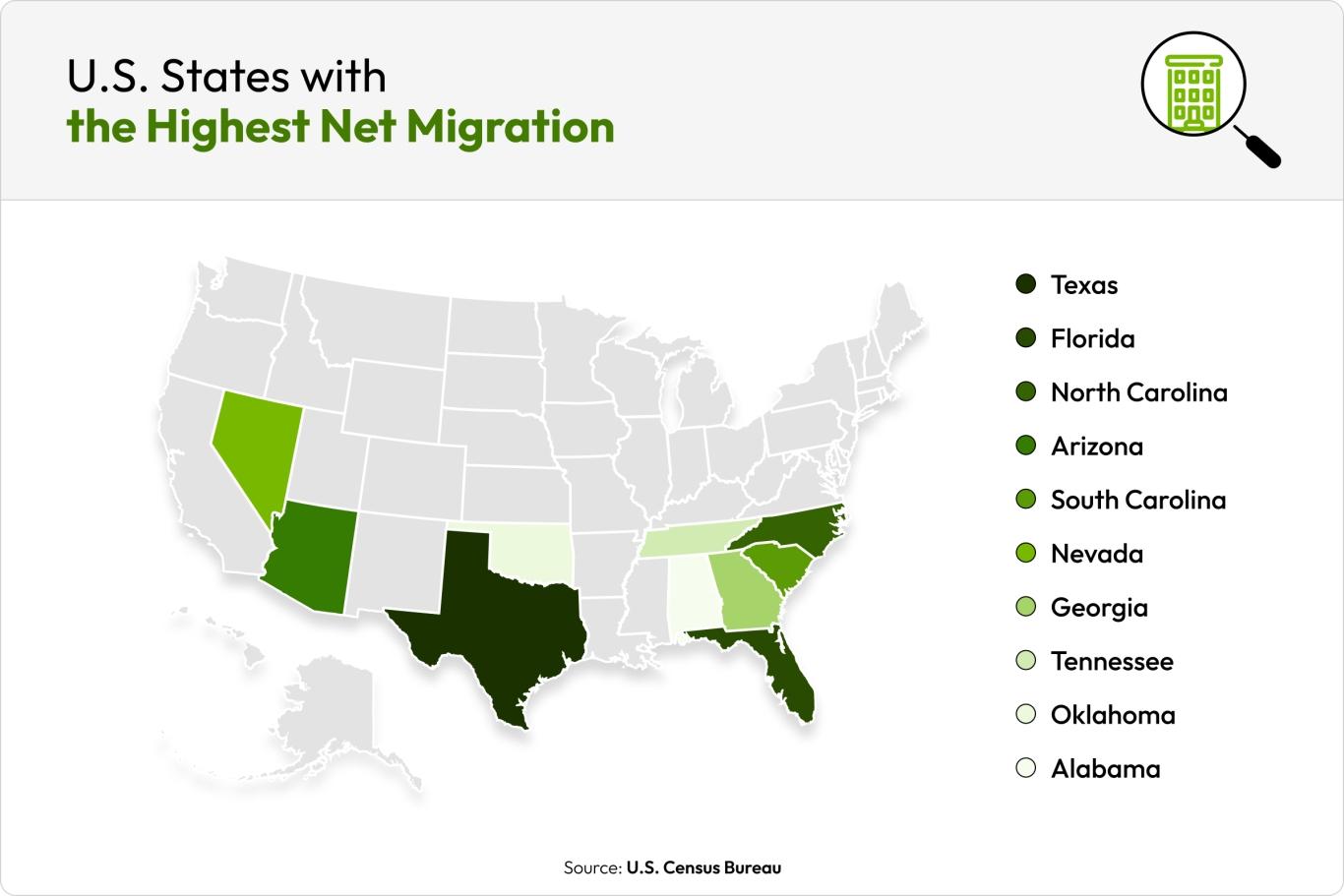
The Sun Belt continues to see high levels of popularity as all of the top 10 states for domestic net migration are part of the Sun Belt.
|
Rank |
State |
Net Migration |
|
1 |
Texas |
72,680 |
|
2 |
Florida |
67,630 |
|
3 |
North Carolina |
58,587 |
|
4 |
Arizona |
55,160 |
|
5 |
South Carolina |
54,676 |
|
6 |
Nevada |
41,278 |
|
7 |
Georgia |
37,012 |
|
8 |
Tennessee |
35,780 |
|
9 |
Oklahoma |
33,900 |
|
10 |
Alabama |
22,232 |
Why the Sun Belt is America’s new destination
People are moving to the Sun Belt for a simple reason: it offers a rare mix of affordability, lifestyle, and opportunity. The region’s popularity has fueled a massive supply wave of apartment communities. This surplus has kept rent prices low, rent concessions high, and availability strong, attracting renters from across the country. Though the supply wave has crested and is on the downward slope, renters continue to move to the Sun Belt as conditions remain favorable.
Renters aren’t the only ones attracted to the Sun Belt. Many businesses and companies have expanded or relocated their operations to the region. This is largely due to favorable business conditions, like affordable operational costs, business-friendly policies, and strong infrastructure. This investment and interest has supported the flow of renters by creating jobs and professional opportunities for career growth.
Lifestyle is another major driver, with migration slowly shifting toward warmer regions and away from colder ones. Renters are leaving behind colder places for warmer cities with mild winters, long summers, and more opportunities to spend time outside. This desirable lifestyle reflects renter preferences, which is why the Sun Belt has seen such a population boom.
Standout Sun Belt Cities
Out of the 10 top cities for migration on Apartments.com, six are part of the Sun Belt: Houston, Dallas, Atlanta, Miami, San Diego, and Austin. This highlights the intersection between affordability and demand from renters. While not all cities follow this pattern, many Sun Belt metros have lower rent prices, more rent concessions, higher vacancy rates, and more availability. These favorable conditions are part of the reason why so many renters are moving to the Sun Belt.
|
City |
Rent Price |
Vacancy Rate |
|
$1,185/month |
12.7% |
|
|
$1,402/month |
12.4% |
|
|
$1,626/month |
11.5% |
|
|
$2,224/month |
7.4% |
|
|
$2,389/month |
6.0% |
|
|
$1,387/month |
13.6% |
Houston, TX
Houston’s population has increased by 3.9 percent from 2020 to 2024, outpacing the national population increase of 2.6 percent. Its large size offers renters plenty of space for a low price, along with a variety of housing choices and locations to choose from. Renters can live downtown, near nightlife, cultural attractions, restaurants, and job hubs or find more space and quiet in the suburbs or satellite cities.
Though the city has seen growth in recent years, a steady supply of apartment communities has kept rents low. The average rent in Houston is $1,185/month and it has decreased by 1.2 percent over the past year.
Dallas, TX
Dallas has become a hot spot for corporate headquarters across industries, including finance, tech, logistics, health care, and more. These professional opportunities have contributed to the moderate 1.7 percent population increase from 2020 to 2024. Developers recognized this interest and fueled a supply wave of mixed-use, amenity-rich apartment communities. These spaces typically have pools, gyms, coworking spaces, pet amenities, lounges, and more above shops and restaurants.
Yet, the city still remains affordable with an average rent of $1,402/month. With modern housing choices backed by a strong job market that supports income growth, it’s easy to see why renters are flocking to Dallas.
Atlanta, GA
Atlanta has seen a high 4.3 percent population increase from 2020 to 2024, highlighting it as one of the most popular cities in the Sun Belt for renters. The city is all about character and identity while still being connected, with distinct neighborhoods interwoven into one metro that shares a strong culture. Each neighborhood has its own strengths, from being near major companies, restaurants, and entertainment to having a thriving arts scene with galleries, art museums, and art-focused events.
A steady supply line of apartment communities has kept rents relatively affordable even as demand has skyrocketed. In the past year, the average rent in Atlanta has decreased 0.5 percent to its current price of $1,626/month. Between newer apartment communities with all the bells and whistles to affordable places in the suburbs, there is a place for every budget.
States with Major Metros Are Losing Residents
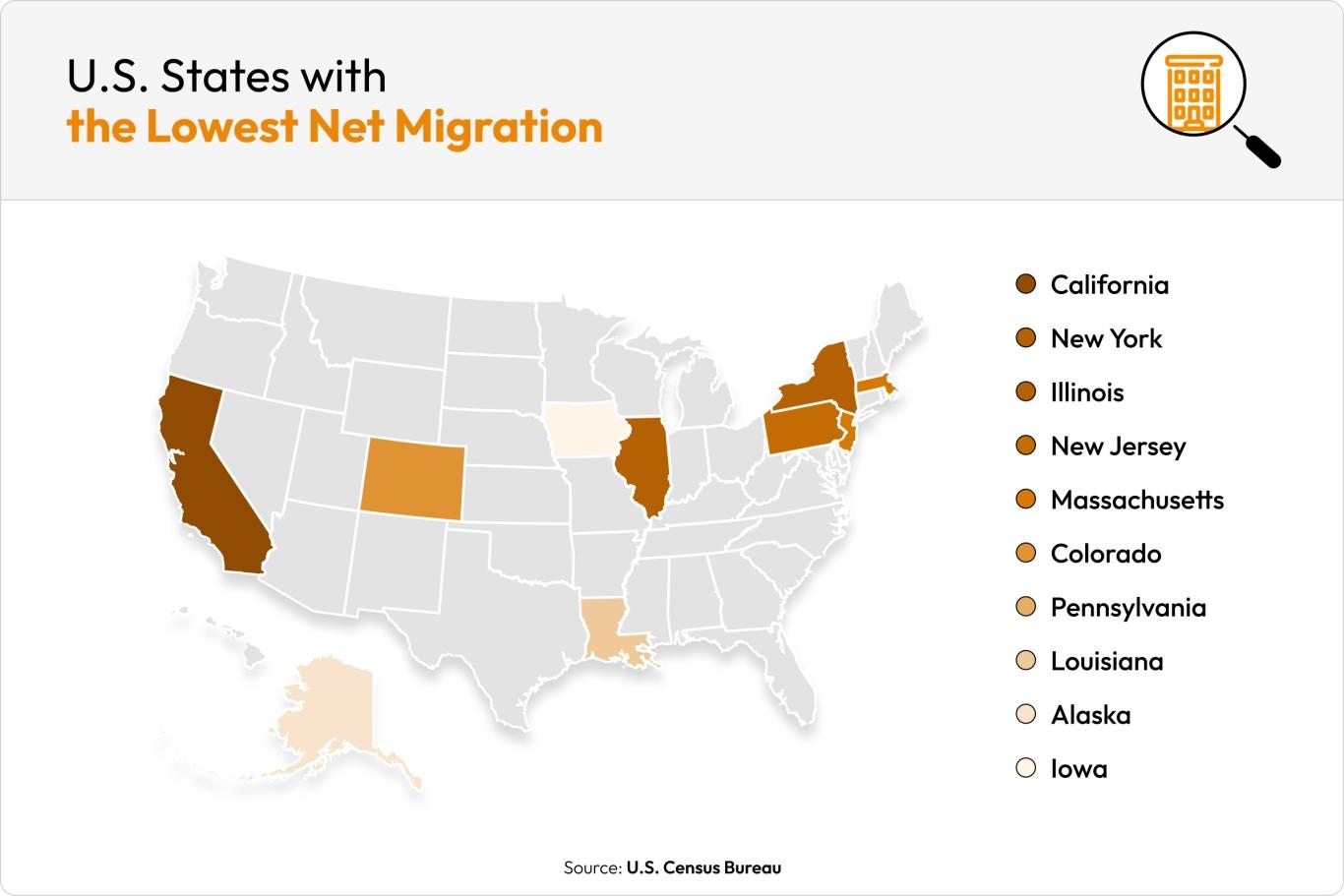
Most of the states with negative net migration are ones that are anchored by major metros, like Los Angeles, Chicago, and New York. The top ten cities with negative net migration are:
|
Rank |
State |
Net Migration |
|
51 |
California |
-254,332 |
|
50 |
New York |
-130,145 |
|
49 |
Illinois |
-82,470 |
|
48 |
New Jersey |
-63,913 |
|
47 |
Massachusetts |
-30,032 |
|
46 |
Colorado |
-24,205 |
|
45 |
Pennsylvania |
-17,108 |
|
44 |
Louisiana |
-12,166 |
|
43 |
Alaska |
-10,615 |
|
42 |
Iowa |
-9,683 |
Why states with major cities are seeing negative migration
The fact that many states with major cities are seeing negative net migration points to a growing renter focus on affordability. As inflation and cost of living rise, people are cutting costs in order to afford housing or reevaluating their living situation. According to Apartments.com, 47 percent of renters in 2026 adjusted their housing situation or rental wish list to better manage bills and everyday expenses.
While big cities still offer a lifestyle like no other place, many medium-sized metros are providing similar attractions at a much more affordable price. In addition, these cities have strong economies and steady job markets, so renters don’t have to stay in major metros to find professional opportunities.
Beyond price: why some affordable states still lose residents
A few states without major cities, such as Alaska and Iowa, are also seeing negative net migration. These markets prove that while affordability is a priority, it is not the sole factor renters base their decision on — people are also looking for the right lifestyle.
Generally, people want a mix of city amenities, lifestyle, and affordability. Even though these states have lower costs, they may not provide the convenience, entertainment, or career opportunities that people look for.
City-Search Data Still Says Major Cities Are on Top
Still, renters aren’t writing off major cities entirely. Half of the top cities searched on Apartments.com were in states that had the highest migration losses: New York, California, Illinois, and Massachusetts. That demand shows cities in these states still have strong appeal, especially among renters, even as the states lose residents overall. Compared to the Sun Belt, these major cities have a more competitive rental landscape with lower vacancy rates, more competition, lower availability, fewer rent concessions, and higher rent prices.
|
City |
Rent Price |
Vacancy Rate |
|
$2,015/month |
5.1% |
|
|
$4,095/month |
2.9% |
|
|
$2,184/month |
5.7% |
|
|
$2,389/month |
6.0% |
|
|
$3,515/month |
6.4% |
Chicago, IL
Chicago gives renters that compact, city lifestyle at a lower price than other metros. With an average rent of $2,015/month, it sits only 23 percent higher than the national average. However, rents have been climbing. Over the past year, they have increased by 3.9 percent as renters have flocked to the city.
The city has everything, including entertainment, famous restaurants, major employers, expansive green spaces, and renowned cultural destinations. Yet, it still offers a distinctly community-focused lifestyle, since each neighborhood has a strong identity. Though it remains one of the most popular big cities among renters, there is a steady outflow of residents. The population dropped one percent from 2020 to 2024.
New York, NY
New York remains one of the nation's premier rental destinations, commanding an average rent of $4,095/month. Even though the population has decreased by 3.7 percent from 2020 to 2024, rents are still climbing, jumping 1.2 percent in the past year. This is largely due to the city still capturing a lot of demand while struggling with low supply and affordability issues. The population drop reflects a shift in renter demand as some have explored alternatives in suburbs or other major metros.
If you’re looking for an apartment with charm and character or the newest luxuries, New York has plenty of options. Each of the five boroughs presents distinct neighborhoods with their own character, from Brooklyn's creative enclaves near Manhattan's bustling energy to Queens' diverse cultural communities across the East River.
The city's unparalleled offerings justify its cost for many renters: world-class cultural institutions, Michelin-starred dining, Broadway entertainment, iconic landmarks, and an unmatched job market spanning finance, technology, media, and countless other industries.
Los Angeles, CA
Los Angeles offers renters the quintessential California lifestyle with sprawling neighborhoods, year-round sunshine, and tons of options. Though the city has an average rent of $2,184/month, prices can fluctuate widely across its 469 square miles. Downtown and coastal neighborhoods, like Santa Monica and the Financial District, have high rent prices reflecting their popularity and high demand levels. Yet, there are still many affordable neighborhoods that can position you exactly where you need to be.
Due to its higher prices and cost of living, Los Angeles has experienced a small population decline of 0.5 percent from 2020 to 2024. However, with its outdoor attractions, entertainment districts, cultural institutions, thriving music and film industries, and a robust job market spanning tech, aerospace, entertainment, and health care, the city stands strong. Los Angeles is truly a collection of distinct neighborhoods, each with its own personality and appeal, like the trendy nightlife in West Hollywood to the beachy vibes of Venice Beach.
Find Your Next Home in America's Hottest Rental Markets
Ready to find your perfect apartment in one of these trending markets? Use Apartments.com's filters to narrow down your search by location, price range, and amenities — so you can compare thousands of listings across the Sun Belt and beyond, all in one place. Start exploring apartments in your ideal destination today and move with confidence.
State-by-State Migration Table
|
State |
Inflow |
Outflow |
Net Migration |
|
Texas |
556,156 |
483,476 |
72,680 |
|
Florida |
573,876 |
506,246 |
67,630 |
|
North Carolina |
299,782 |
241,195 |
58,587 |
|
Arizona |
234,926 |
179,766 |
55,160 |
|
South Carolina |
189,333 |
134,657 |
54,676 |
|
Nevada |
130,813 |
89,535 |
41,278 |
|
Georgia |
266,483 |
229,471 |
37,012 |
|
Tennessee |
192,215 |
156,435 |
35,780 |
|
Oklahoma |
107,523 |
73,623 |
33,900 |
|
Alabama |
119,890 |
97,658 |
22,232 |
|
Ohio |
197,890 |
177,575 |
20,315 |
|
Washington |
222,059 |
204,352 |
17,707 |
|
Kentucky |
95,793 |
82,563 |
13,230 |
|
Idaho |
72,817 |
60,351 |
12,466 |
|
Mississippi |
65,391 |
55,258 |
10,133 |
|
Wisconsin |
116,355 |
107,081 |
9,274 |
|
Utah |
95,218 |
85,952 |
9,266 |
|
Vermont |
24,503 |
15,366 |
9,137 |
|
New Hampshire |
48,666 |
40,570 |
8,096 |
|
Missouri |
140,693 |
132,632 |
8,061 |
|
Maine |
35,900 |
28,146 |
7,754 |
|
West Virginia |
43,945 |
36,791 |
7,154 |
|
North Dakota |
27,348 |
21,106 |
6,242 |
|
Michigan |
140,413 |
134,292 |
6,121 |
|
Arkansas |
62,908 |
56,812 |
6,096 |
|
Oregon |
118,547 |
112,955 |
5,592 |
|
Wyoming |
25,548 |
20,247 |
5,301 |
|
Maryland |
164,424 |
159,125 |
5,299 |
|
Delaware |
34,602 |
29,719 |
4,883 |
|
Rhode Island |
36,203 |
32,711 |
3,492 |
|
Indiana |
133,951 |
130,728 |
3,223 |
|
Virginia |
265,514 |
263,931 |
1,583 |
|
Nebraska |
49,949 |
48,631 |
1,318 |
|
Montana |
36,159 |
35,447 |
712 |
|
Hawaii |
53,744 |
53,214 |
530 |
|
Kansas |
83,676 |
83,761 |
-85 |
|
Washington, D.C. |
53,791 |
54,246 |
-455 |
|
Connecticut |
82,686 |
88,508 |
-5,822 |
|
Minnesota |
104,959 |
111,705 |
-6,746 |
|
New Mexico |
54,241 |
61,085 |
-6,844 |
|
South Dakota |
23,419 |
30,718 |
-7,299 |
|
Iowa |
59,946 |
69,629 |
-9,683 |
|
Alaska |
29,995 |
40,610 |
-10,615 |
|
Louisiana |
72,028 |
84,194 |
-12,166 |
|
Pennsylvania |
234,593 |
251,701 |
-17,108 |
|
Colorado |
182,469 |
206,674 |
-24,205 |
|
Massachusetts |
152,915 |
182,947 |
-30,032 |
|
New Jersey |
150,849 |
214,762 |
-63,913 |
|
Illinois |
200,326 |
282,796 |
-82,470 |
|
New York |
285,304 |
415,449 |
-130,145 |
|
California |
406,873 |
661,205 |
-254,332 |
Source: U.S. Census Bureau
FAQs
What is the #1 state people are leaving?
California has the largest negative net migration, meaning it has a much larger population outflow than inflow.
Where are people moving to?
People are moving to Sun Belt states where they can find lower rents, more apartment options, warmer weather, and strong job opportunities. The states with the highest net migration gains are Texas, Florida, North Carolina, Arizona, and South Carolina.
Many renters are also searching in Sun Belt cities like Houston, Dallas, Atlanta, Miami, San Diego, and Austin. These markets offer a balance of affordability, lifestyle, and career access, which is why they continue to stand out in current migration trends.
Why are renters moving?
Renters are moving for a mix of affordability, lifestyle, and job opportunities. Many are leaving high-cost states and major metros to find lower rents, more apartment availability, and a better overall cost of living. Sun Belt states like Texas, Florida, and North Carolina are attracting renters because they offer warmer weather, strong job markets, newer apartment supply, and more budget-friendly options.
At the same time, fewer renters are moving overall because relocation costs are high, some renters want to keep lower rents, and limited supply in certain markets makes moving harder. Renters who move are looking for places where their money goes further without sacrificing career access or quality of life.


