7 Best Places to Live in Vermont
Open to exploring your options? Discover great cities in Vermont with our detailed guide.

Avg Rent
$2,075
Population
44,088
Renter Mix
62% Rent
Burlington, Vermont combines small-city charm with natural beauty along the shores of Lake Champlain. The heart of downtown features Church Street Marketplace, a four-block pedestrian mall where local shops and restaurants create an inviting atmosphere throughout the year. The Burlington Bike Path traces the waterfront and connects to the Island Line Trail, extending into Lake Champlain on a historic railroad causeway. The rental market reflects strong demand, with current average rents ranging from $1,752 for studios to $2,068 for one-bedroom apartments, while larger units can command up to $3,417 for four bedrooms. The Hill Section stands out with its historic architecture and tree-lined streets near Champlain College, while the South End district features renovated industrial spaces housing galleries and studios.
Burlington serves as home to the University of Vermont and the UVM Medical Center. The Old North End neighborhood preserves the city's cultural heritage, including the historic Little Jerusalem district. Residents enjoy access to waterfront paths, beaches, and parks, including the popular Waterfront Park and North Beach. The city demonstrates environmental leadership through its renewable energy initiatives, and the local food scene emphasizes connections to Vermont farms and producers. The original Ben & Jerry's scoop shop on Cherry Street marks the spot where the famous ice cream company began in 1978. From summer festivals at Waterfront Park to the year-round farmers' market in City Hall Park, Burlington offers recreational opportunities across all seasons.
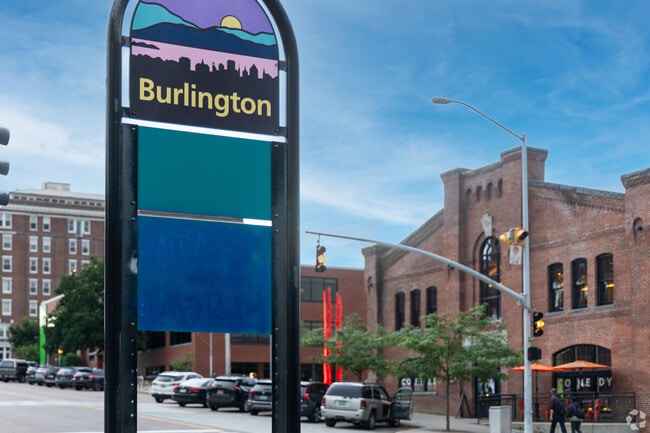
A "Burlington" sign on a sidewalk in Downtown Burlington.
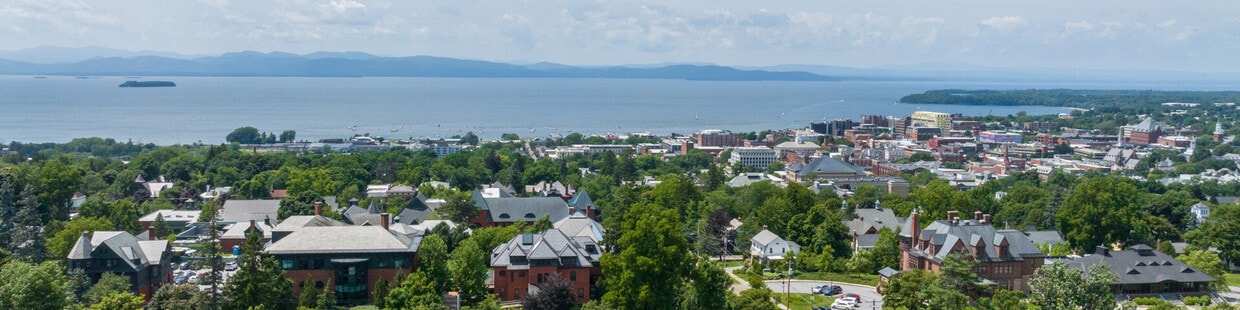
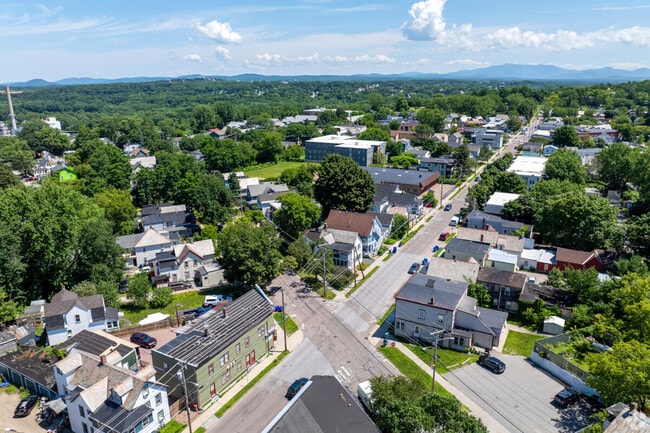
An aerial view of the Old North End neighborhood in Burlington, VT.
Battery Park in Burlington is a 14 acre historic park offering stunning views of Lake Champlain.
Median Household Income
$65,563
Average: $91,803
Education
19,998
Residents Have a Degree
Job Market
23,988
Workers Employed
Median Age
30 Years
Largest Age Group
20-29 Years
Approximately 29% of Residents
Under 20
21%
Over 65
13%
Housing Distribution
Burlington has more renters than homeowners.

Education Distribution
Review this city's overall education levels.

As of September 2026, the average apartment rent in Burlington, VT is $1,654 for a studio, $2,076 for one bedroom, $1,744 for two bedrooms, and $1,535 for three bedrooms. Apartment rent in Burlington has decreased by -2.0% in the past year.
The cost of living in Burlington, VT is 13.4% higher than the national average. Generally, housing in Burlington is 28.9% more expensive than the national average, with rent falling between $1,535 - $2,076. You can expect to pay 4.1% more for groceries, 12.7% more for utilities, and 4.2% more for transportation.
Compare Cities

7 Best Places to Live in Vermont
Open to exploring your options? Discover great cities in Vermont with our detailed guide.

How to Budget and Save for an Apartment
From the 50/30/20 rule to cutting personal spending, learn how to set smart goals for apartment living.

10 Things to Do Before Moving Day
Before moving day arrives, make time to plan your budget, pack smart, review your lease, and tie up loose ends.
Explore how walkable, bikeable, drivable, and transit-friendly Burlington, VT is for everyday living.
Fairly Walkable
Walkability
Minimal Public Transit
Transit
Exceptionally Drivable
Drivability
Not Bikeable
Bikeability

Public
Grades PK-5
559 Students

Public
Grades PK-5
279 Students

Sustainability Academy At Lawrence Barnes
Public
Grades PK-5
213 Students
Public
Grades PK-5
255 Students

Integrated Arts Academy At H. O. Wheeler
Public
Grades PK-5
201 Students
Public
Grades 6-8
356 Students
Public
Grades 6-8
322 Students
Public
Grades 9-12
921 Students
Public
Grades 9-12

 The GreatSchools Rating helps parents compare schools within a state based on a variety of school quality indicators and provides a helpful picture of how effectively each school serves all of its students. Ratings are on a scale of 1 (below average) to 10 (above average) and can include test scores, college readiness, academic progress, advanced courses, equity, discipline and attendance data. We also advise parents to visit schools, consider other information on school performance and programs, and consider family needs as part of the school selection process.
View GreatSchools Rating Methodology
Data provided by
GreatSchools.org
© 2026. All rights reserved.
The GreatSchools Rating helps parents compare schools within a state based on a variety of school quality indicators and provides a helpful picture of how effectively each school serves all of its students. Ratings are on a scale of 1 (below average) to 10 (above average) and can include test scores, college readiness, academic progress, advanced courses, equity, discipline and attendance data. We also advise parents to visit schools, consider other information on school performance and programs, and consider family needs as part of the school selection process.
View GreatSchools Rating Methodology
Data provided by
GreatSchools.org
© 2026. All rights reserved.
† Our analysis of utilities, groceries, transportation, healthcare, home prices, and other goods and services is sourced from the Cost of Living Index, a respected benchmark published by the Council for Community and Economic Research (C2ER) that provides a thorough overview of living expenses across different regions.
Rent data is provided by CoStar Group’s Market Trend reports. As the industry leader in commercial real estate information, analytics, and news, CoStar conducts extensive research to produce and maintain a comprehensive database of commercial real estate information. We combine this data with public record to provide the most up-to-date rental information available.
Consumer goods, services, and home prices are sourced from the Cost of Living Index published by the Council for Community and Economic Research (C2ER). The data on this page is updated quarterly. It was last published in September 2026.
Demographic information comes from Neustar and combines detailed address data with U.S. Census and American Community Survey statistics to produce reliable local estimates.