Median Age
40 Years
Largest Age Group
35-44 Years
Approximately 14% of Residents
Under 20
24%
Over 65
21%



Avg Rent
$1,129
Population
75,942
Renter Mix
37% Rent
Situated along the Missouri River, Bismarck combines outdoor recreation with city amenities. The state capital features over 2,300 acres of public parkland, including Sertoma Park's three-mile stretch along the riverbank. The city maintains an extensive network of walking and biking trails, and the Dakota Zoo offers year-round activities. Downtown Bismarck houses local shops and restaurants, alongside the Belle Mehus Auditorium, home to the Bismarck-Mandan Symphony Orchestra. The Art Deco State Capitol building, North Dakota's tallest structure at 241.75 feet, serves as the city's defining landmark.
The rental market in Bismarck shows average rents of $846 for studios, $1,022 for one-bedrooms, and $1,163 for two-bedroom units. Year-over-year increases range from 4.9% to 6.8% for most unit types. Housing options span from downtown apartments near the Capitol complex to residential communities in the expanding northern section. The presence of the University of Mary and Bismarck State College adds to the area's rental demand, while Sanford Health and CHI St. Alexius Medical Center represent major employers in the healthcare sector. With a median household income of $71,917, Bismarck maintains competitive living costs compared to other state capitals. Notable areas include the Cathedral District, distinguished by its American elms and historic homes from the 1880s, and the developing south side along the Missouri River floodplain, which has expanded since the Garrison Dam's construction.
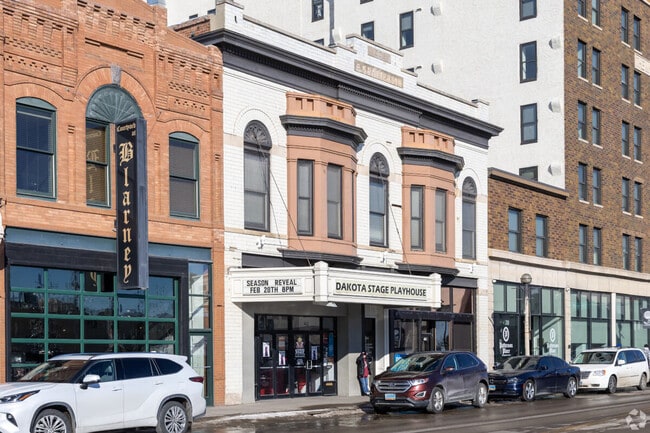
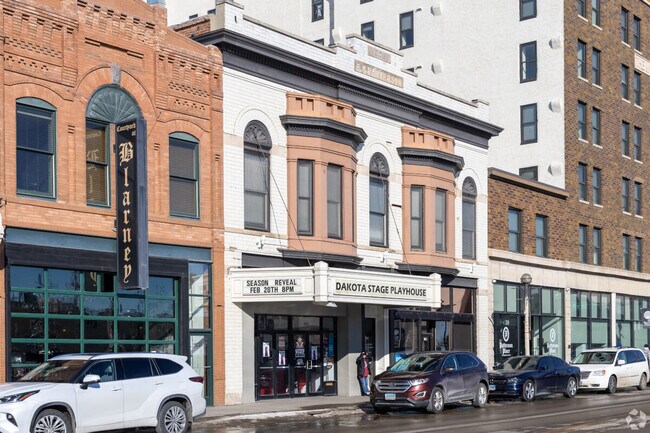
The Dakota Stage Playhouse is a historic theater in downtown Bismarck.
North Dakota Heritage Center & State Museum has an impressive natural history collection.
Bismarck Art Alley displays murals spanning a city block.
Median Household Income
$65,799
Average: $85,179
Education
23,454
Residents Have a Degree
Job Market
40,373
Workers Employed
Median Age
40 Years
Largest Age Group
35-44 Years
Approximately 14% of Residents
Under 20
24%
Over 65
21%
Housing Distribution
Bismarck has more homeowners than renters.

Education Distribution
Review this city's overall education levels.

As of September 2026, the average apartment rent in Bismarck, ND is $936 for a studio, $1,128 for one bedroom, $1,311 for two bedrooms, and $1,846 for three bedrooms. Apartment rent in Bismarck has increased by 1.4% in the past year.
The cost of living in Bismarck, ND is 13.1% lower than the national average. Generally, housing in Bismarck is 30.4% less expensive than the national average, with rent falling between $936 - $1,846. You can expect to pay 0.5% more for groceries, 17.5% less for utilities, and 3.5% less for transportation.
Compare Cities
Explore how walkable, bikeable, drivable, and transit-friendly Bismarck, ND is for everyday living.
Moderately Walkable
Walkability
Very Drivable
Drivability
Moderately Bikeable
Bikeability

Public
Grades K-5
510 Students

Public
Grades PK-5
78 Students
Dorothy Moses Elementary School
Public
Grades K-5
390 Students

Public
Grades K-5
390 Students
Victor Solheim Elementary School
Public
Grades K-5
588 Students

Public
Grades 6-8
1,012 Students
Public
Grades 6-8
1,124 Students
Public
Grades 6-8
1,053 Students

Theodore Jamerson Elementary School
Public
Grades K-8
102 Students

Public
Grades PK-8
16 Students
Public
Grades 9-12
1,406 Students
Public
Grades 9-12
1,419 Students

Public
Grades 9-12
1,367 Students
Public
Grades 9-12
Public
Grades K-12
 The GreatSchools Rating helps parents compare schools within a state based on a variety of school quality indicators and provides a helpful picture of how effectively each school serves all of its students. Ratings are on a scale of 1 (below average) to 10 (above average) and can include test scores, college readiness, academic progress, advanced courses, equity, discipline and attendance data. We also advise parents to visit schools, consider other information on school performance and programs, and consider family needs as part of the school selection process.
View GreatSchools Rating Methodology
Data provided by
GreatSchools.org
© 2026. All rights reserved.
The GreatSchools Rating helps parents compare schools within a state based on a variety of school quality indicators and provides a helpful picture of how effectively each school serves all of its students. Ratings are on a scale of 1 (below average) to 10 (above average) and can include test scores, college readiness, academic progress, advanced courses, equity, discipline and attendance data. We also advise parents to visit schools, consider other information on school performance and programs, and consider family needs as part of the school selection process.
View GreatSchools Rating Methodology
Data provided by
GreatSchools.org
© 2026. All rights reserved.
† Our analysis of utilities, groceries, transportation, healthcare, home prices, and other goods and services is sourced from the Cost of Living Index, a respected benchmark published by the Council for Community and Economic Research (C2ER) that provides a thorough overview of living expenses across different regions.
Rent data is provided by CoStar Group’s Market Trend reports. As the industry leader in commercial real estate information, analytics, and news, CoStar conducts extensive research to produce and maintain a comprehensive database of commercial real estate information. We combine this data with public record to provide the most up-to-date rental information available.
Consumer goods, services, and home prices are sourced from the Cost of Living Index published by the Council for Community and Economic Research (C2ER). The data on this page is updated quarterly. It was last published in September 2026.
Demographic information comes from Neustar and combines detailed address data with U.S. Census and American Community Survey statistics to produce reliable local estimates.