

What comes to mind when you think of a “big city” in the United States? Is it Washington D.C. and its cherry blossoms, or sprawling New York City? Ten years ago, if you were serious about renting an apartment in a big city, everyone was pretty much on the same page about what a “big American city” was.
That list has changed since then. The cities with the newest buildings going up, the most units available, and the most landlords willing to negotiate are not necessarily the ones you'd name first.
Fortunately, this shift is working in renters' favor. Where apartments got built in bulk, renters got choices in the form of newer units, steadier rents, and move-in specials that didn't exist a few years ago. Understanding where demand actually went, and why, is a practical advantage on your next lease.
The Rental Demands Map Just Got Redrawn
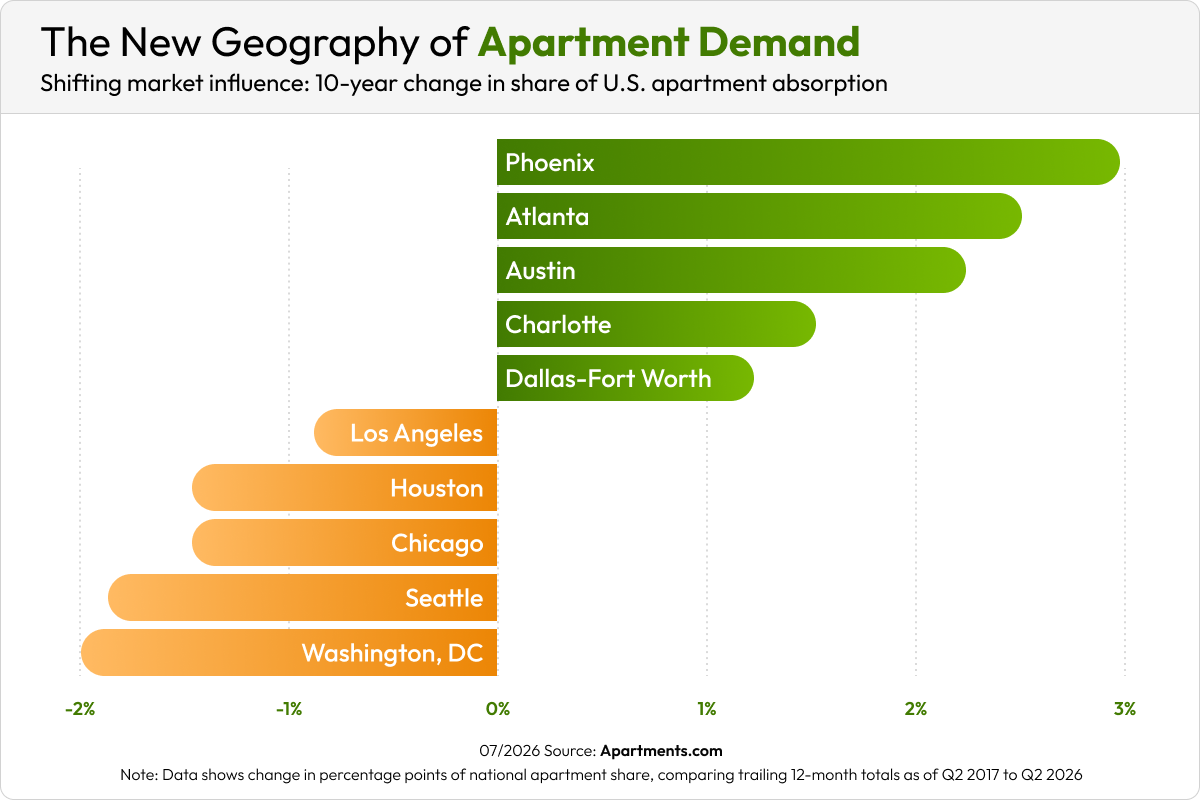
Apartment "demand" means where renters are signing leases and moving in, minus the renters moving out. It's a measure of which cities are absorbing people. By that metric, traditional metropolitan giants lost ground in recent years.
Washington, D.C., Seattle, Chicago, Los Angeles, and San Francisco collectively lost about 6.7 percentage points of national apartment demand over the past decade, according to a CoStar analysis of 394 U.S. markets.
Those cities aren't losing renters’ attention entirely. However, they’re no longer where the growth is.
The top cities list just became a crowded top tier
Rental demand remains concentrated. Over the past year, the 10 largest markets made up nearly 40% of national apartment demand, up from about 32% two years earlier.
The expected roster changed a bit. Some were always there while others climbed the list fast. Today's heavyweights are:
From more cities with an active rental market to fewer sought-after locations and apartments only overlapping in three or four expensive places, a crowded top tier spells great perks for renters.
Phoenix: the City That Gained the Most Renters in the United States from 2017 to 2026
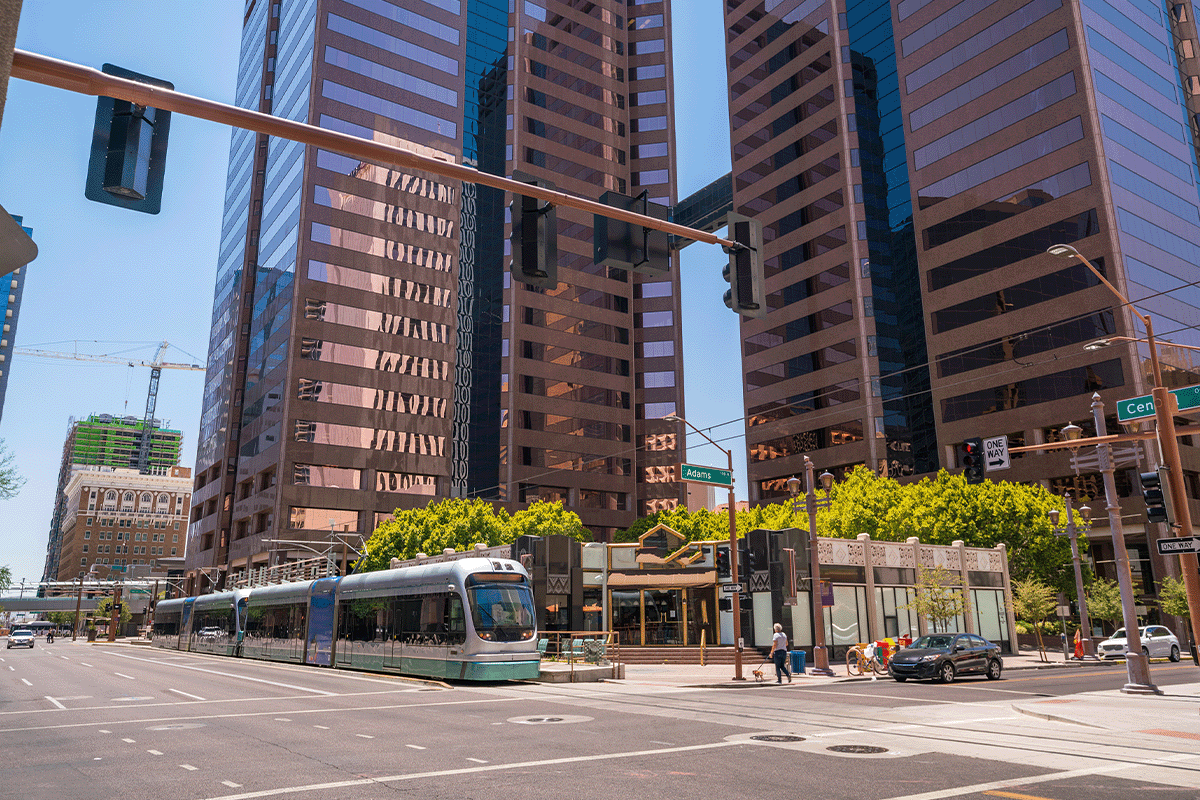
The city that rose like a phoenix is, fittingly, Phoenix.
Phoenix stood out in the data as an outlier. Among 394 tracked markets, it recorded the largest increase in its share of national apartment demand. The metro rose from about 2% of U.S. demand in 2017 to nearly 5% today; a gain of roughly 3 percentage points.
Developers in Phoenix delivered units through a migration wave, which meant supply mostly kept pace with the crowd. Compare that to Los Angeles, San Diego, or Seattle, where demand climbed against a much tighter pipeline while rents climbed.
What a Phoenix budget actually gets you
If Phoenix is on the list with some of the most expensive cities in the United States, many renters may be wondering: is it cheaper to rent in Phoenix than, say, New York? The answer is a resounding “yes.”
When comparing the cost of living in Phoenix vs. New York in 2026, it costs renters 125.3% more to live in the Big Apple. Here are some quick points of comparison:
Metric |
New York |
Phoenix |
Difference percentage |
|
Rent |
Average rent in New York, NY is $4,203/month |
Average rent in Phoenix, AZ is $1,307/month |
New York average rent is 222% higher than Phoenix’s. |
|
House cost |
$2,991,695 |
$596,676 |
New York average house cost is 401% higher than Phoenix’s. |
|
Healthcare spending |
$206/month |
$140/month |
The average cost of healthcare in New York is 47.5% higher than Phoenix’s. |
|
Transportation |
$431/month |
$403/month |
The average cost of transportation in New York is 8.5% higher than Phoenix’s. |
One of the biggest tradeoffs for Phoenix’s booming market is summer. Phoenix is the hottest city in the United States, and cooling costs take a toll. Although the average cost of utilities is still higher in New York City, utilities in Phoenix still run over 4% above the national average.
Meet the New Renter Hotspots Joining Phoenix’s Hot Streak

While Phoenix might be a headliner, there are other notable newcomers on this list.
-
Austin, Texas: Austin nearly doubled its share of national apartment demand, rising from 2.4% in 2017 to 4.5% today. Tech employers helped anchor the job market, and a large construction pipeline followed. The metro also offers a renter-friendly cautionary tale: so many new apartments were built that rents in parts of Austin have actually declined.
-
Charlotte, North Carolina: Charlotte increased its share of national apartment demand from 1.9% to 3.2%. Banking and finance remain major drivers, while Uptown’s rapid addition of residential towers has given the city a boomtown feel beyond its traditional image as a Southern banking hub.
-
Orlando, Florida: Orlando’s share of national apartment demand rose from 1.5% to 2.4%. Although the market is still often associated with tourism, it has quietly built a more diversified job base alongside a significant wave of new apartment development.
Florida played an outsized role out of all states. It claimed 11 of the 25 largest demand-share gains nationwide. Growth extended beyond Miami and Orlando, with smaller markets such as Sarasota also climbing as people and employers moved south.
The Reasons Why Renters Are Looking Toward Other Cities

Renters follow employers
Renters are moving to the Sun Belt for multiple reasons. However, employment may be a big one. Corporate relocations and expansions concentrated in low- or no-income-tax, business-friendly metros across Texas, the Carolinas, Arizona, and Florida. Renters simply followed the paychecks.
Coastal perks without coastal rent
Nowadays, renters skew toward lifestyle. But where is a dream lifestyle attainable? A salary that forces a renter to deal with a roommate and a long commute in the Bay Area can likely afford a one-bedroom apartment with in-unit laundry and a parking spot in a Sun Belt metro.
Demand brewed availability
Developers responded with a construction wave, and in many of these markets, the added supply attracted even more renters, creating a reinforcing cycle. But the pattern was not universal. Boston passed 300,000 apartment units and still lost share of national demand, showing that building alone is not enough; jobs and migration have to follow.
Find a Renter’s Market on Apartments.com
If you’re on the market for an apartment in a new city, Apartments.com has your back. With our tools, you can make the most of a renter’s market city:
-
Filter for recently built properties: Brand new constructions are eager to welcome new renters. On Apartments.com, you can filter for “New Construction” rentals.
-
Look for specials in the listing itself: Listings will often insert great deals, so read carefully! "One month free," "look and lease," and waived fees are some examples you can find in a listing. If you see several of these deals advertised in one neighborhood, that submarket could skew in your favor.
-
Check a few neighborhoods, not just the metro: New supply often clusters within specific areas, so the best deals are usually where construction has been most active.
FAQs
Why are more renters moving to Phoenix?
Phoenix recorded the largest increase in its share of national apartment demand among the 394 U.S. markets analyzed. Its share grew from about 2% in 2017 to nearly 5% in 2026.
Is Phoenix becoming a renter’s market?
Yes, Phoenix is becoming a renter’s market. Phoenix has added substantial apartment inventory alongside growing renter demand. More supply can create greater competition among properties, potentially giving apartment hunters more choices, slower rent growth, and access to move-in specials or other concessions.
Is it cheaper to rent in Phoenix than New York City?
Yes. Based on the 2026 figures in the article, average rent in Phoenix is $1,307 per month compared with $4,203 in New York City. That makes New York's average rent about 222% higher than Phoenix's.
How can I tell if an apartment market favors renters?
Look for high inventory, recently constructed communities, multiple properties advertising move-in specials, and flat or declining asking rents. Seeing several properties offering concessions in the same neighborhood can be a particularly useful sign of competition for renters.
What cities are emerging as alternatives to traditional expensive rental markets?
Phoenix, Austin, Charlotte, and Orlando are emerging alternatives to traditionally expensive markets. They have all increased their share of national apartment demand since 2017. Dallas–Fort Worth, Houston, Atlanta, and New York also remain among the country's major apartment markets.
When is the best time to negotiate an apartment move-in special?
You may have more negotiating power when a property has several vacant units, is newly opened, or is already advertising leasing incentives. Ask which specials are currently available and compare the total cost of the lease, not just the advertised monthly rent, before choosing a deal.


