

Housing affordability pressures are changing how homeowners approach selling their homes. In 2025, the average fixed mortgage rate reached a peak of 6.28 percent, almost doubling from the 3.15 percent rate the market saw during the pandemic. Conversely, the national average rent stayed relatively stable, fluctuating between $1,600 and $1,700 per month. With mortgage rates rising, rents staying consistent, and prospective homebuyers being priced out of the housing market, more homeowners are choosing to rent their homes rather than sell them.
Key Takeaways:
- Homeowners with pandemic era mortgages (3.15%) are staying put and renting out properties rather than selling at today’s 6.49% rate.
- Renter households jumped from 408,000 to 848,000 in 2023-2024, with the 35-44 age group (prime first-time homebuyers) one of the largest renter segments.
- 27% of Gen Z renters say they’re deliberately avoiding homeownership to skip becoming “house-poor,” not just priced out.
- Single-family rentals offer more space and privacy at a lower per-bedroom cost than apartments, with 31% of renters already living in this housing type.
- 33% of renters have considered buying a home, with many browsing listings or researching mortgages while renting single-family homes.
Why Homeowners Are Renting Instead of Selling Their Homes
Rising mortgage rates and borrowing costs are keeping homeowners locked into their properties while pricing out renters who want to become homeowners. While mortgage and interest rates are part of the reason why homeowners are turning away from selling, renter behavior plays a role. Because renters cannot afford to buy homes, they remain in the rental market, creating continued demand for rental housing.
Mortgage rates are keeping homeowners in place
As of July 2026, the 30-year fixed mortgage rate sits at around 6.49 percent, slightly above the 2025 average. If homeowners who bought during the pandemic in 2020-2021, when interest rates were historically low, sold their homes and reentered the market, they would likely pay hundreds more per month to finance a new home. Homeowners who sell today would be giving up a favorable mortgage rate for a significantly higher one.
Sellers have lost the upper hand
With the number of homebuyers decreasing because of increased rates, there are fewer buyers in the market, making renting out a home the more attractive option for some owners. As market conditions continue to shift, what does this mean for renters?
What This Means for Renters

Although rent prices remain elevated in many markets, renters may benefit from greater housing flexibility. Renting is not only more affordable than owning a home, but it also provides an easier way to budget and often comes with less responsibility and stress than homeownership. Although the housing market may feel out of reach, renters can make informed housing decisions with confidence.
Renting is more affordable than buying
According to Harvard University’s State of the Nation’s Housing 2025 report, the average monthly mortgage payment rose to $2,570 in 2024, a 40 percent increase from the 1990s. A potential homebuyer would have to make at least $126,700 per year to afford this payment. According to the American Community Survey, only 6 million of the nation’s 45 million renters meet this benchmark, making homeownership difficult for many households.
Although homeownership is still a goal for many, renters can benefit from lower monthly housing costs. The average rent in the United States as of July 2026 is $1,662 per month, much lower than the average monthly mortgage payment. Renting also makes it easier to budget month to month, as renters usually pay a flat rate each month with no fluctuation, while homeowners must budget for unexpected expenses like plumbing repairs, electrical work, or other maintenance costs.
Renters are renting longer
Renting is often the more affordable housing option, and many renters recognize that. The U.S. Census Bureau found in their Housing Vacancy Survey that the number of renter households jumped from 408,000 in 2023 to 848,000 in 2024. By the first quarter of 2025, renter households accounted for 46.1 million households in the United States.
As homeownership becomes more expensive, many renters are staying in rentals longer. Particularly, renters who are on the cusp of homeownership are feeling affordability pressures the most. Harvard University’s housing report found that in 2023, people between the ages of 35 and 44 were the fastest-growing renter segment, a 2.6 percent increase from the previous year. This suggests that many people in their prime first-time homebuying years are delaying homeownership because of rising housing costs.
A recent Apartments.com survey found that younger renters are also intentionally delaying homeownership. Among Gen Z renters ages 18 to 29, 27 percent said they are choosing to remain renters because they want to avoid becoming “house-poor.” While other renters are postponing homeownership because affordability has put it out of reach, younger renters are making a deliberate financial choice to continue renting while maintaining greater financial flexibility.
Rising costs are adding to the pressure
Mortgage and interest rates are not the only increasing homeownership costs. Harvard University found that property taxes increased by 12 percent between 2021 and 2023. In addition, the U.S. homeownership rate declined by 0.3 percentage points in 2024 and continued to decline in 2025. Mortgage rates, interest rates, property taxes, and down payments continue to rise, making it difficult for renters to become homeowners and leaving many households waiting for favorable market conditions.
Single-Family Rentals: The Middle Ground Between Renting and Owning

While becoming a homeowner may not be realistic for many renters in the current housing market, single-family rentals offer a mix of both lifestyles. Single-family rentals are standalone residential homes built on their own lots. Because they offer more privacy than multifamily housing, renters who hope to own a home someday can enjoy many of the same lifestyle benefits while continuing to rent.
More space at a lower cost
In the United States, the average size of a single-family home is about 2,200 square feet, compared to the average apartment size of only 846 square feet. The extra space is also more affordable per square foot. Harvard University found that single-family rentals often provide more space for the price. On a per bedroom basis, they tend to cost less than comparable multifamily units. While renters may pay more for utilities and other household expenses, many find the added space and privacy worth the additional costs.
Renters are already turning to this housing type. As of 2023, 14.2 million renters lived in single-family homes, accounting for 31 percent of renter-occupied households. Whether renters are choosing this option because of affordability or as a step toward homeownership, single-family rentals continue to grow in popularity.
Stepping stone toward homeownership
According to an Apartments.com Q2 2026 survey, 33 percent of renters have considered buying a home. Of those renters, 63 percent have browsed home listings, and 24 percent have researched mortgage options. This suggests that many renters want to become homeowners but are financially unable.
Because single-family homes are built on individual lots, renters enjoy a yard, driveway, and more privacy- a different experience from living in a multifamily community. Single-family rentals can serve as a transition between apartment living and homeownership while giving renters additional time to save for a future home purchase.
What to weigh before you sign a lease
Although renting a single-family home may seem like a perfect fit with its large floor plan and privacy, it’s important to weigh the cons before you sign a lease. Renters who have only lived in multifamily communities may find the transition to a single-family rental difficult. You no longer have 24-hour maintenance and office staff to voice concerns. Instead, you’ll typically work directly with a private landlord.
Lifestyle is also an important factor to consider. Many single-family homes and neighborhoods are built farther from major metros and city centers, making them less walkable than many multifamily units. Apartment communities often include amenities, like a pool, fitness center, or screening room, that most single-family homes do not.
No matter what housing decision you make, it’s important to weigh the pros and cons of your choice. If more space and privacy is what you want, a single-family rental may be right up your alley. But if you enjoy the convenience of apartment living, staying in a multifamily unit may be the more practical choice.
Where Homes for Rent Are Showing Up Most
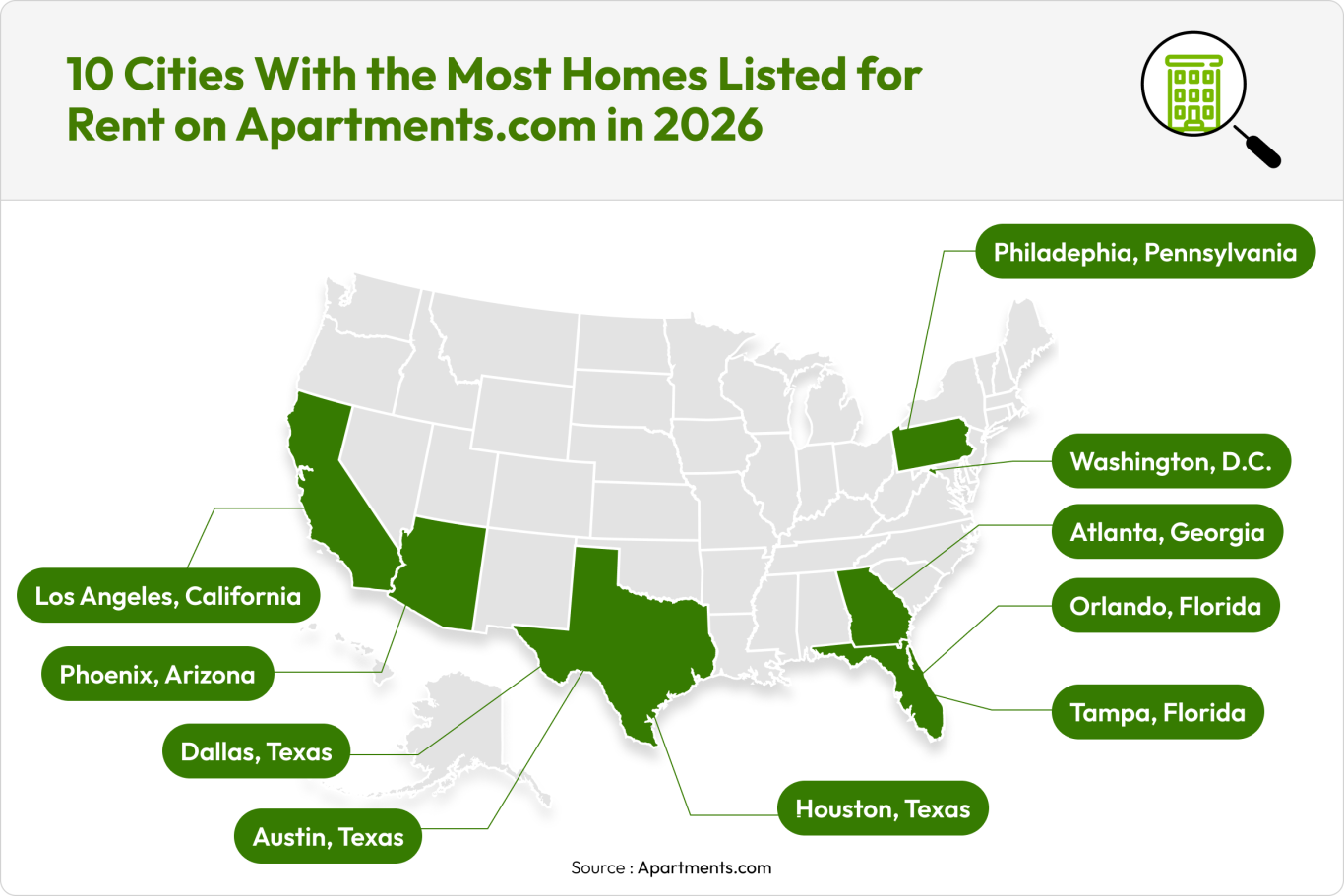
Single-family rentals are already popular in many areas. Harvard University found that the largest concentration of single-family rental homes was in rural (45%), suburban (25%), and metro (25%) areas, but where are renters finding the most homes for rent? Based on Apartments.com data, these cities had the highest number of homes and townhomes listed for rent in the first half of 2026.
|
City |
Number of Homes Listed for Rent in 2026 |
|
12,701 |
|
|
11,329 |
|
|
10,866 |
|
|
8,196 |
|
|
7,377 |
|
|
5,892 |
|
|
5,163 |
|
|
5,045 |
|
|
4,914 |
|
|
4,547 |
Source: Apartments.com
These cities had the most homes for rent on Apartments.com in 2026. Almost all these cities have average rents below the national average, except for Los Angeles, Washington D.C., and Philadelphia. This suggests that while affordability remains a main concern, many renters are willing to make tradeoffs to live where they want.
The cities with the most searches for homes on Apartments.com closely mirror the cities with the most listings. These 10 cities saw the most searches for homes for rent on Apartments.com in the first half of 2026:
- Houston, Texas
- Chicago, Illinois
- Los Angeles, California
- Atlanta, Georgia
- Dallas, Texas
- Orlando, Florida
- Charlotte, North Carolina
- Austin, Texas
- Philadelphia, Pennsylvania
- San Diego, California
While many of the most-searched cities also have the most homes for rent, markets like Chicago, Charlotte, and San Diego stand out. Strong renter demand in these cities may reflect competitive markets, limited supply, or continued affordability pressures for homebuyers. As home prices and mortgage rates remain elevated, renting a home may continue to be a practical alternative for households at every stage of life.
Find Homes for Rent on Apartments.com
If you’re a renter looking to become a homeowner but aren’t ready financially, Apartments.com can help you explore rental homes that fit your lifestyle. On Apartments.com, you can filter search results by housing type, including rental houses.
For example, search for the city you want to browse, such as Atlanta, then select the “Home Type” button and choose “Houses” to view available rental homes.
Apartments.com is with you through every step of the renting process. Start your search today!
FAQs
Why are homeowners renting their homes instead of selling?
Many homeowners are renting instead of selling because they do not want to give up the low mortgage rates they secured in previous years. Higher borrowing costs and fewer qualified buyers can also make renting out a property more attractive than listing it for sale.
Is renting more affordable than buying a home?
For many households, renting has lower upfront and monthly costs than buying. Homebuyers must account for down payment costs, mortgage and interest rates, property taxes, insurance, and maintenance repairs, while renters have more predictable monthly expenses.
Why are renters waiting to buy homes?
Many renters are delaying homeownership because mortgage rates, home prices, and property taxes have increased. Even renters who are interested in buying may need additional time to save money or wait for more favorable market conditions.
Where are single-family rental homes most common/affordable?
Based on Apartments.com data, the cities with the most homes for rent on Apartments.com are Houston, Dallas, Atlanta, Tampa, Phoenix, Los Angeles, Austin, Orlando, Washington D.C., and Philadelphia. Of these, the cities with the lowest average monthly rents are Houston ($1,181/month), Phoenix ($1,305/month), Dallas ($1,411/month), and Austin ($1,420/month).


