
Gen Z adults are entering the rental market at one of the hardest moments in recent memory. Housing costs have climbed steadily in the cities where young adults most want to live, and competition for units shows no sign of letting up.
New survey data from Apartments.com shows that 24% of Gen Zers ages 18–29 aren't confident they'll be able to afford their current living situation by January 2027, the highest percentage of any generation.
Our data digs into what's driving Gen Zers' anxiety, how young renters who are living independently are coping with housing costs, and where they may find affordable housing in the future.
Key Takeaways
- More than half of Gen Z renters (54%) spend 40% or more of their take-home income on rent.
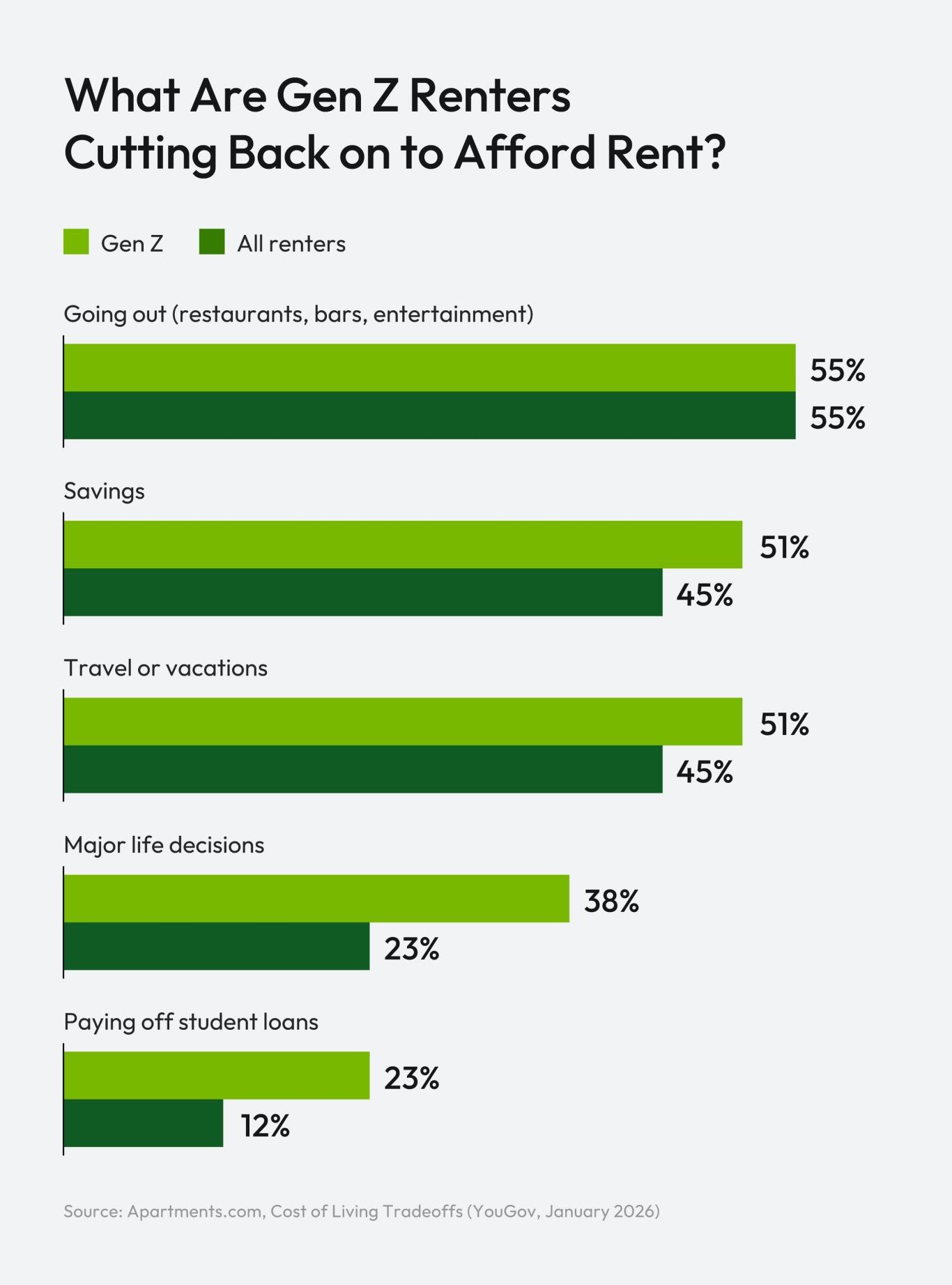
- 38% of Gen Z renters have delayed or reduced spending on major life decisions because of housing costs, nearly double the rate of all renters (23%).
- 80% of Gen Z adults say they would move to a walkable, transit-connected city neighborhood if it were priced comparably to the suburbs, but only 42% say they can currently afford to live where they actually want to be.
- 58% of Gen Z adults cite job opportunities as a key factor in where they choose to live, significantly more than the overall rate of 34%.
Gen Z Adults Are Less Confident About the Year Ahead Than Millennials
Gen Z adults report the lowest financial confidence of any generation heading into the next several months, with 24% saying they're not confident they can afford their living expenses. That compares to 20% of Gen X adults, 20% of Baby Boomers, and just 15% of Millennials.
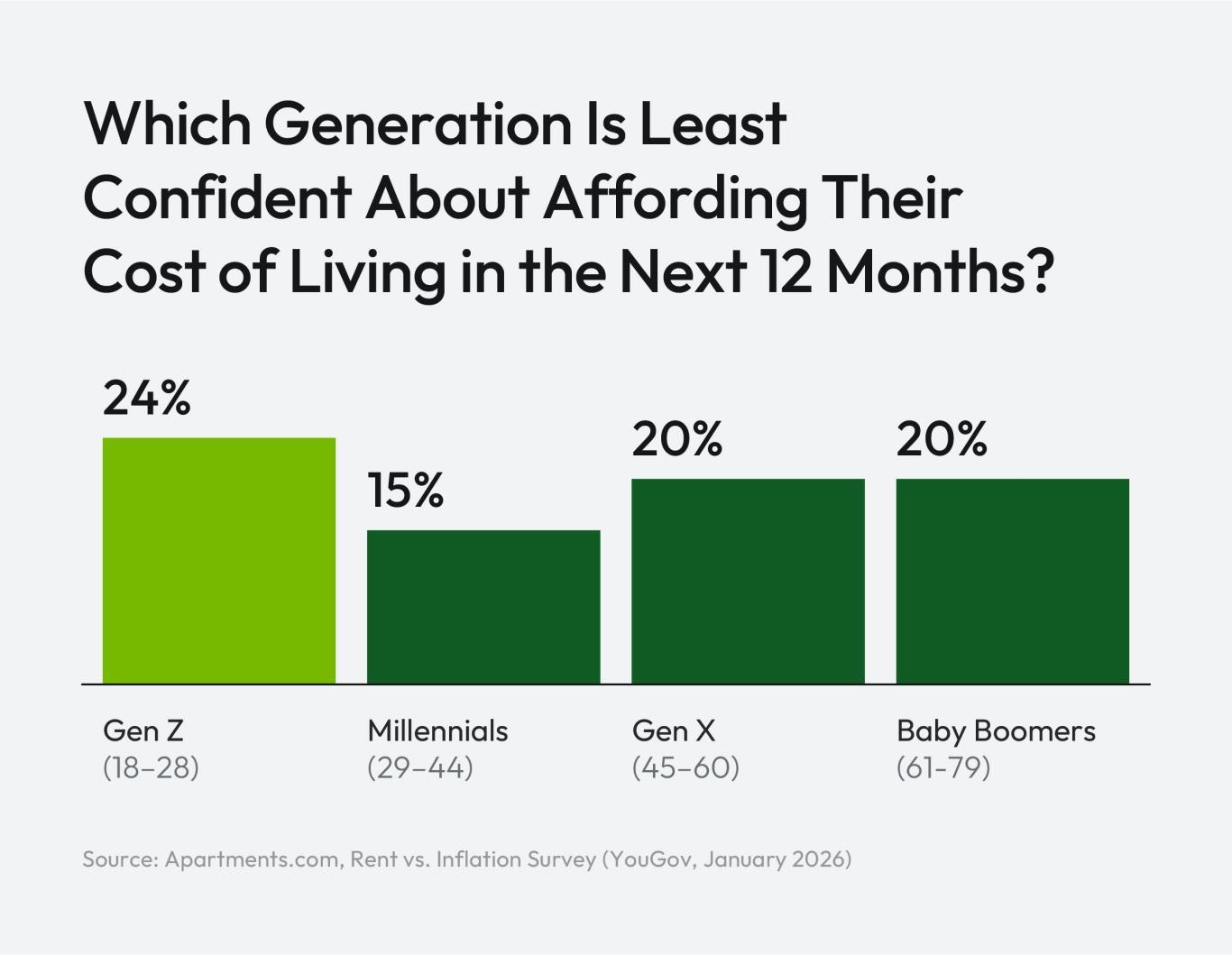
It's surprising that so many Millennials feel confident, considering they're more likely to be managing mortgages, student debt, and dependent children, compared to Gen Zers. Yet they're more confident about the year ahead than Gen Z adults are. The cost of starting an independent adult life seems to be a heavier burden than the cost of sustaining it.
That tracks when you consider that nearly half of Gen Z adults (46%) still live with parents, family, or friends without paying rent, which is more than 2.5 times the rate of all adults (17%). For many, that's not a carefree arrangement. It's a financial calculation, and the costs they're deferring by staying home are the same ones driving their anxiety about the future.
For Gen Z Renters, Housing Costs Are Delaying Life Milestones
At a time when rent statistics show monthly costs are climbing, 54% of Gen Z renters spend 40% or more of their monthly take-home income on housing, higher than the U.S. average of 47%. More than 1 in 5 (22%) are spending 60% or more. Renters are advised to only spend 30% of their monthly gross income on rent, or risk struggling to afford their other expenses like utilities and food.
To afford housing costs like rent, more Gen Zers are cutting back on savings (51% vs. 45% of all renters), travel (51% vs. 45%), and other major life decisions (38% vs. 23%). Those major decisions often include important benchmarks like starting a family, going back to school, or relocating for a career. But each of those requires a financial cushion, which is difficult to build when half your income goes to rent.
More than 1 in 3 (35%) say they'd accept delaying major life goals as a housing affordability trade-off, compared to 21% of all adults. Whether by choice or by circumstance, the generation increasingly likely to rent forever is often normalizing deferred milestones that their parents most likely took for granted.
Housing costs are also reshaping how Gen Z approaches relationships. According to another recent Apartments.com survey, Gen Zers are more likely than the general population to worry about tension building in a relationship after moving in together. 46% of the young adult couples surveyed are already cohabitating to save money, which risks relationship stress on top of financial stress.
Most Gen Z Adults Know Where They Want to Live. Affordability Is the Only Thing Standing in the Way
Only 23% of Gen Z adults currently live downtown, or in a city center, yet 80% say they'd move to a walkable, transit-connected city neighborhood if rents were priced like the suburbs. The demand for urban living is already there. Price is simply what's keeping it from materializing.
Nearly 6 in 10 (58%) of Gen Zers say they consider local job opportunities and wages when weighing where they want to live, the highest rate of any generation and far higher than the overall rate of 34%. Finding the right apartment means landing somewhere close enough to work to make the commute manageable, but affordable enough to actually make the numbers work.
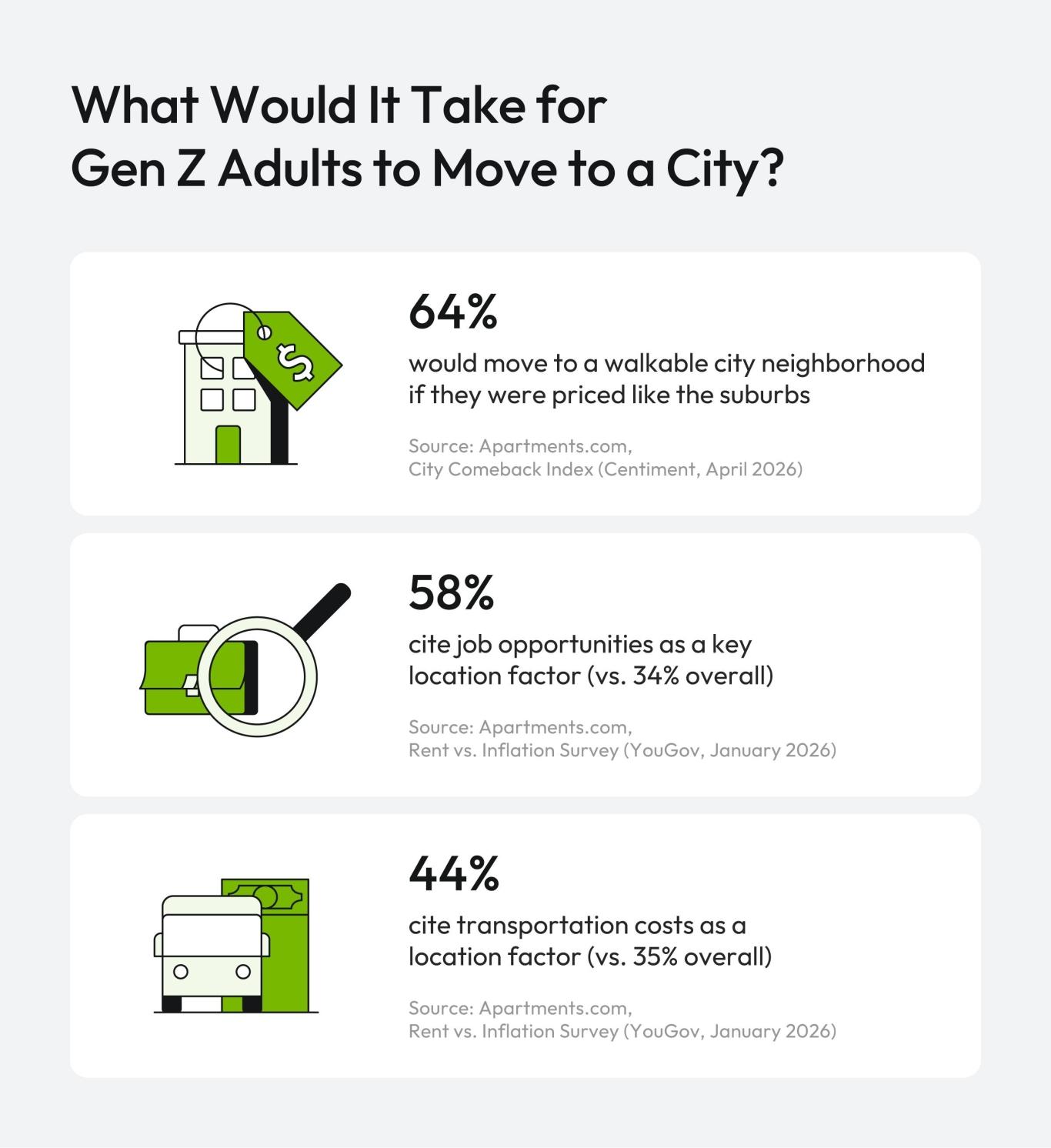
Transportation costs matter, too. More than 2 in 5 (44%) Gen Z renters say transportation costs are a factor in where they live, compared to 35% overall. When renting near job centers isn't an option, the commute is a major expense. Young renters who don't live near job centers, will need to search carefully for an apartment with the cheapest rent within a reasonable distance from work.
What Comes Next for Gen Z Renters
Many Gen Zers are struggling financially, but they're still early in their careers. As they age, data shows many young adults may prioritize affordable urban housing, even though supply is limited in many major metros.
Overall, Gen Zers consistently say they prioritize urban and walkable rentals that are close to work and good transit options. The only question is whether the rental market will meet that demand, or if Gen Zers will remain at home until they find an affordable housing option that fits their lifestyle.
Ready to find a rental that works for your budget and your commute? Search apartments near you on Apartments.com.
Methodology
For this report, Gen Z is defined as adults ages 18–29. Respondents under the age of 18 were not included in any of the surveys cited.
The Roommate Affordability, Renter Cost of Living Tradeoffs, and Rent vs. Inflation surveys were all conducted by YouGov on behalf of Apartments.com. All three surveys were fielded between January 19–22, 2026. Sample sizes were 1,155 (Roommate Affordability), 3,635 (Renter Cost of Living Tradeoffs), and 1,248 (Rent vs. Inflation). Results are weighted and representative of U.S. adults ages 18 and older.
The City Comeback Index survey was conducted by Centiment on behalf of Apartments.com. The survey was fielded in late 2025 and is based on 1,045 completed responses from U.S. adults who indicated they were looking to buy a home within the next one to three years. The Centiment data is unweighted.


