

Families who rent have a unique set of needs as they balance school quality, affordability, and space. With more people in the household, they typically need bigger rentals, but the rent for larger units often outpaces what most households can realistically pay. While parents want to focus on school quality, today’s rental market often makes that priority hard to act on.
This gap between rents and budgets has made the phrase “family-friendly” take on a different meaning; one that focuses more on affordability and cost-of-living thresholds than on quality of life and access to good schools.
Using proprietary rent data, a national renter survey, and third-party school-quality metrics, this analysis identifies where families get the most educational value per dollar spent on rent — and where affordability changes access.
Key Takeaways
- 59% of renters say they would not pay any additional rent for better schools, even though most parents say school quality is important — revealing an affordability ceiling rather than a lack of concern.
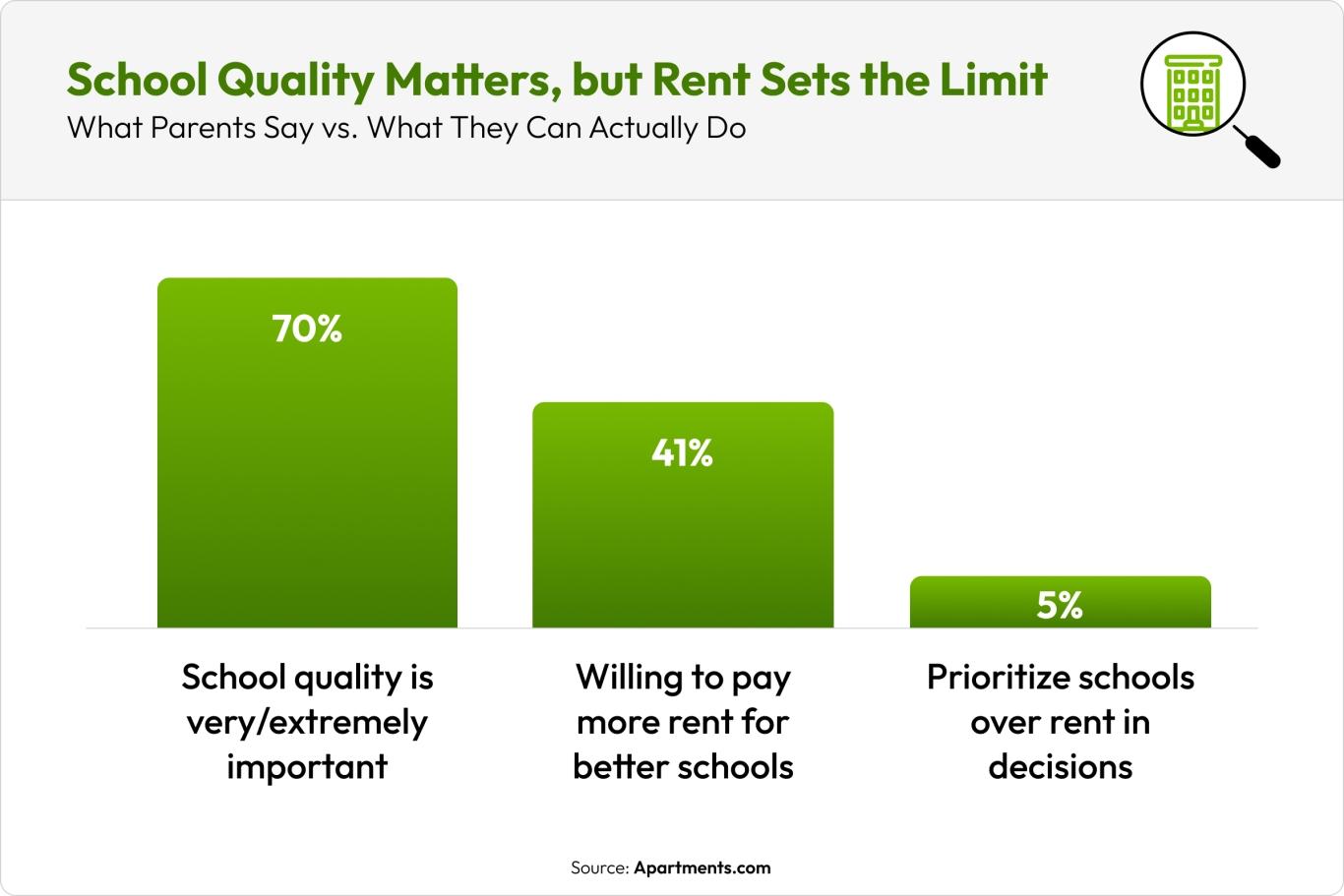
- 70% of renters with school-aged children rate school quality as very or extremely important, but only 5% rank it as their top deciding factor, showing how budgets override these priorities.
- The most affordable cities for larger-sized rentals consistently rank below average on school quality, forcing families to choose between low rent and educational outcomes.
- Two-thirds of renters can’t afford the median rent for multiple-bedroom apartments under standard affordability guidelines, reporting household incomes under $40,000.
Most Renters Can’t Afford School Quality — Even When They Prioritize It
School quality consistently ranks among parents’ top factors when choosing where to live. In our survey, 70% of renters with school-aged children rate school quality as “very” or “extremely” important. Yet, rent affordability dictates this decision rather than the quality of the school.
Only 5% say school quality was the single most important factor in their last rental decision, compared with 41% who chose rent affordability. Fifty-nine percent of renters say they would not pay more in rent for better schools under any circumstances. This suggests a shift from school quality being a basic expectation to a conditional luxury for renting families.
Many parents want to choose housing based on school quality, but high rents force them to make a decision based on affordability instead. In our survey, 66% of respondents earned under $40,000 a year. At this income level, average two-bedroom rents exceeded the 30% income affordability guideline.
The national average rent for a two-bedroom apartment is $1,882/month, while a three-bedroom apartment is $2,362/month. An annual salary of $39,000 broken down into monthly income is about $3,250/month. Using the Rent Calculator, that means a rent budget of $975/month. With this amount well below the national average for a two-bedroom apartment, average rents price many families out of the space they need before school quality even comes into play.
Affordable Cities and the Quality of Schools
Families often end up setting down roots based on rental prices of multiple-bedroom apartments instead of school ratings. Niche.com says the five cities with the best public schools are Naperville, IL; Carlsbad, CA; Bellevue, WA; The Woodlands, TX; and Irvine, CA. But when we look at rents in these high-quality, high-cost markets, the tradeoff is clear: It often costs significantly more to rent the multi-bedroom space families need in the cities with the best public schools.
|
City |
Public Schools Niche Grade |
Average Two-Bedroom Rent |
Average Three-Bedroom Rent |
|
A+ |
$2,686/month |
||
|
A+ |
$3,810/month |
||
|
A+ |
$4,062/month |
||
|
A+ |
$2,972/month |
||
|
A+ |
$4,330/month |
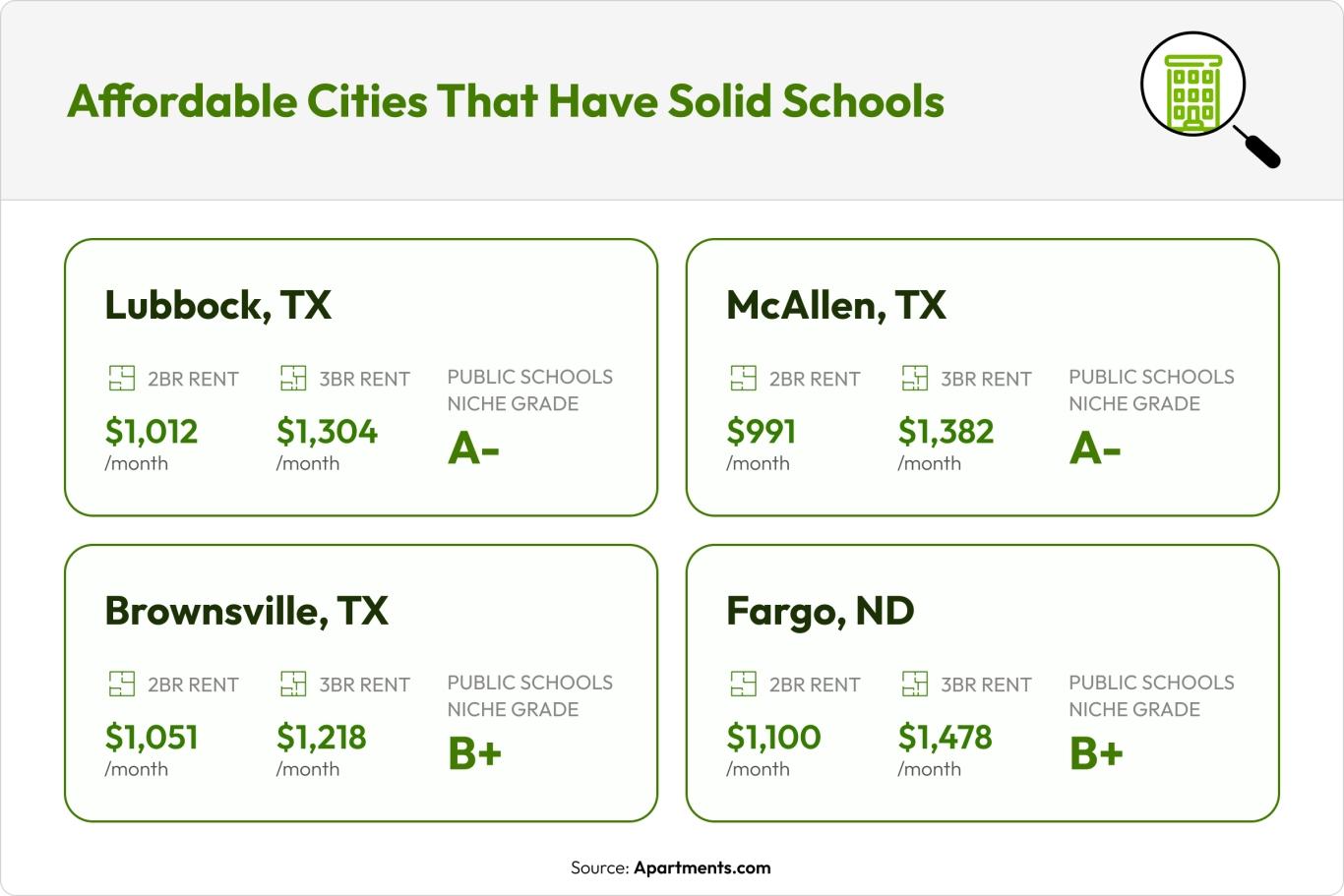
So, families look towards cities that are more affordable but still have solid public schools. Since most respondents earn under $40,000, we used that as a benchmark to identify cities on Niche.com’s list where the average two-bedroom apartment rents come closer to the 30% rent guideline while still offering stronger-than-average school ratings.
|
City |
Public Schools Niche Grade |
Average Two-Bedroom Rent |
Average Three-Bedroom Rent |
|
A- |
$1,304/month |
||
|
A- |
$1,382/month |
||
|
B+ |
$1,218/month |
||
|
B+ |
$1,478/month |
||
|
B+ |
$1,484/month |
These cities illustrate where renters with more limited budgets can still find relatively strong public schools without facing the steep rent premiums common in many high-performing school districts.
For those with the budget to afford the national average two-bedroom rent or higher, the list of options is broad. For households closer to what most survey respondents earn, these cities show where stronger-than-average schools and relatively manageable rents can still overlap.
Families Will Sacrifice Lifestyle — But Not Their Budget
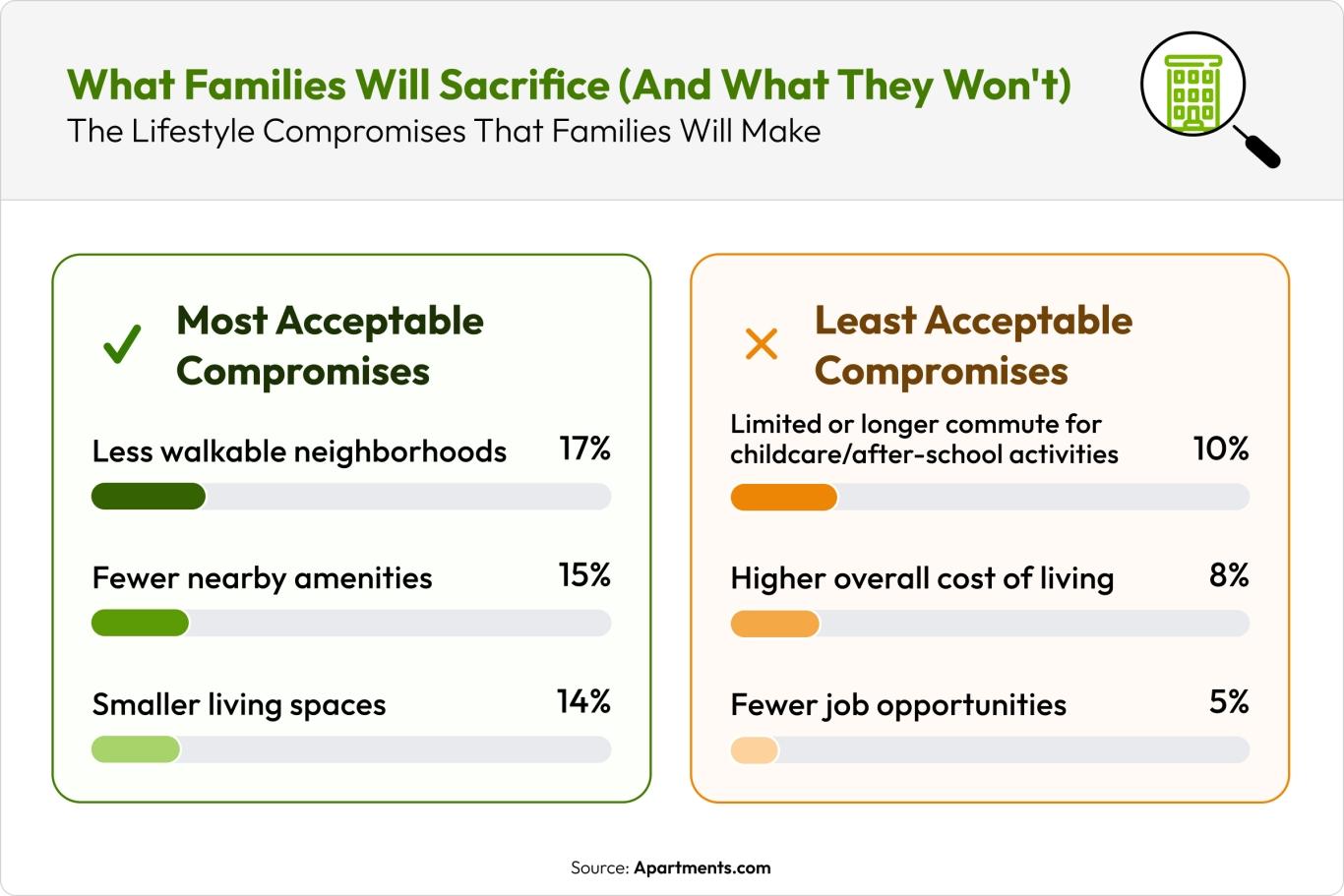
Families are not willing to budge on their budget, but they are willing to adjust their lifestyle. Eighty percent of parents are willing to give up a housing priority, like commute or apartment size, to live in a rental in a preferred school district.
Though families are willing to compromise, financial stability defines the line between acceptable and unacceptable, and the specific concession determines whether they will make the trade-off. Parents are least willing to compromise on the cost of living and job opportunities. They’re most receptive to giving up quality-of-life factors, like walkable neighborhoods and nearby amenities and entertainment.
Higher-Ranked Schools Come at a Price Many Renting Families Can’t Afford
Homeownership is getting increasingly expensive, especially in cities with highly-rated schools. Four of Niche.com’s top five cities for public schools have a median list price of over $500,000, according to a Homes.com analysis of Naperville, IL; Carlsbad, CA; Bellevue, WA; The Woodlands, TX; and Irvine, CA.
Additionally, the Federal Reserve Bank of St. Louis identified three of those cities with top listing prices above $1 million, more than double the national median listing price of $399,000.
Instead of a short stop on the way to homeownership, renting has become a long-term strategy to stay near better schools. 12% of renters report renting because they cannot afford to buy a home in areas with good schools. That share climbs to 17.5% for single-parent households and 15.8% among two-adult households with children.
That means families need significantly higher income, a larger down payment, or both to “buy into” a higher-ranked school area. To lower the financial barrier, the most realistic path to good schools is long-term renting.
Why This Matters for Families and Renters Searching Today
Today, family-friendly rental markets are defined by the intersection of quality schools and housing budgets, not just one or the other. Families have to make high-stakes decisions that shape educational access, long-term financial stability, and where they’ll set down roots. Understanding these factors helps renters make confident decisions and simplifies moving as a family.
Apartments.com makes it easier to compare the factors that matter most to families. Start by entering your budget to narrow your search to affordable rentals, then explore your options with the context you need to choose confidently.
Each property shows school and neighborhood details side by side. You’ll see nearby schools, including public and private options, with ratings and key details, plus distance to local colleges and universities. Neighborhood information, like walkability and nearby points of interest, helps you get a feel for the area before you decide.
With affordability, school quality, and neighborhood context all in one place, Apartments.com simplifies finding a rental that fits your family.
Methodology
The survey was conducted by Centiment for Apartments.com. The survey was fielded between January 13, 2026, and January 18, 2026. The results are based on 1,005 completed surveys. In order to qualify, respondents were screened to be residents of the United States, over 18 years of age, and rent a home. Data is unweighted, and the margin of error is approximately +/- 3% for the overall sample with a 95% confidence level.
Survey findings were analyzed alongside Apartments.com’s proprietary rental pricing data for two- and three-bedroom units in the 50 largest U.S. metro areas and third-party school quality metrics from Niche.com and GreatSchools.
FAQs
What makes a city “family-friendly” for renters?
A family-friendly city for renters is one where families can afford multi-bedroom rentals and still access decent school options. In today’s market, “family-friendly” often ends up meaning “financially realistic” more than “quality schools.”
Can a household income under $40,000 afford a typical two-bedroom apartment?
Typically no. An income of $39,000/year is about $3,250/month, and using the 30% guideline, results in a rent budget of around $975/month. That is far below the national average two-bedroom rent of $1,882/month.


