

It’s been a little more than one year since one of the biggest changes in New York’s rental landscape landed: the FARE Act. The act took effect on June 11, 2025, and aimed to reshape fees, in particular broker fees, which are one of the major challenges and costs that renters face in New York. Renters used to have to foot the bill for a broker, regardless of who hired them, and it would cost them about 12 to 15 percent of their annual rent.
The FARE Act flipped this payment arrangement and also sought to increase fee transparency. A year might sound like a long time, but for a law transforming a longstanding rental market, it is no time at all. Though the long-term effects of the act are still taking shape, some early shifts are already noticeable. We surveyed renters and spoke with experts to find out what's actually changed and what renters have felt.
Key Takeaways
- Both renters and industry experts see the FARE Act as a meaningful step toward fairness and transparency in the New York rental market.
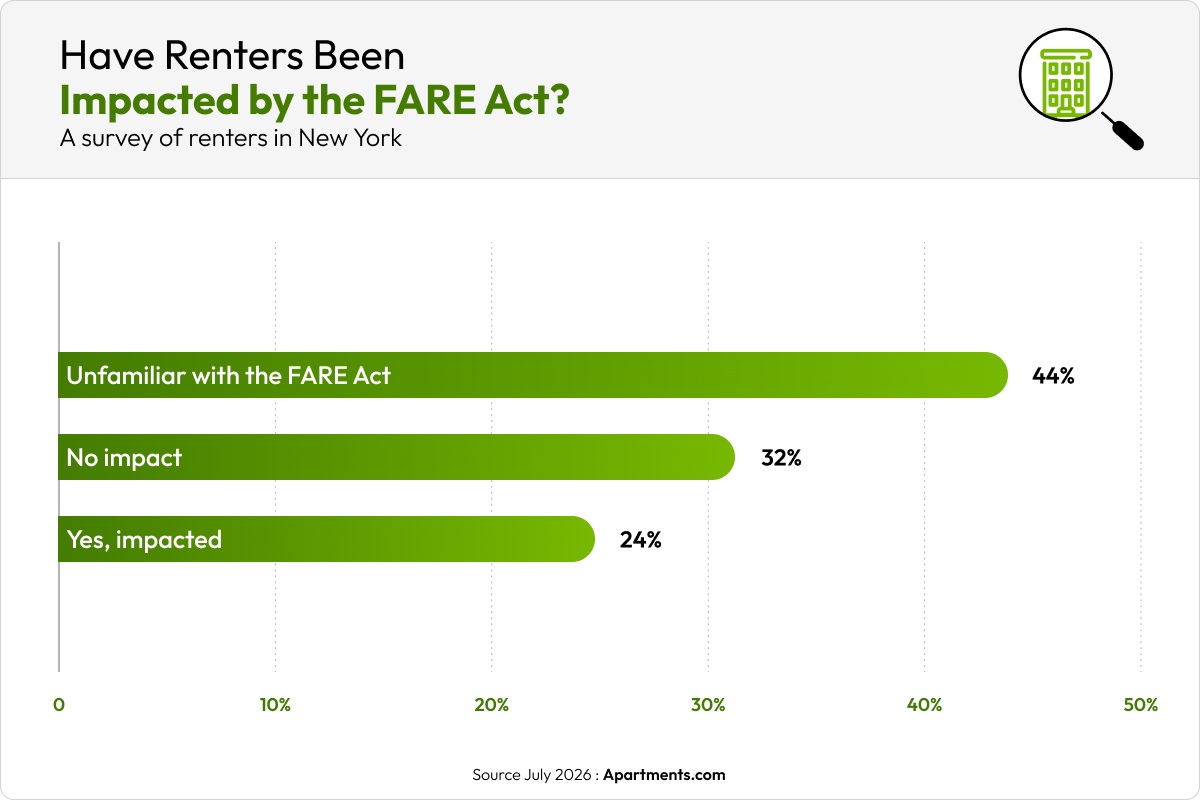
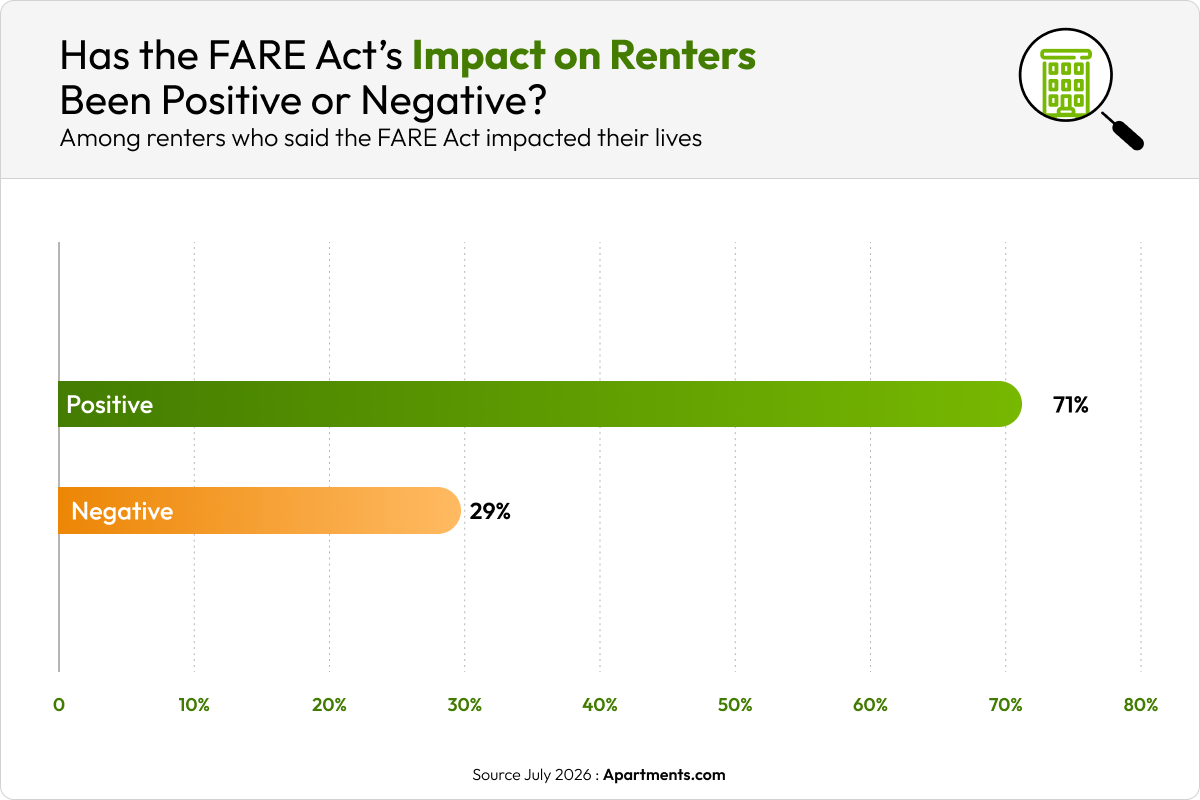
- A year in, 44 percent of renters still aren't familiar with the law. Of those who do know it and have been impacted, 71 percent report a positive effect.
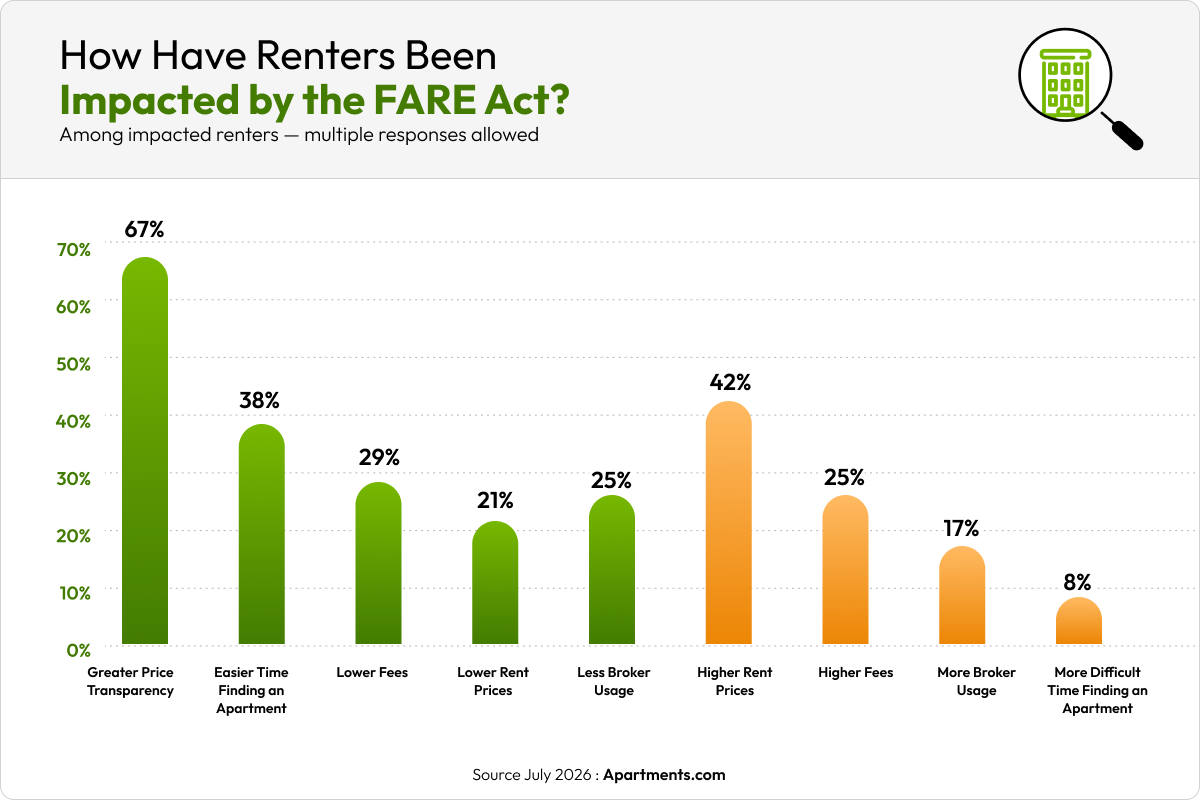
- Transparency is the most agreed-upon change as 67 percent of renters say the FARE Act made costs clearer upfront, a shift experts attribute to the law forcing fees to be disclosed before a renter even applies.
- Fees may have shifted, rather than disappearing, as 29 percent of renters reported lower fees, while a nearly equal 25 percent reported higher fees. Experts note landlords are responding in different ways, from absorbing the cost to factoring it into another expense or rethinking leasing strategy altogether.
What Renters Don’t Have to Deal with Anymore, Thanks to the FARE Act
The Fairness in Apartment Rental Expenses (FARE) Act significantly altered the rental landscape of New York by changing how broker fees worked and impacting fee transparency. The central change is that whoever hires the broker has to pay the broker. This means that if a landlord hires a broker, they have to pay the broker instead of the renter, as was standard practice for decades.
The law also strengthened disclosure requirements. Landlords and their brokers now have to tell renters about all required fees upfront. That’s a big win for renters since they’ll know exactly what an apartment will cost them from the start, meaning no hidden charges waiting.
A Quiet Start with Real Results
Despite being one of the biggest shifts in New York’s rental market in years, the FARE Act hasn’t been front and center for all renters. According to an Apartments.com survey conducted in July 2026, 44 percent of renters said they were unfamiliar with the law, and among those who did know it, 57 percent said it hasn’t impacted their lives.
That gap doesn’t mean indifference, but rather renters are still figuring out how it affects them.
Steve Longobardi, the Regional Director of Multifamily in New York for CoStar Group, says, “Even though the FARE Act has been in effect for about a year, I still think many renters are learning what it actually means and how it applies to their search.”
Even while navigating this new law, renters and the FARE Act haven’t been sitting idle. In February, the DCWP reported they had received more than 1,400 complaints about illegal broker fees and filed 50 summonses for violations since the FARE Act was enacted. For the renters who do know their rights under the law, they're clearly putting them to use, and the city is acting on those complaints.
Among those who know, the reviews are good
The story takes an even more positive turn once you isolate the 24 percent of renters who are actually aware of the law and have been impacted by it. Of that group, 71 percent said that the FARE Act has had a positive effect on them, a strong sign that the law has helped renters overcome one of the biggest barriers in the New York rental market.
What Renters Actually Felt
When the FARE Act was first announced, there was speculation around what would happen once it took effect. The law drew both support and opposition from all sides. New York City Councilmembers championed it while real estate groups fought it in court.
A year later, we asked renters directly what they'd actually experienced. The results show that what renters felt varied; some renters saw the law work while others experienced its trade-offs. Here's how renters said the FARE Act has impacted them:
The One Thing Almost Everyone Agrees Changed: Transparency
If there’s a consensus on the biggest effect of the FARE Act, it’s transparency. Sixty-seven percent of renters said the law made costs clear upfront. One renter said, “I saved money on broker fees when I recently rented an apartment. The upfront disclosure of fees also made it easier to compare total costs between listings.”
Experts agree. Longobardi said the act has pushed transparency to the front of the conversation as renters want to understand fees, upfront costs, availability, and overall value before they inquire. Having worked in the New York rental market for over 15 years, he watched the renter mindset shift firsthand as the FARE Act went into effect. “That’s the mindset renters are bringing to the apartment search now,” he says, “They want to understand what they’re paying for, what’s included, what’s due upfront, and whether the apartment is worth the commitment.”
Victor Rodriguez, Senior Director of Market Analytics for CoStar Group in New York, expands the picture by saying how transparency is real, but it doesn’t affect every renter the same way.
Rodriguez explains, “The clearest change a year in is what you see at the top of a listing. Broker fees are no longer mentioned as an upfront cost for the renter. Whether that cost has truly disappeared, or simply been folded into the monthly rent, is a separate question, and one the listing alone won't answer."
The Upfront Savings Renters Actually Felt
While the FARE Act was theorized to help renters with costs, there was no telling if it would. After a year of the law being in effect, some renters are saying that they’ve seen clear savings and benefits. One renter reported that they saved a significant amount of money when renting because the FARE Act lowered upfront moving costs by prohibiting a broker fee.
The law doesn’t just help renters save; it also gives them more options.
Another renter said, “The FARE Act has prevented my landlord from charging me a fee, and I instead used that money to find a good broker of my own.” Renters have a greater ability to decide for themselves if, and how, a broker fits into their search, as well as being able to choose one.
Fees Shifted, Not Eliminated

A major concern with the FARE Act was that instead of actually decreasing fees, those costs would just be moved to another part of rental expenses. Yet looking at the results a year later, there’s no clear-cut answer.
According to our survey, 29 percent of respondents said that the FARE Act lowered fees. However, an almost equal 25 percent said it caused higher fees. This suggests that renters are experiencing it differently across the city. Though the broker fee may be eliminated, rent could have increased, or additional fees added, to cover this. Longobardi has also observed these fluctuating effects, “…Some landlords are absorbing the cost. Some may be factoring it into their broader pricing strategy. Others are rethinking their entire leasing approach.”
Rodriguez explains why this may happen, “The marketing, showings, and tenant screening still have to get done, and small landlords in particular rely on brokers to do them. That work usually shows up as a higher asking rent, sometimes as a new fee.”
Even when renters know they don’t have to pay a broker fee, it is still tough for them. According to Rodriguez, the harder issue is leverage. Renters know that the cost is being rolled into other apartment costs (such as the rent), but there is little they can do about it because the New York market is tight and renters are competing for limited apartments.
An Unverifiable Effect: Higher Rent
Rent prices are affected by a variety of factors, and directly tying increases to the FARE Act is difficult. Still, 42 percent of renters cited higher rent as an effect they associate with the law. Whether that's correlation or causation is hard to say.
Experts are also skeptical of the link. Rodriguez says, “The FARE Act has increased transparency around broker fees, but it hasn’t fundamentally altered expenses for the overwhelming majority of renters. Renters will pay to secure housing in a low-supply [and] high-demand market.”
Longobardi echoes that sentiment, “Rent growth is still largely driven by limited supply and strong demand. So, renters may save during the move-in process, but monthly rents are still going to reflect overall market pressure.”
The FARE Act: A Step in the Right Direction, but Limited

A year in, there is no one way to sum up the FARE Act. Renters have experienced all sorts of effects, and many other factors are influencing New York’s rental market at the same time. Still, both renters and experts have largely come to the same, positive consensus, even if its concrete results aren’t always clearly visible.
Rodriguez captures that viewpoint by saying, “There are real cases where the broker fee has been eliminated outright, and for those renters the FARE Act has worked exactly as intended. The problem is that group is small. For most renters, the cost is still in the deal somewhere. The law is well-intentioned, but I think most New Yorkers would call it more symbolic.”
Longobardi shares the same cautious optimism, “Generally, I think renters see it as a step in the right direction. It doesn’t make renting in New York cheap, but it does make the process feel a little more fair — especially for renters who were used to seeing large upfront costs attached to an apartment.”
The FARE Act may not have had a prominent impact on everyone, but its effects are definitely visible. From eliminating brokers fees to ensuring all costs are known from the start, renters have seen a wealth of changes. In a market as competitive as New York, a little more clarity and fairness with the FARE Act is a large step in the right direction.
See the Real Cost Before You Tour on Apartments.com
The FARE Act confronted broker fees and increased transparency, but that doesn’t mean that all fees have disappeared. Even though landlords and brokers are required to disclose all fees upfront, they only need to be listed, making the full price difficult to pinpoint. That's where Apartments.com’s focus on price transparency comes in handy.
Listings with a "Total Monthly Price" badge show the actual price you'll pay, combining rent and required fees into one number, so you're not left doing mental math to figure out your real monthly cost. And the Cost Calculator goes a step further, adding base rent, required fees, and optional add-ons to estimate your one-time and monthly costs for a specific unit. In a market where fees shift more than they disappear, that kind of visibility is exactly what renters need to search with confidence.
FAQs
Did the FARE Act pass in NYC?
Yes, the FARE Act passed in NYC and went into effect on June 11, 2025.
Why am I paying the brokerage fee as a renter?
Under the FARE Act, renters are no longer required to pay a brokerage fee in most cases. The law is clear that whoever hires the broker is responsible for paying them. So, if the landlord hires a broker, the landlord pays that broker’s fee. However, if the renter chooses to hire their own broker, then the renter pays for that broker’s services.
What fees can a landlord charge?
Beyond base rent, landlords in New York can charge a security deposit (capped at one month's rent under state law), along with an application fee to cover background and credit checks, which is capped at $20 or the actual cost of the screening, whichever is lower. Many apartment communities also charge monthly fees for things like trash, pest control, or shared amenities, and renters with pets or reserved parking may pay extra for those as well. However, New York law doesn't allow landlords to charge separate "administration" or "move-in" fees on top of the security deposit.


