

Tennessee has been drawing newcomers at a steady pace for good reason. The state sits squarely in the Southeast, stretching from the Appalachian Mountains in the east to the Mississippi River in the west. That varied geography tells you about the variety of lifestyles the state offers. From the music and energy of Nashville to the outdoor access in Knoxville to the history along Beale Street in Memphis, living in Tennessee means you're in a community with a distinct identity.
But beyond the scenery and culture, Tennessee is a practical place to settle down for renters. The average rent in Tennessee sits below the national average, drawing renters looking for affordability. Yet, the state has many metros that offer big-city energy and amenities paired with a small-town feel.
What to Know About Living in Tennessee
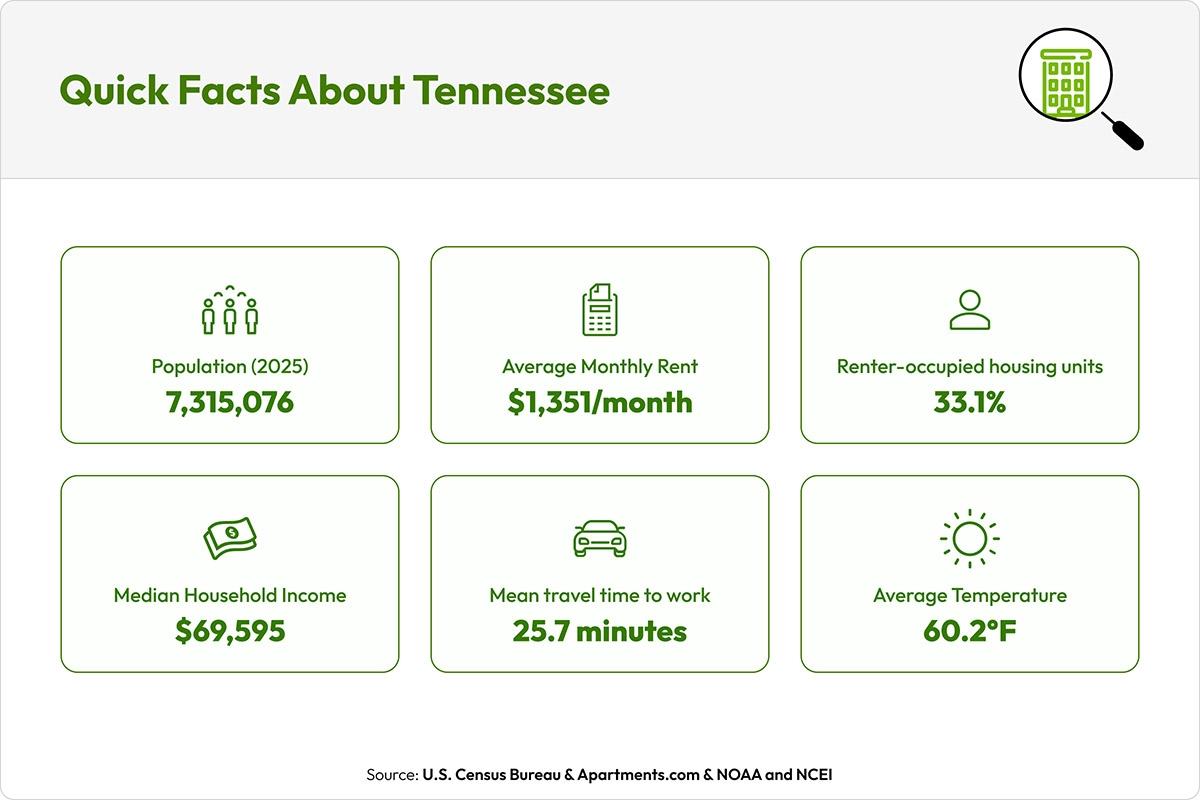
Before you trade your current ZIP code for Tennessee’s music venues, mountain trails, and lower cost of living, it helps to know what day-to-day life actually looks like. These key stats give renters a clearer view of living in Tennessee:
Is Tennessee a Good Place to Live?

Culturally, the state carries a strong identity tied to music, food, and the outdoors. The state's economy has grown steadily in recent years, with several industries establishing a strong foothold across different cities and regions. Nashville has emerged as a major hub for healthcare, music and entertainment, higher education, and technology, with large employers and a steady stream of corporate relocations fueling consistent job growth.
Memphis anchors its economy around logistics, transportation, and distribution, largely shaped by its position as a major freight corridor and home to one of the world's busiest cargo airports. Smaller cities like Knoxville and Chattanooga round out the picture with manufacturing, energy, and outdoor tourism playing significant roles.
One of Tennessee's most attractive qualities is its overall affordability, particularly when compared to many other states. The absence of a state income tax on wages puts more money in residents' pockets, and the cost of living across most of the state remains below the national average. The priciest city, Nashville, still has a cost of living that is 1.6 percent lower than the national average, and there are many affordable neighborhoods that come in under the average price. While groceries and housing typically are pricier than the national average, utilities, transportation, healthcare, and goods and services are all cheaper.
However, mid-sized cities like Chattanooga and Knoxville offer a strong quality of life at a lower price point, making them appealing alternatives for renters who want are searching for even more affordability. These cities are more affordable across the board with prices all under the national average.
Is It Expensive to Live in Tennessee?
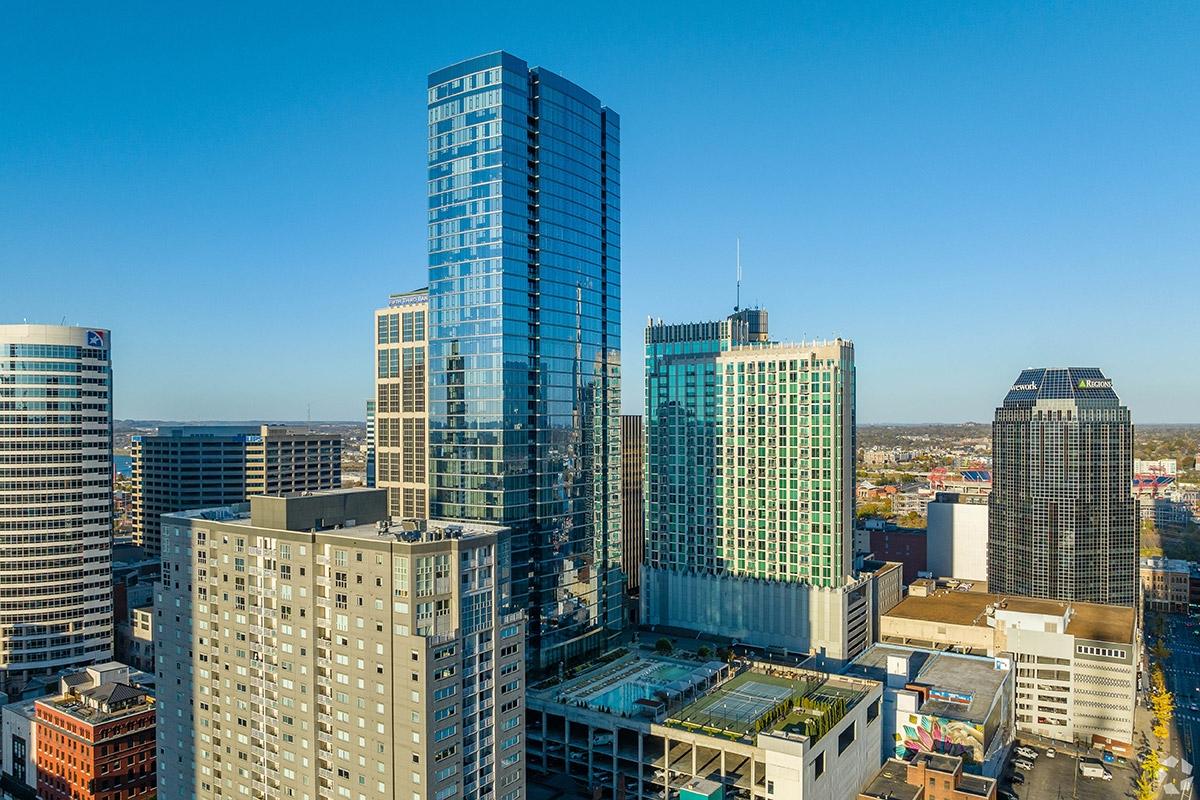
Tennessee is one of the more affordable states for renters, even in Nashville. Here's a quick look at what renters across the state can expect to pay:
|
Property Type |
Average Rent |
Average Sq. Ft. |
|
$1,351/month |
725 sq. ft. |
|
|
$1,746/month |
1362 sq. ft. |
|
|
$1,829/month |
809 sq. ft. |
|
|
$2,148/month |
1404 sq. ft. |
Tennessee is ranked as the 22nd least expensive state, and most expenses are lower than the national average. The average rent in Tennessee has decreased by 1.5 percent over the past year. Its current price of $1,351/month is 18 percent lower than the national average of $1,642/month.
The cheapest metro areas for renters in Tennessee are Memphis and Chattanooga, both of which sit well below the state average rent and offer strong overall cost-of-living advantages. Memphis’ average rent is only $1,046/month, while Chattanooga is $1,267/month. While Memphis rents have dropped 0.5 percent in the last year, Chattanooga has increased by 0.7 percent.
The most expensive metro area in Tennessee is Nashville, where the average 1-bedroom apartment runs $1,682. While that is about 25 percent above the state average, it is only two percent above the national average. Rents have dropped by 2.6 percent over the last year, further increasing the favorable renter conditions.
Where Are the Best Places to Live in Tennessee?
|
Top Cities in Tennessee |
Average 1-Bedroom Rent |
|
$1,682/month |
|
|
$1,046/month |
|
|
$1,336/month |
|
|
$1,267/month |
|
|
$1,309/month |
|
|
$1,787/month |
|
|
$1,104/month |
|
|
$1,386/month |
|
|
$1,019/month |
|
|
$1,621/month |
|
|
$1,313/month |
|
|
$1,372/month |
|
|
$893/month |
|
|
$1,355/month |
|
|
$1,416/month |
|
|
$1,525/month |
|
|
$1,614/month |
|
|
$1,209/month |
|
|
$1,133/month |
|
|
$1,364/month |
Nashville, Tennessee's capital and largest city, is home to over 678,000 residents with a metro area of more than two million people. Known as Music City, it has long been synonymous with country music, but its cultural reach now spans blues, jazz, gospel, rock, and Americana, with legendary venues and museums like the Ryman Auditorium, the Grand Ole Opry, the Country Music Hall of Fame, and the honky-tonk bars of Lower Broadway defining the scene.
Beyond the music, Nashville has emerged as a major economic engine for the Southeast, with a job market centered on Vanderbilt University, a booming healthcare industry, Nissan North America, and a growing tech scene that has drawn Fortune 500 companies and corporate relocations in recent years.
Memphis has musical roots that run just as deep as Nashville’s, where rhythm is the centerpiece of many neighborhoods. As the birthplace of rock and roll and the cradle of the blues, the city is home to Sun Studio, Graceland, Beale Street, the Stax Museum of American Soul Music, and the National Civil Rights Museum, which together form one of the most historically significant cultural corridors in the country.
With a population of about 629,000, the city's economy runs on a strong commercial foundation built on FedEx, AutoZone, and International Paper, while St. Jude Children's Research Hospital and the University of Memphis fill out the medical and academic sectors.
Orange runs deep in Knoxville, where the University of Tennessee infuses neighborhoods with collegiate energy. On football Saturdays, the Tennessee River turn orange as the Vol Navy heads to Neyland Stadium.
As Tennessee's first capital and the heart of the eastern side of the state, Knoxville carries a history that shows up in its architecture and community. Downtown's Market Square draws crowds year-round for concerts, festivals, and farmers markets, while the Old City has evolved into the go-to destination for dining and nightlife, and tree-lined Sequoyah Hills offers a quieter rhythm along the river. Knoxville's title as the Gateway to the Great Smoky Mountains means the national park is just 45 minutes away, making weekend hikes and mountain drives a regular part of life for residents. The main pillars of the economy are education, healthcare, and manufacturing.
Set where the Tennessee River curves against the base of Lookout Mountain, Chattanooga is where city life and nature meet. Nicknamed the Scenic City, it backs up that reputation with a 16-mile Tennessee Riverwalk, easy access to Chickamauga and Chattanooga National Military Park, and a short drive to Ruby Falls and Rock City.
The city's economy is driven by advanced manufacturing, healthcare, and insurance, leading to numerous manufacturers and businesses moving to the metro area. In addition, the University of Tennessee at Chattanooga has built an active medical, tech, and academic corridor near the heart of the city that supports the specialized workforce that draws corporate offices to the region.
What to Expect from Tennessee Weather

Tennessee has a temperate, four-season climate that's generally mild compared to much of the country. Based on NOAA and NCEI statewide climate data:
|
Average Temperature |
60.2°F |
|
Average Precipitation |
47.79” |
|
Temperature Range July 2025 |
70.5-90.4°F |
|
Temperature Range Jan 2025 |
22.8-42.6°F |
*Averages from April 2025-March 2026
Summer (June–August)
Highs in July and August typically reach the upper 80s to low 90s°F (roughly 88–93°F), especially in West Tennessee and Nashville. East Tennessee and higher elevations run slightly cooler.
Winter (December–February)
December through February brings average highs in the mid-40s to low 50s°F, with lows dipping into the mid-20s to mid-30s. Snow is possible but rarely heavy or long-lasting in most parts of the state.
Additional weather considerations
Tennessee sits in a region prone to severe thunderstorms and occasional tornadoes, particularly in the spring. The state also receives enough rainfall year-round that drought is relatively uncommon, but notable dry stretches do occur. East Tennessee's mountainous terrain can produce localized weather differences, with cooler temperatures and higher snowfall than the western half of the state.
What Are the Pros and Cons of Living in Tennessee?
Tennessee offers a lower cost of living, lively music scene, and expansive outdoor recreation opportunities, but a few downsides may make some renters reconsider. Before you pack for the Volunteer State, weigh the pros and cons of living in Tennessee to decide whether it’s the right fit for you.
Pro: no state income tax on wages
Tennessee does not tax wages or salaries at the state level, which puts more money in renters' pockets compared to many other states. Combined with a generally lower cost of living outside of Nashville, this tax advantage can make a meaningful difference in affordability.
Con: sales tax is high
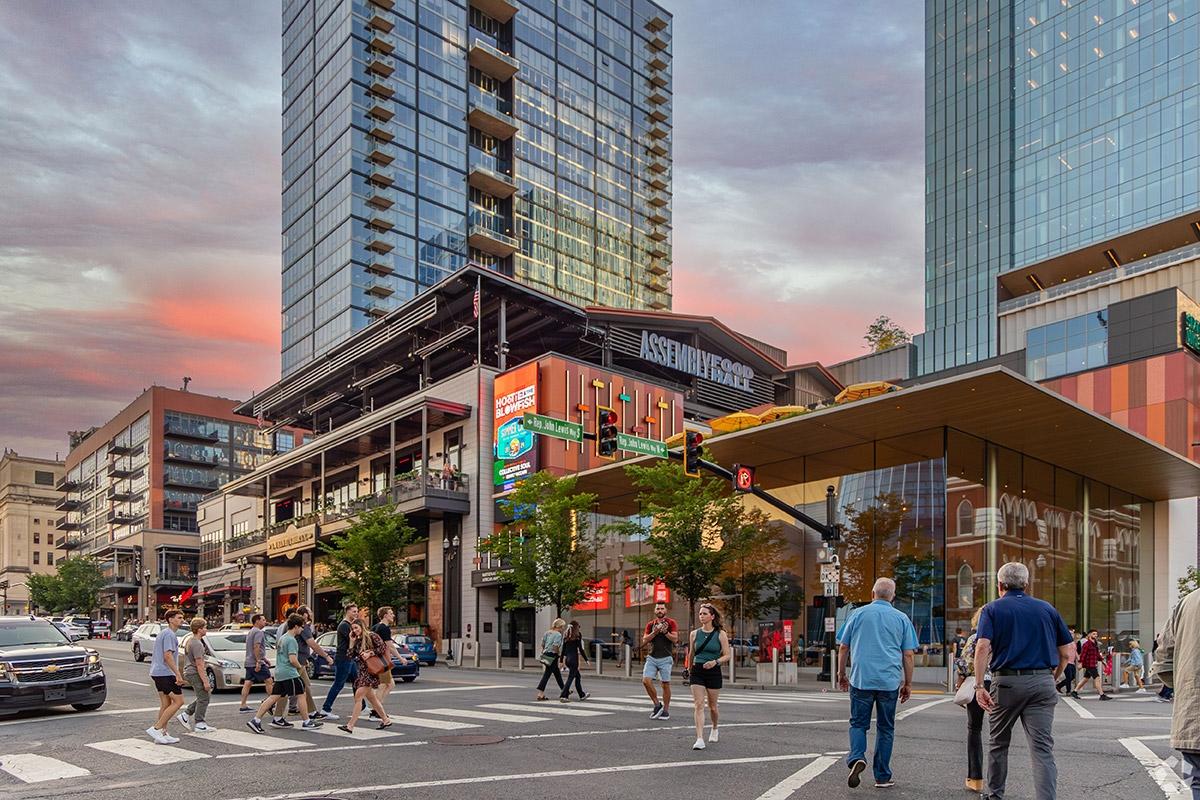
Since there is no state income tax, Tennessee relies heavily on sales taxes. That means purchases can feel more expensive, especially when local sales taxes are added on top of the state rate. For budgeting purposes, the lack of state income tax is helpful, but it does not mean Tennessee is tax-free.
Pro: below-average cost of living in most cities
Most of Tennessee's cities have a cost-of-living that sits below the national average, though the actual savings vary. Memphis runs 10.8 percent below the national average, Knoxville 14.1 percent below, and Chattanooga 12.5 percent below. Even Nashville, the most expensive market in the state, sits roughly 1.6 percent below the national average. This price difference can make many renters put Tennessee in their top contenders.
Con: car dependency and limited public transit
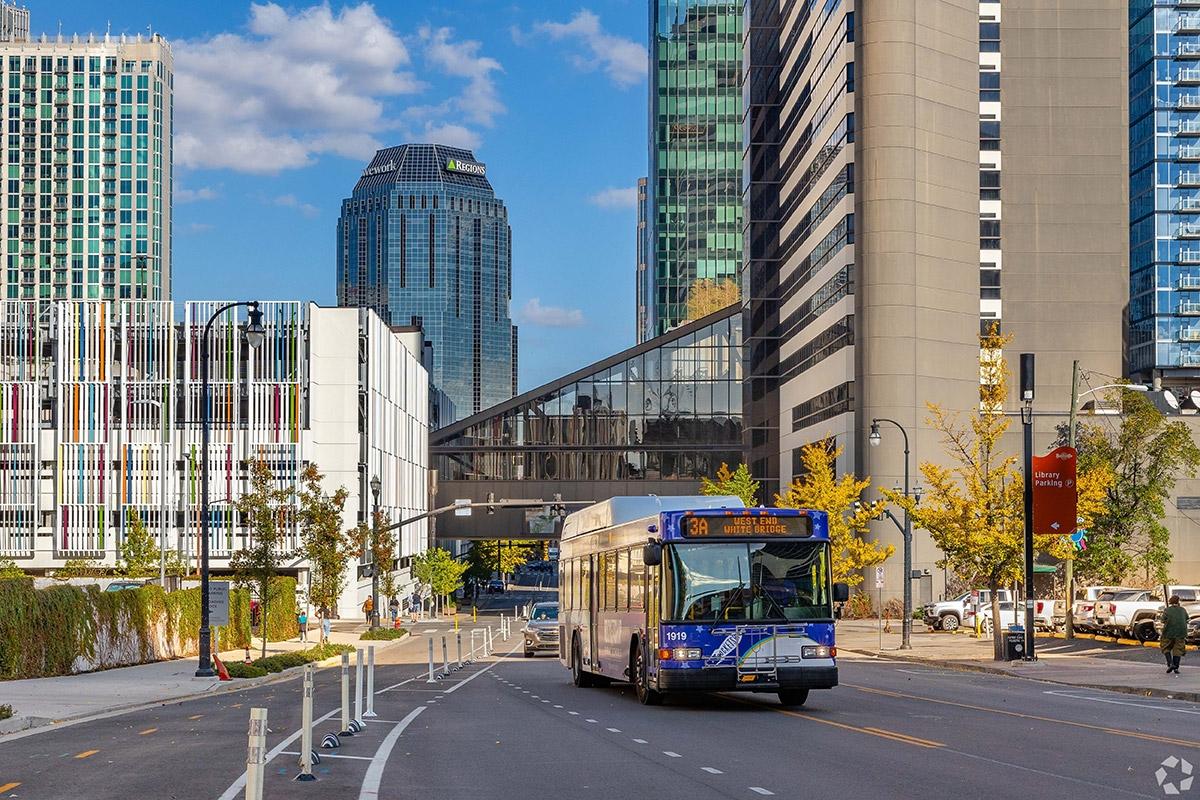
Tennessee has minimal public transit even in its major cities, limiting transportation options to buses and cars for renters. Public transit in Nashville is served by WeGo buses and a single commuter rail line; Memphis has the Main Street Trolley connecting downtown; Knoxville's KAT bus system covers most of the city; and Chattanooga's CARTA operates buses plus a free downtown electric shuttle. But all four cities are mainly car-oriented. Renters who rely on transit should look carefully at specific neighborhoods and proximity to employment and points of interest.
Pro: outdoor recreation and natural access
Tennessee's geography gives residents access to some of the best outdoor recreation in the eastern United States. Great Smoky Mountains National Park (the most-visited national park in the country) sits just 45 minutes from Knoxville. In addition, the Knoxville Greenway System provides over 100 miles of trails along the Tennessee River. Chattanooga's Tennessee Riverwalk stretches 16 miles along the waterfront, and Lookout Mountain is minutes from downtown. Nashville's Warner Parks offer more than 3,000 acres of trails within the city, while the Cumberland River is a popular destination for water-based activities. Whether you like hiking, kayaking, mountain biking, or simply getting outside, Tennessee's natural assets are hard to match.
Con: humid summers and severe weather risk
Tennessee summers are genuinely hot and humid, particularly in the western and middle parts of the state. Memphis and Nashville regularly see July and August highs in the low-to-mid 90s°F, and the humidity makes the air feel heavy. Additionally, Tennessee experiences significant tornado activity during spring, even though the state is not part of Tornado Alley, and severe thunderstorms are a regular feature of spring and fall weather.
Find Your Next Apartment in Tennessee on Apartments.com
Tennessee is appealing to renters because of its below-average cost of living in most cities, no state income tax on wages, a strong cultural identity tied to music and food, and natural features. The rental market is active as many are moving to the Sun Belt, though rent prices are still quite affordable; only Nashville has an average rent above the national rate and just slightly. Each city has a unique vibe that allows renters to find a home that supports their desired lifestyle.
However, there are trade-offs that can make living in Tennessee more difficult. It is a car-dependent state with limited public transit the summer heat and humidity are significant, and the sales tax impacts the cost of living. This doesn’t stop many renters from moving to Tennessee since these challenges are often considered manageable and not dealbreakers. The affordability, culture, and outdoor scene are worth the trade-offs for a lot of renters.
Whether you're drawn to the energy of Nashville's music scene, the Smoky Mountain access out of Knoxville, the riverside trails of Chattanooga, or the rich cultural history of Memphis, Tennessee has a city that fits. Search apartments in Tennessee on Apartments.com to explore available listings across all of the state's top cities and neighborhoods.
Methodology
All rent trends and cost-of-living information comes from CoStar Group and Apartments.com. Weather data is provided by the NOAA and NCEI. The U.S. Census Bureau supplied the median income data, median commute times, and the percentage of renter-occupied housing units.
FAQs
Is Tennessee a good state to live?
Yes, Tennessee is a good state to live in for most renters. Tennessee has no state income tax on wages, a cost of living below the national average in most cities, and a strong cultural identity across cities. Nashville is the most expensive market in the state, where rents are a bit higher than the national average while the cost of living is lower. Knoxville, Chattanooga, and Memphis offer rents and living costs below national averages.
What are the benefits of living in Tennessee?
The key benefits of living in Tennessee include: no state income tax on wages; a below-average cost of living in Memphis, Knoxville, and Chattanooga; proximity to the Great Smoky Mountains National Park and extensive outdoor recreation; a deep music, food, and arts culture; and a rental market that offers diverse options across a range of price points. Transportation and healthcare costs in particular run below national averages in most Tennessee cities.
What is the cost of living in Tennessee?
The cost of living in Tennessee varies by city, but almost all cities have a cost of living lower than the national average. Even as one of the pricier cities in the state, Nashville has a cost of living 1.6 percent lower than the national rate. Mid-sized and smaller cities stretch affordability even further, where the cost of living is 10 to 20 percent lower than the national average.
What are the best places to live in Tennessee?
The best places to live in Tennessee depend on your priorities. Nashville is the largest city and offers the most job market diversity, entertainment options, and neighborhood variety, though it's the most expensive. Knoxville is a strong choice for outdoor access and a college-town atmosphere. Chattanooga has some of the best walkable neighborhoods and outdoor recreation access in the state, while Memphis is a very affordable city with a rich music and cultural history.


