

Key Takeaways
- The average rent in San Francisco has increased by 13.3% year-over-year and the vacancy rate has fallen to 3.5%, driven almost exclusively by AI industry hiring.
- Renters in San Francisco are turning to areas further out in the Bay Area to save money.
- New York City's average rent has increased by 3.2% year-over-year, with hundreds of new luxury units concentrated in Midtown Manhattan to meet demand as employees return to the office.
- New York's rent increases are steadier and broader, and the city has policies in place to combat the affordability crisis. San Francisco's squeeze is newer and more acute, and the main question is whether supply can catch up with demand.
National rent growth is barely moving. On average, rents are only 0.8% higher than they were a year ago, and Sun Belt cities like Austin, Denver, and Phoenix are actually seeing rents fall.
However, several cities are still seeing sharp increases this year, and San Francisco and New York are at the top of the list. Both are posting some of the fastest rent growth in the country, which means less room to negotiate, fewer move-in deals, and a harder search overall.
The two cities are getting there differently, though—San Francisco’s price pressure is being driven by a single industry moving fast, while New York’s is broader and steadier.
Here’s what’s really going on in both markets, and what it means if you’re the one signing the lease.
At a Glance: What Renters Are Up Against
|
Metric |
San Francisco |
New York City |
|
Average one-bedroom rent |
$3,619/month |
$4,195/month |
|
Year-over-year rent growth |
+13.3% |
+3.2% |
|
Vacancy rate |
3.5% |
3% |
|
New units delivered over the past 12 months |
635 |
28,511 |
|
Year-over-year inventory growth |
0.3% |
1.6% |
San Francisco’s rental market took off in late 2023, a year after OpenAI launched ChatGPT. The average rent in San Francisco has increased by 28% since January 2024, and the vacancy rate has decreased by 2.5 percentage points. Supply can’t keep up with the rapid increase in demand, fueling the city’s exponential rent growth.
"The common experience is long lines at open houses, leasing agents accepting bids above the asking rent, and very little inventory available."
Nigel Hughes, Senior Director of Market Analytics in San Francisco, CoStar Group
New York’s rental inventory is larger, and the city delivers more new units every year. Despite a lower vacancy rate than San Francisco, New York’s higher volume of inventory helps curtail rent spikes.
Same squeeze, different cause
San Francisco’s rental market spent 2022 and 2023 in a real slump, with tech layoffs and empty downtown offices giving renters some rare leverage. That window has closed. A wave of AI-industry hiring has pulled workers back into the city, and landlords in the neighborhoods those workers want to live in have noticed.
“The apartment search process in San Francisco has become incredibly difficult,” says Nigel Hughes, senior director of market analytics for San Francisco at CoStar Group. “The common experience is long lines at open houses, leasing agents accepting bids above the asking rent, and very little inventory available.”
New York never loosened up much to begin with, so the squeeze there feels less like a sudden reversal and more like business as usual getting slightly worse. Demand has stayed strong and broad-based across Manhattan and the boroughs rather than tied to one industry, which means there’s no single sector slowdown that’s likely to give renters a break.
Where Renters Feel It Most
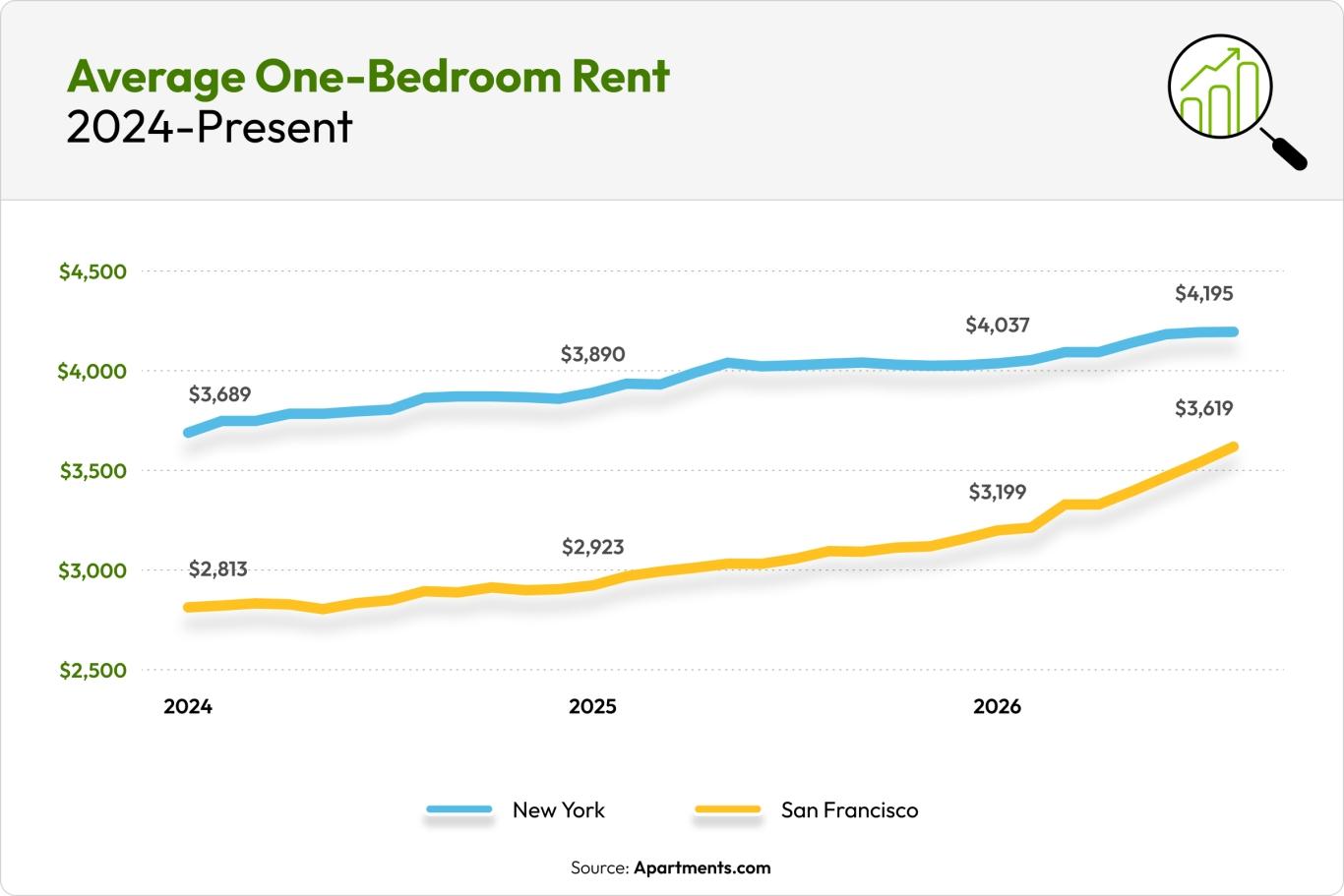
Neither city is cheap, and both are getting more expensive, but the pain is landing in different places.
San Francisco’s AI boom is rewriting the rent curve
The citywide numbers already look rough, but that average undersells what’s happening in the neighborhoods driving San Francisco’s rent spikes. In AI-industry hubs like SoMa and Mission Bay, year-over-year gains have surpassed 15%, and vacancy rates fall under the citywide vacancy rate of 3.6%.
Even neighborhoods further out into the metro area are feeling the squeeze, and Hughes says that renters have begun to search further away from the city center to save on rent.
“Most notably, neighborhoods in the East Bay, such as Oakland, Alameda, and Berkeley, have seen increased interest from people who work in San Francisco. These areas are also now seeing rents grow and vacancy fall,” says Hughes.
Year-over-year rent increases in Oakland, Alameda, and Berkeley are now 5.7%, 2.4%, and 4.4%, respectively.
Manhattan’s return-to-office wave keeps rents climbing
According to CoStar Group insights, office building vacancy in New York has hit its lowest point since 2022, with office leasing primarily concentrated in Manhattan. Following that trend, rents are increasing the most in high-demand Manhattan neighborhoods like the East Village, the Financial District, and Kips Bay as hundreds of luxury units enter the market.
Manhattan’s high rents have been pushing renters to the other boroughs, and several neighborhoods in Brooklyn and Queens have seen the most lease-ups in New York in the past 12 months. While rents are still increasing outside Manhattan, renters can get more for much less in neighborhoods like Bushwick, where the average rent for a one-bedroom is 35% below the citywide average.
Vacancy: Why Renters Aren’t Finding as Many Open Units
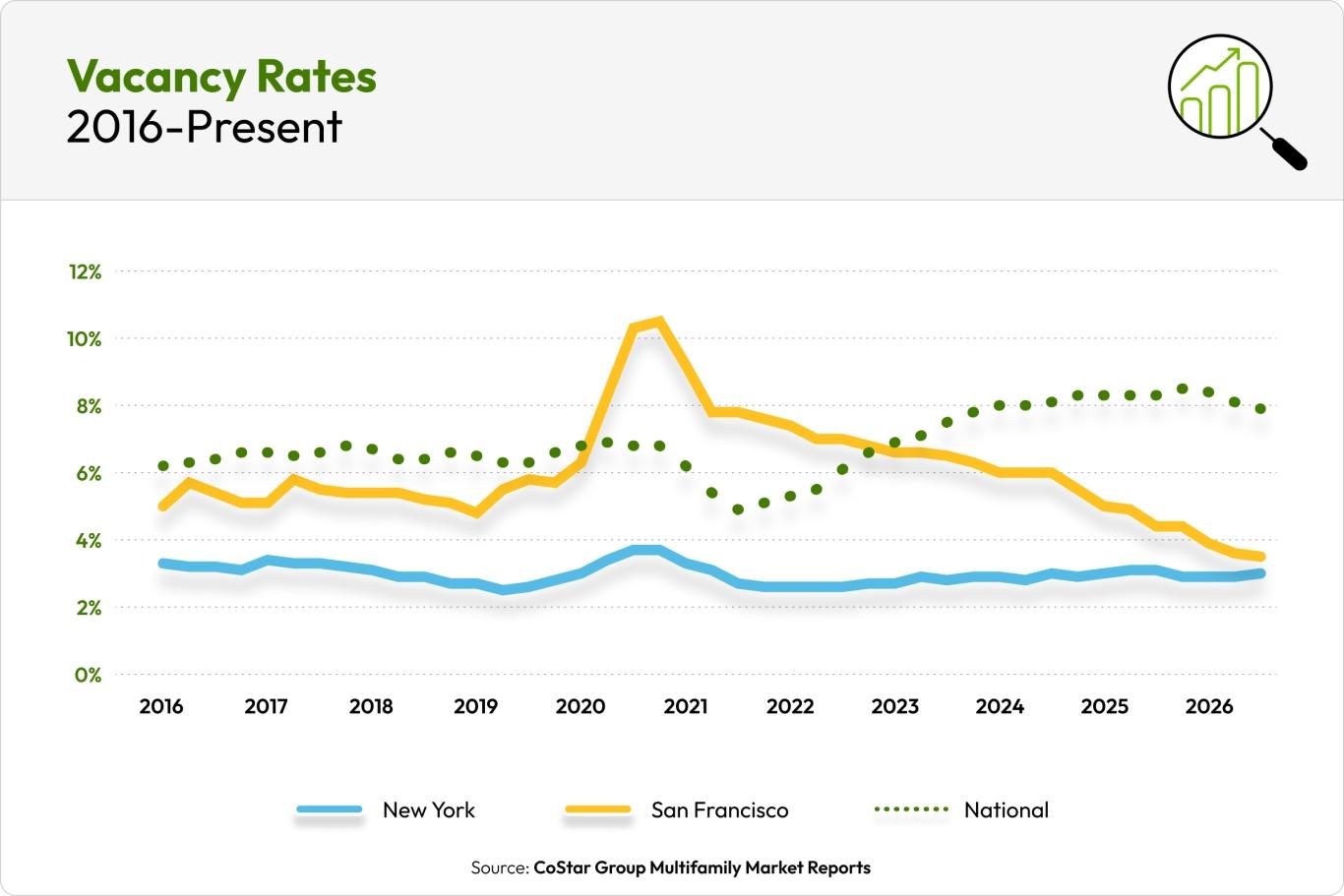
Vacancy is a decent proxy for how much leverage you have as a renter, and by that measure, New York is the tougher search.
However, the sudden skyrocket in demand due to the AI industry boom has shocked San Francisco’s market and turned the apartment search into a mad dash for limited rentals. Contrary to New Yorkers, who are accustomed to the city’s high rents and cost of living, San Franciscans are dealing with a completely new rental landscape.
Both numbers are tight, especially when compared to the national rate of 7.9%, but San Francisco’s vacancy rate of 3.5% is the lowest since 2000. In practice, that means fewer rent concessions like a free month of rent or waived move-in fees, less flexibility on move-in dates, and listings that don’t stay up long. Any flexibility on neighborhood or unit size is worth more now than ever before.
New Construction: Don’t Expect the Squeeze to Ease Soon
Relief isn’t on the way anytime soon, because neither city is building enough new apartments to fully catch up with demand.
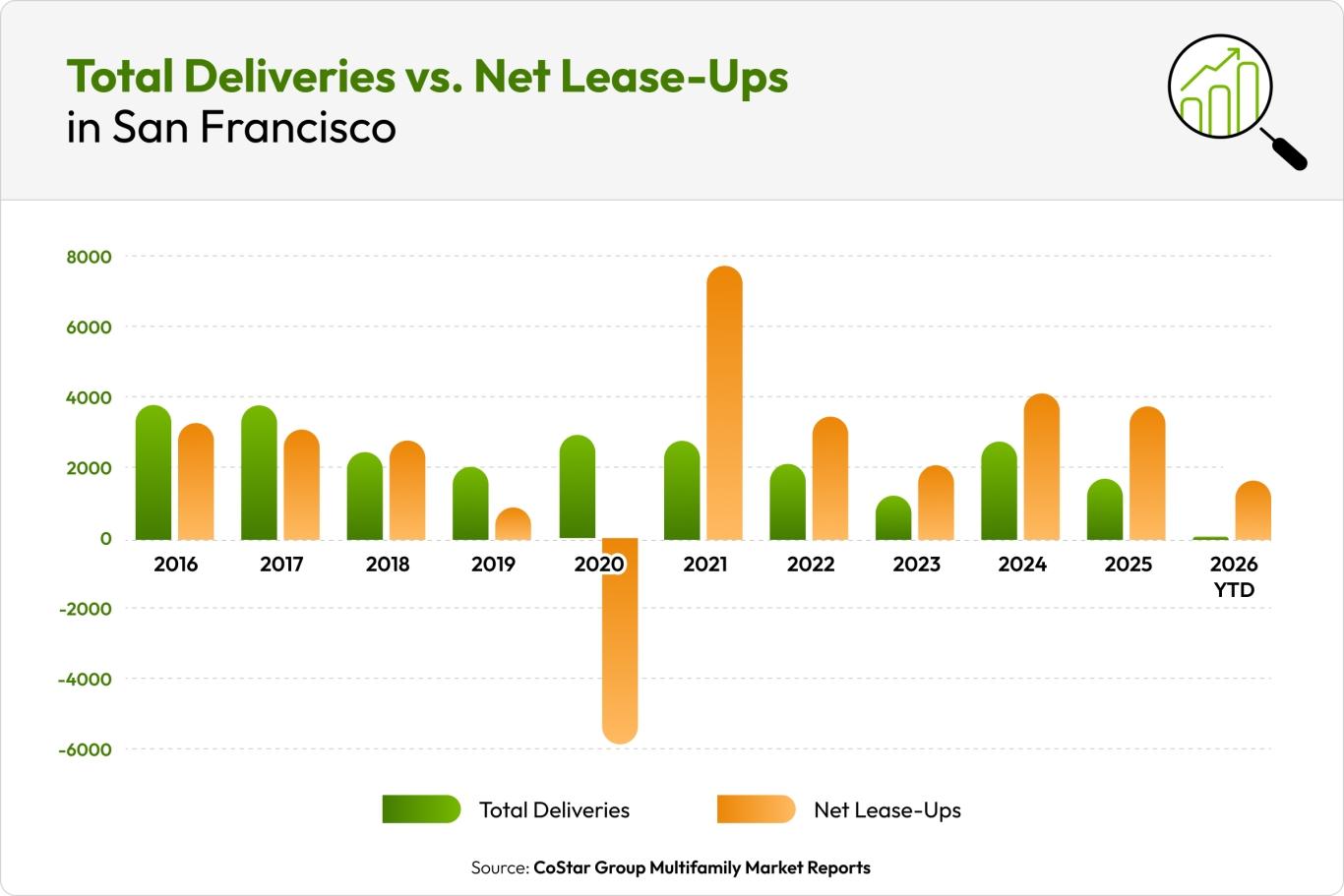
Between the COVID-19 pandemic causing a mass exodus of newly minted remote workers, then the start of the AI boom in late 2023 bringing tech workers back to the Bay Area, San Francisco’s rental market has been playing a years-long game of tug-of-war.
According to CoStar Group’s multifamily market report, San Francisco saw about a 38% decrease in new units delivered between 2024 and 2025 as pandemic-era construction projects wrapped up. Developers are rushing to build new rentals to meet the newfound demand, but it may be too little, too late.
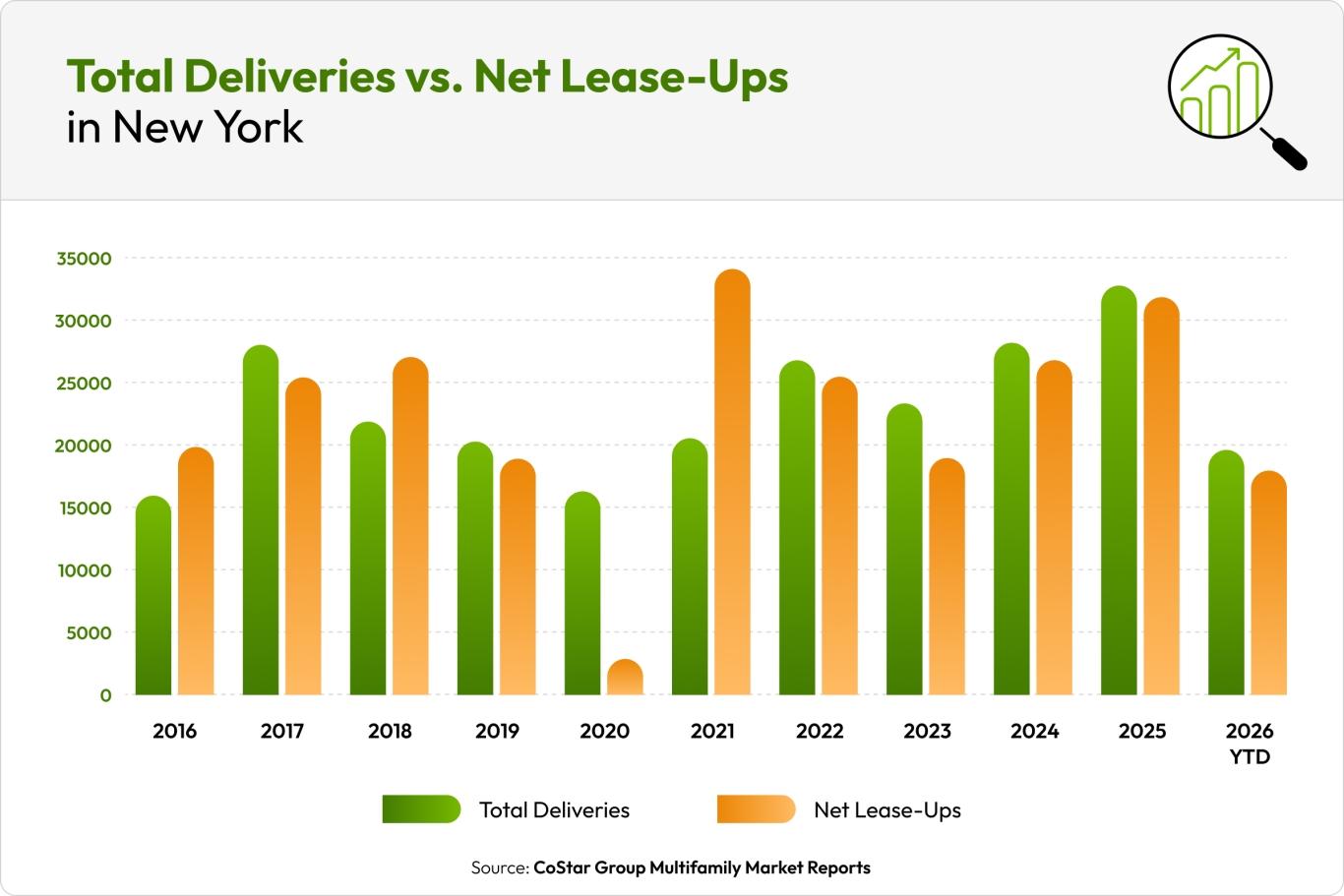
New York’s story isn’t quite as dramatic, but the market has still seen major fluctuations. Like in San Francisco, vacancies flip-flopped between 2020 and 2021 before returning to equilibrium in 2022. Total deliveries have narrowly outpaced net lease-ups since 2022, but that difference isn’t significant enough to give renters a reprieve.
"The city was hit first and hardest by the pandemic, but it also recovered faster, as jobs, office attendance, and migration returned more quickly than expected."
Victor Rodriguez, Senior Director of Market Analytics in New York, CoStar Group
While other cities struggled to rebalance after the COVID-19 pandemic turned the national rental market on its head, New York’s rental market was able to remain relatively stable. Victor Rodriguez, CoStar Group’s senior director of market analytics for New York, says this is due to the simultaneous impending expiration of the 421-a tax incentive, which offered a partial property tax to residential developments in exchange for including a set percentage of affordable units, and faster-than-anticipated market recovery.
“Developers were racing to break ground before the 421-a tax incentive expired, which pulled years of planned construction into a shorter window. At the same time, New York’s housing recovery outpaced most major cities,” says Rodriguez. “The city was hit first and hardest by the pandemic, but it also recovered faster, as jobs, office attendance, and migration returned more quickly than expected.”
The post-pandemic supply wave has helped absorb the surge in demand as New Yorkers return to the office, but it’s still not enough to fully catch up.
“Even a surge in construction wasn’t enough to fundamentally rebalance a market that has been undersupplied for decades,” says Rodriguez.
The One Bright Spot: New York’s Rent Freeze Debate
The one thing working in New Yorkers’ favor that San Francisco renters don’t have is a live political debate over freezing rent increases on regulated units, which could shape the market in a way policy in San Francisco isn’t positioned to.
The NYC Rent Guidelines Board (RGB) just approved a rent freeze on one-year and two-year leases for rent-stabilized apartments beginning or renewing between Oct. 1, 2026, and Sept. 30, 2027. This is the first time the RGB has approved a two-year rent freeze.
San Francisco doesn’t have anything comparable on the table right now. The bigger open question isn’t policy, but whether new construction can catch up to the current pace of rent growth, and nothing in the data suggests that’s happening soon.
Neither market is offering renters much breathing room in 2026, but the shape of the squeeze is different in each city. San Francisco’s crunch is sharper and newer, tied almost entirely to one industry’s hiring boom. This means the market could ease if AI-driven demand cools, but there’s no sign of that happening yet, and the city’s weak construction pipeline isn’t helping.
New York’s squeeze is older and steadier, spread across boroughs rather than concentrated in a few neighborhoods, but it comes with something San Francisco doesn’t have on the table: a rent freeze for stabilized units starting this fall.
Methodology
Average one-bedroom rents and year-over-year rent increases are sourced from Apartments.com Rent Trends pages. Data on delivered units and inventory growth, lease-ups, and vacancy rates are sourced from CoStar Group’s August multifamily market reports.


